
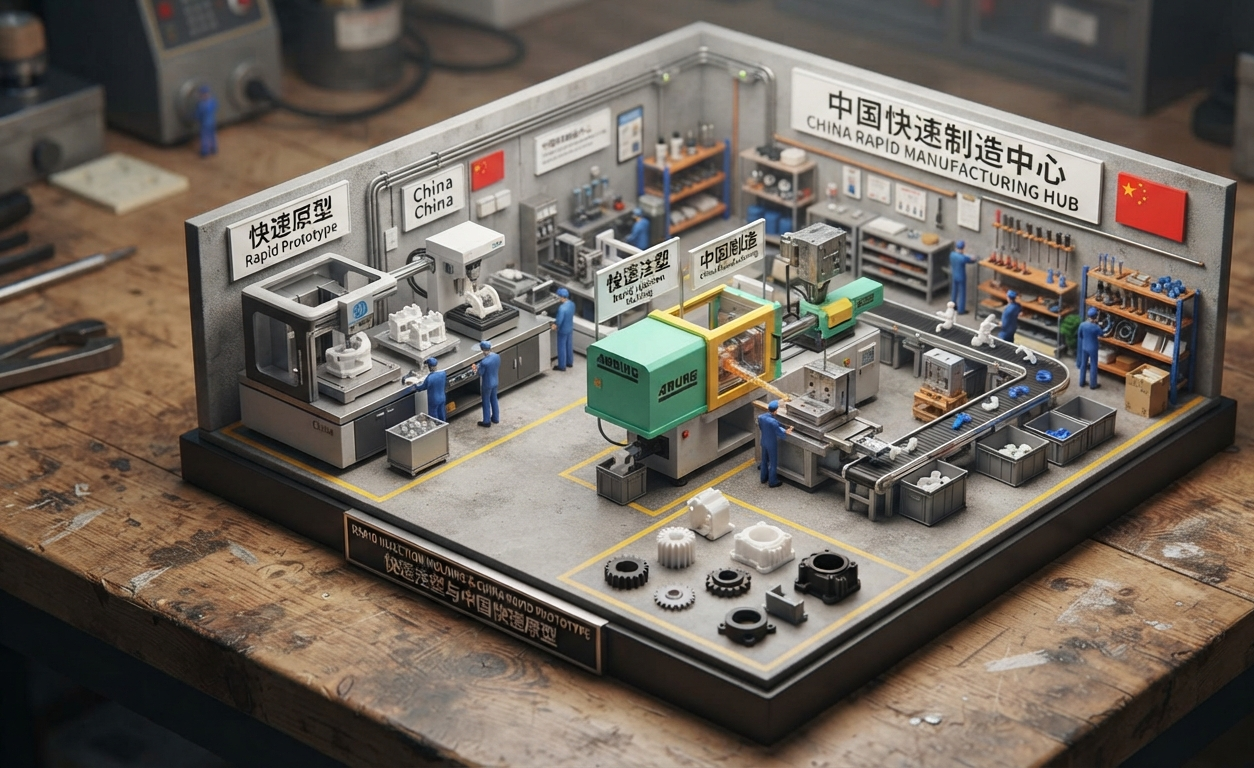
Turning a product idea into a reliable physical component is rarely a single-step process. Engineers must evaluate dimensions, materials, assembly, appearance, functionality and manufacturability before committing to full-scale production. Rapid injection molding and china rapid prototype services help bridge this gap by allowing businesses to manufacture, test and improve components without immediately investing in conventional mass-production tooling.
These manufacturing methods are especially valuable for new product development, engineering validation, market testing and low-volume production. The objective is not simply to manufacture a part quickly. It is to discover potential problems earlier, make informed design decisions and establish a practical route towards repeatable production.
Understanding Rapid Injection Molding in Modern Manufacturing
Rapid injection molding applies the principles of conventional plastic injection moulding while focusing on shorter tooling and production lead times.
Plastic resin is heated until it reaches a suitable processing state and is injected under controlled pressure into a machined mould. After cooling and solidification, the component is released from the mould.
The difference is primarily in how the tooling programme is approached.
Conventional production moulds may be engineered for very high manufacturing volumes and long operating lives. Rapid moulds are generally designed around shorter development schedules and specific production requirements.
They can therefore be suitable for:
- Engineering prototypes
- Functional testing
- Pilot production
- Pre-production components
- Customer evaluation samples
- Bridge manufacturing
- Low-volume plastic products
- Initial market-launch quantities
The appropriate tooling material and construction depend on component geometry, resin, expected quantities and quality requirements.
What Does China Rapid Prototype Manufacturing Include?
The term china rapid prototype covers considerably more than 3D printing. Many Chinese prototype manufacturers provide several processes under one manufacturing programme.
Depending on the project, services may include:
- CNC machining
- SLA and SLS 3D printing
- Vacuum casting
- Sheet-metal prototyping
- Silicone moulding
- Rapid tooling
- Injection moulding
- Surface finishing
- Painting and polishing
- Prototype assembly
This gives product developers the flexibility to select a manufacturing process according to the stage of development rather than forcing every component through the same technology.
For example, an early enclosure may be 3D printed to evaluate dimensions. A later version could be CNC machined for improved accuracy. Once the geometry has been approved, rapid injection molding can produce components using the intended thermoplastic.
Why Prototype Before Investing in Injection Mould Tooling?
A CAD model can appear perfect on a computer screen while still creating problems when converted into a physical product.
A prototype allows engineers to examine details that may be difficult to evaluate digitally.
These can include:
- How comfortably a product fits in the hand.
- Whether mating components align correctly.
- Whether clips and fastening features operate as expected.
- Whether there is sufficient clearance between components.
- Whether wall sections are unnecessarily thick.
- Whether the component can be manufactured efficiently.
Making a design change during the prototype stage is generally more practical than discovering the same problem after complex production tooling has been manufactured.
A structured china rapid prototype programme therefore becomes part of engineering risk management rather than simply a method of producing presentation models.
Moving From Prototype to Rapid Injection Molding
An effective development programme normally moves through several validation stages.
| Development Stage | Suitable Process | Main Objective |
| Initial concept | 3D printing | Check overall form and dimensions |
| Engineering development | CNC machining | Evaluate accuracy and functionality |
| Small prototype batch | Vacuum casting | Test multiple representative samples |
| Production validation | Rapid injection molding | Evaluate actual moulded components |
| Market introduction | Low-volume moulding | Produce initial commercial quantities |
| Mature product | Production tooling | Support repeatable higher-volume manufacturing |
The exact sequence varies according to the product. Not every project requires every process.
The key principle is to invest progressively as the design becomes more mature.
Material Selection Can Determine Prototype Success
Choosing a manufacturing process without considering material behaviour can produce misleading test results.
A prototype intended only to demonstrate appearance has very different material requirements from a component that must withstand heat, repeated loading or chemical exposure.
Common injection-moulding polymers include:
- ABS
- Polypropylene
- Polyethylene
- Polycarbonate
- Nylon
- POM
- TPE
- PMMA
- Glass-filled engineering plastics
When using rapid injection molding, designers can often manufacture samples from the intended production material. This makes it possible to evaluate properties that may not be accurately represented by some additive prototypes.
Design for Manufacturing Is More Important Than Speed
Rapid manufacturing does not make poor component geometry automatically suitable for injection moulding.
Design for Manufacturing, commonly called DFM, should be performed before tooling begins.
Wall Thickness
Large changes in wall thickness can influence cooling behaviour and may contribute to sink, warpage or dimensional variation.
Draft Angles
Suitable draft can make it easier to release components from the mould without damaging surfaces.
Ribs and Bosses
Ribs can improve structural performance without simply increasing the thickness of an entire component. Bosses require careful design when they are used for screws or assembly features.
Undercuts
Undercuts may require sliders, lifters or other tooling mechanisms, potentially increasing mould complexity.
Gate and Ejector Locations
Gate position affects how material enters the cavity, while ejector locations can influence visible surfaces. These details should be considered before mould manufacture.
A knowledgeable china rapid prototype partner should therefore provide engineering feedback instead of treating the supplied CAD file as automatically production-ready.
When Rapid Injection Molding Makes Commercial Sense
Rapid injection molding is particularly valuable in the gap between prototype quantities and established mass production.
Imagine a company developing a handheld electronic device. The design has passed initial prototype testing, but the company does not yet need hundreds of thousands of housings.
Rapid tooling could allow it to manufacture an initial batch of moulded housings for assembly trials, demonstrations or controlled market introduction.
This approach may help the company avoid committing prematurely to tooling designed around production assumptions that could still change.
It is also useful when a manufacturer needs bridge production while long-life tooling is being developed.
How to Evaluate a China Rapid Prototype Supplier
Price should be one factor in supplier selection, but it should not be the only factor.
A manufacturing partner should be evaluated according to:
- Experience with the required manufacturing process
- Ability to understand engineering drawings
- DFM capabilities
- Material sourcing and identification
- Dimensional inspection capability
- Communication quality
- Tooling knowledge
- Surface-finishing capabilities
- Quality documentation
- Intellectual-property procedures
- Ability to scale into production
Ask suppliers how they will manufacture the component rather than requesting only a quotation.
Understanding the Real Cost of Rapid Manufacturing
A common mistake is comparing quotations solely by tooling price.
The total cost of rapid injection molding depends on multiple variables, including:
| Cost Factor | Potential Impact |
| Component complexity | Complex geometry may require sophisticated tooling |
| Tool material | Aluminium and different steel grades have different applications |
| Cavities | Multi-cavity tooling can affect investment and output |
| Resin | Engineering polymers may cost more than commodity plastics |
| Tolerance | Tight requirements can increase manufacturing complexity |
| Surface finish | Texturing, polishing and cosmetic standards add processing |
| Undercuts | May require sliders, lifters or inserts |
| Quantity | Influences tooling and production strategy |
The lowest initial quotation may not provide the lowest total project cost if repeated modifications, quality problems or remanufacturing become necessary.
Quality Control for Prototype and Moulded Components
Quality control should begin before the first component is manufactured.
Engineering drawings should identify critical dimensions, tolerances, materials, surface requirements and inspection expectations.
After manufacturing, important checks may include:
- Dimensional inspection
- Visual inspection
- Assembly testing
- Material verification
- Functional testing
- Surface-finish evaluation
For critical projects, buyers can also request first-article inspection reports or other agreed quality documentation.
Rapid Injection Molding for Different Industries
The technology can support product development across numerous sectors.
Consumer electronics companies may use it for housings, brackets and internal components. Automotive development teams can use moulded prototypes for fit and functional evaluation. Industrial equipment manufacturers may require custom covers, handles, connectors or enclosures.
Medical and regulated applications can also use prototype and moulding technologies, although applicable material, documentation, traceability and regulatory requirements must be carefully addressed.
The process should always be selected according to the actual application rather than industry trends.
Frequently Asked Questions
1. What is rapid injection molding used for?
It is commonly used for functional prototypes, engineering validation, bridge manufacturing and low-volume plastic component production.
2. What is a china rapid prototype?
It generally describes prototype manufacturing services provided by Chinese companies using processes such as CNC machining, 3D printing, vacuum casting and rapid tooling.
3. Is rapid injection molding the same as 3D printing?
No. Injection moulding uses a mould and molten polymer, while 3D printing typically creates components layer by layer.
4. Why use rapid tooling?
Rapid tooling can provide a faster transition from validated prototype geometry to injection-moulded components.
5. Can production-grade plastic be used?
Yes. Many common thermoplastics and engineering polymers can be used, depending on the mould and component design.
6. When should I move from 3D printing to injection moulding?
Consider the transition when geometry is sufficiently stable and you need moulded-material performance, repeatability or larger quantities.
7. Can rapid moulds produce sellable products?
Yes, where the tooling specification, material, quality and expected quantities are appropriate for the commercial application.
8. What information does a prototype supplier need?
Typically, the supplier needs CAD files, drawings, material requirements, quantity, tolerances and surface-finish specifications.
9. How can injection moulding defects be reduced?
Good DFM, appropriate material selection, suitable tooling and controlled processing conditions are essential.
10. Is sourcing prototypes from China suitable for international companies?
It can be, provided the manufacturer meets the required engineering, quality, communication and intellectual-property standards.
https://newsgrow.blogspot.com/2026/08/rapid-injection-molding-and-china-rapid.html