
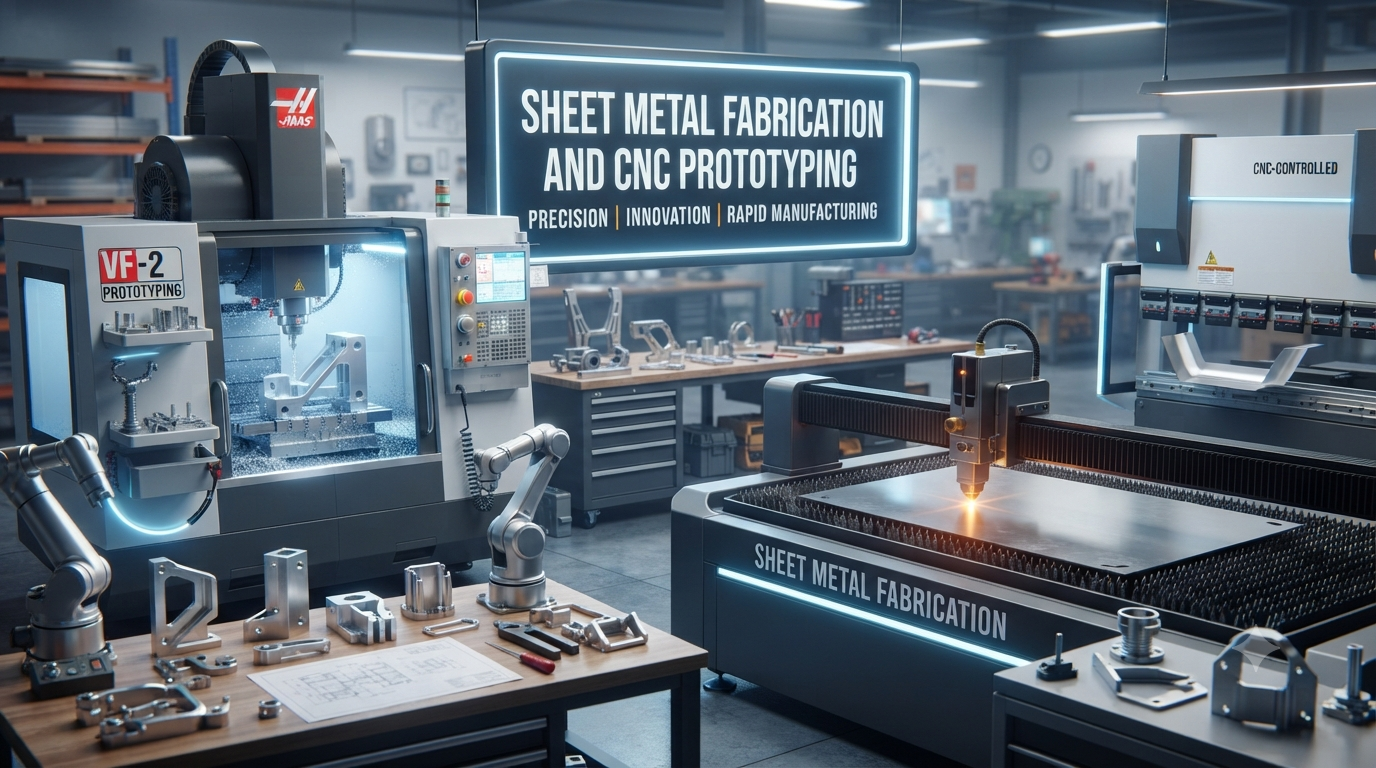
Manufacturing a successful component is not simply about converting a drawing into a physical part. Material behaviour, dimensional accuracy, production volume, assembly requirements, surface quality and manufacturing cost must all work together. This is where sheet metal fabrication and CNC prototyping become particularly valuable.
While sheet metal fabrication converts flat metal sheets into functional structures, CNC prototyping creates precision components by machining solid material. Used separately or together, these technologies help manufacturers develop everything from simple brackets and enclosures to sophisticated industrial assemblies.
Understanding Sheet Metal Fabrication Beyond Basic Cutting
Sheet metal fabrication is a multi-stage manufacturing approach used to create parts from thin, flat metal stock. Cutting is only the beginning. A complete fabrication project may involve laser cutting, punching, bending, rolling, welding, fastening, grinding and surface treatment.
Common applications include:
- Electrical and electronic enclosures
- Machine guards and covers
- Automotive brackets
- Industrial cabinets
- Control-panel housings
- HVAC components
- Equipment frames
- Battery enclosures
- Medical equipment structures
- Custom metal assemblies
The major advantage is design flexibility. A correctly developed flat pattern can be transformed into a strong three-dimensional component without machining the entire shape from a solid block.
How a Flat Metal Sheet Becomes a Finished Component
A typical sheet metal fabrication project starts with engineering drawings and CAD data. Before production, manufacturers examine dimensions, material thickness, bend positions, tolerances, hole locations and assembly requirements.
Material Preparation and Cutting
The required profile is cut from the metal sheet. Depending on the design, production quantity and material, manufacturers may use laser cutting, CNC punching, waterjet cutting, plasma cutting or shearing.
Laser cutting is particularly useful for detailed profiles because digital programming allows complex geometries to be produced without dedicated cutting dies.
Bending and Forming
Cut components are subsequently transformed using press brakes and other forming equipment.
The manufacturer must consider:
- Material thickness
- Inside bend radius
- Bend allowance
- Springback
- Grain direction
- Tool selection
- Hole-to-bend distance
These details directly affect dimensional accuracy.
Joining and Assembly
A fabricated product may contain several individual parts. Depending on structural and cosmetic requirements, these can be connected through welding, riveting, threaded fasteners, clinching or other joining technologies.
Why Design Decisions Matter in Sheet Metal Fabrication
A component may look simple on a CAD screen but become difficult or expensive to manufacture if fabrication principles are ignored.
For example, positioning a hole extremely close to a bend can cause deformation. Specifying unnecessarily complex bends can require additional tooling or manufacturing operations.
Good sheet metal design therefore balances function with manufacturability.
A Better Design Approach
Instead of asking, “Can this component be manufactured?”, designers should ask, “How can this component be manufactured reliably, repeatedly and economically?”
This Design for Manufacturability approach can reduce unnecessary operations and simplify future production.
What Makes CNC Prototyping Different?
CNC prototyping follows a different manufacturing principle. Instead of forming flat material, CNC machines progressively remove material from solid stock according to programmed toolpaths.
CNC milling machines, turning centres and multi-axis machining centres can produce highly detailed prototype components from metals and engineering plastics.
Common materials include:
- Aluminium
- Stainless steel
- Mild steel
- Brass
- Copper
- Titanium
- ABS
- Nylon
- POM
- Acrylic
- PEEK
Because prototypes can be manufactured from engineering-grade materials, CNC prototyping is particularly valuable when physical performance needs to be evaluated.
Where CNC Prototyping Fits into Product Development
Imagine that an engineering company is developing a new industrial machine. Producing hundreds of components immediately would create considerable risk if the design has not been properly tested.
A prototype allows engineers to identify problems before committing to larger production volumes.
CNC prototyping can help verify:
- Component dimensions
- Hole alignment
- Assembly fit
- Thread compatibility
- Mechanical movement
- Component strength
- Surface requirements
- Functional performance
Once testing identifies a problem, the CAD model can be modified and another prototype produced.
This iterative process can prevent design weaknesses from moving directly into production.
Sheet Metal Fabrication vs CNC Prototyping
Although both processes use computer-controlled equipment, their manufacturing methods and ideal applications differ.
| Manufacturing Factor | Sheet Metal Fabrication | CNC Prototyping |
| Raw material | Flat sheet | Solid block or bar |
| Manufacturing principle | Cutting and forming | Subtractive machining |
| Typical geometry | Panels, boxes and brackets | Detailed solid components |
| Common machinery | Laser cutter, press brake | CNC mill, CNC lathe |
| Functional prototypes | Yes | Yes |
| Complex 3D details | Limited to moderate | High capability |
| Structural enclosures | Excellent | Usually inefficient |
| Precision mechanical parts | Application dependent | Excellent |
| Production suitability | Low to high volume | Prototype to production runs |
The correct process should therefore be selected according to geometry rather than simply choosing whichever technology appears more advanced.
When Both Manufacturing Processes Work Together
The relationship between sheet metal fabrication and CNC prototyping becomes especially important when developing complete mechanical products.
Consider a robotic control system. Its outer cabinet may require fabricated aluminium or steel panels, while internal mounting blocks, precision couplings, shafts and specialised mechanical interfaces could require CNC machining.
The same principle applies to:
- Industrial machinery
- Robotics
- Electric vehicle systems
- Medical equipment
- Electronics
- Laboratory instruments
- Automation systems
- Telecommunications equipment
Using both processes allows structural and precision components to be developed according to their individual manufacturing requirements.
Material Selection Can Change the Entire Project
Material should never be selected solely because it is familiar or inexpensive.
Aluminium, for example, offers relatively low weight and good machinability, making it useful for many prototypes and fabricated products. Stainless steel provides excellent corrosion resistance and is often selected for food-processing, medical and demanding industrial environments.
Mild steel can be appropriate where structural strength and economical production are priorities.
Before selecting material, engineers should evaluate:
- Required strength
- Component weight
- Corrosion exposure
- Operating temperature
- Weldability
- Machinability
- Surface appearance
- Electrical characteristics
- Environmental conditions
- Overall production cost
Material selection should support both product performance and manufacturing practicality.
Precision, Tolerance and Quality Control
Not every dimension requires an extremely tight tolerance.
This is an important consideration in CNC prototyping because tighter tolerances can require additional machining, slower operations, specialised tooling and more extensive inspection.
The same principle applies to sheet metal fabrication. Bend tolerances, hole positions, flatness and assembly dimensions should reflect actual functional requirements.
Professional inspection may involve:
- Digital callipers
- Micrometers
- Height gauges
- Thread gauges
- Coordinate measuring machines
- Surface roughness testing
- Optical measurement systems
Quality should therefore be designed into the manufacturing process rather than inspected only after production is completed.
How to Reduce Manufacturing Cost Without Sacrificing Quality
Cost reduction should come from smarter engineering rather than simply choosing cheaper materials.
Useful strategies include:
- Standardising material thicknesses
- Avoiding unnecessary tight tolerances
- Reducing complex machining setups
- Designing practical bend radii
- Improving sheet nesting
- Eliminating unnecessary cosmetic operations
- Designing components for easy assembly
- Using standard holes and fasteners
- Minimising deep CNC cavities
- Reviewing prototypes before volume production
A small design modification can sometimes eliminate an entire machining, welding or finishing operation.
How to Choose a Sheet Metal Fabrication and CNC Prototyping Supplier
Manufacturing capability should be evaluated beyond machine availability.
A suitable supplier should understand engineering drawings, material characteristics, dimensional requirements and production planning.
Before placing an order, consider:
- What materials can the supplier process?
- Which CNC and fabrication technologies are available?
- Can prototypes and production quantities both be handled?
- What inspection equipment is available?
- Are surface-finishing services offered?
- Can the supplier provide DFM feedback?
- How are engineering revisions controlled?
- Can production scale after prototype approval?
Strong technical communication is particularly important when developing customised components.
Frequently Asked Questions
1. What is sheet metal fabrication?
It is the process of cutting, bending, forming and joining sheet metal to manufacture functional components and assemblies.
2. What products can be manufactured through sheet metal fabrication?
Enclosures, brackets, cabinets, machine covers, chassis, frames, panels and customised industrial structures are common examples.
3. What is CNC prototyping used for?
It is used to create accurate physical prototypes for dimensional, assembly, mechanical and functional evaluation.
4. Can CNC prototypes use production-grade materials?
Yes. CNC prototypes can be manufactured from many engineering metals and plastics used in final products.
5. Which process is better for an enclosure?
Sheet metal fabrication is generally more practical for thin-walled cabinets, housings and industrial enclosures.
6. Which process is suitable for detailed mechanical parts?
CNC prototyping is often preferred for components requiring detailed three-dimensional geometry, threads, pockets and precision features.
7. Can aluminium be used for both processes?
Yes. Various aluminium grades are suitable for both fabrication and CNC machining, depending on application requirements.
8. Why are bend allowances important?
Metal stretches and compresses during bending. Correct bend calculations help achieve the intended final dimensions.
9. Does tighter tolerance always mean better quality?
No. Tolerances should match functional requirements. Unnecessarily tight specifications can increase manufacturing complexity and cost.
10. Can CNC prototyping support low-volume production?
Yes. CNC machining is frequently used for prototypes, customised components and low-to-medium production quantities.
https://newsgrow.blogspot.com/2026/08/rapid-injection-molding-and-china-rapid.html
https://newsgrow.blogspot.com/2026/08/aluminum-prototype-and-sheet-metal.html
https://newsgrow.blogspot.com/2026/08/deep-information-about-sheet-metal.html