
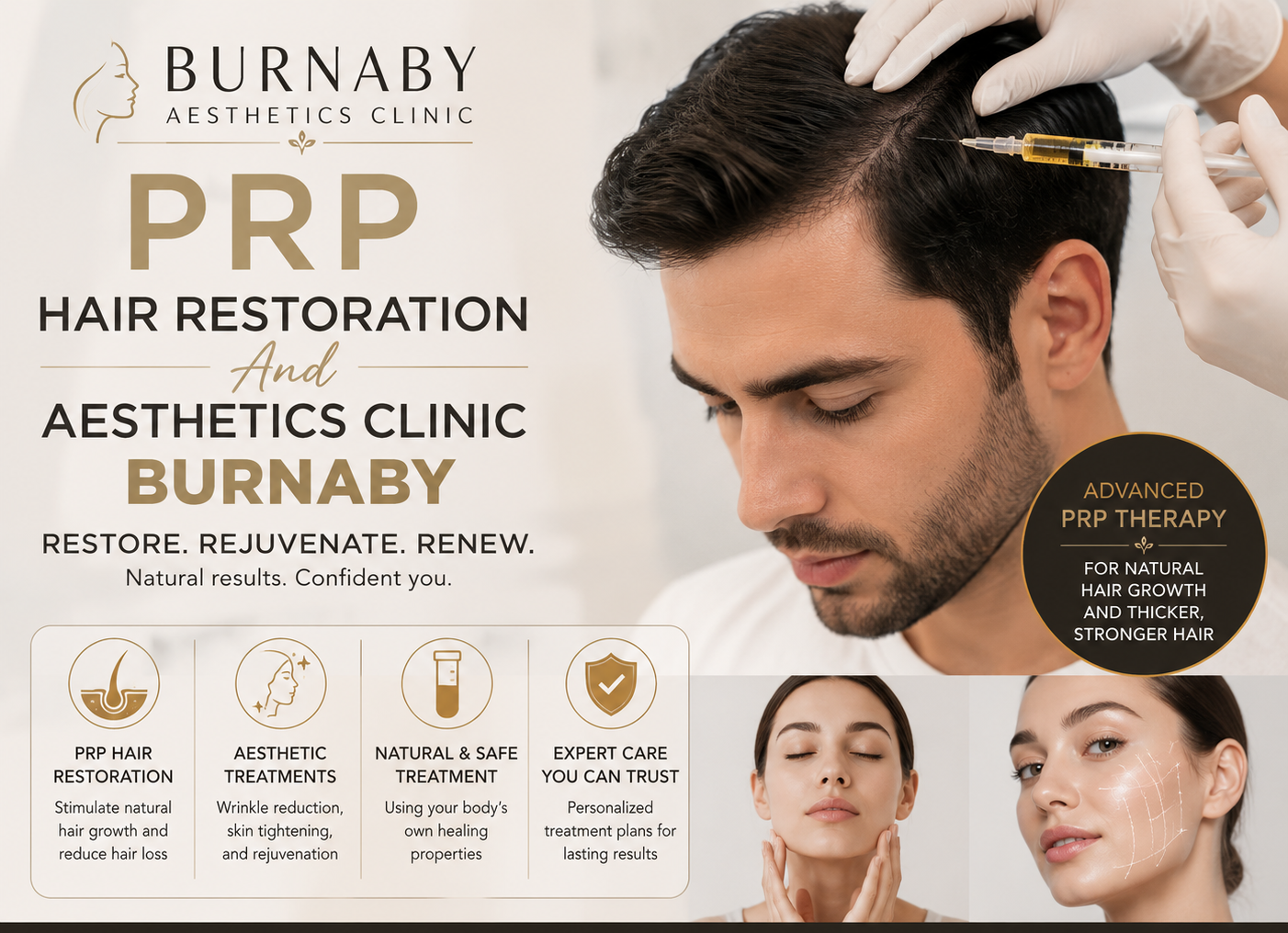
Hair restoration is no longer limited to concealing thinning areas or immediately considering surgery. Modern regenerative approaches have created additional options for people who want to address early or progressive hair thinning. PRP Hair Restoration is one such treatment, using platelet-rich plasma prepared from the patient’s own blood to support existing hair follicles.
For people exploring an Aesthetics Clinic Burnaby, understanding how PRP works, who may benefit, its limitations and how to select a suitable provider can make the treatment decision much easier.
Why Hair Starts Becoming Thinner
Hair loss rarely has one universal cause. Genetics plays an important role, particularly in androgenetic alopecia, but several other factors can influence hair density and shedding.
Common contributors include:
- Family history of pattern hair loss
- Hormonal changes
- Age-related follicle miniaturisation
- Nutritional deficiencies
- Certain medications
- Physical or emotional stress
- Scalp disorders
- Medical conditions
- Changes following pregnancy
- Repeated damage to the hair or scalp
Because different causes require different approaches, identifying why the hair is thinning is an important first step.
A reputable Aesthetics Clinic Burnaby should therefore consider the patient’s history and scalp condition before recommending PRP Hair Restoration.
Understanding the Science Behind PRP Hair Restoration
Platelets are blood components best known for their role in clotting, but they also contain proteins and growth factors associated with healing and tissue-repair processes.
During PRP Hair Restoration, blood is collected from the patient and processed in a centrifuge. This separates different blood components and allows platelet-rich plasma to be prepared.
The PRP is then administered into selected areas of the scalp.
The treatment does not implant hair, replace follicles or create artificial hair. Instead, its purpose is to support the biological environment surrounding existing follicles.
This distinction is important when setting realistic expectations.
What Happens During a PRP Hair Restoration Appointment?
The exact process differs according to the provider and treatment protocol, but the patient journey commonly includes several stages.
- Hair and scalp consultation
- Review of hair-loss history
- Identification of thinning areas
- Blood collection
- Centrifugation and PRP preparation
- Scalp preparation
- PRP administration
- Post-treatment instructions
- Follow-up and progress evaluation
A session is typically considerably less invasive than hair-transplant surgery.
Who Could Be a Suitable Candidate?
PRP Hair Restoration may be considered by adults who still have active hair follicles but are noticing progressive thinning.
It may be discussed for:
- Early-stage pattern hair loss
- Reduced hair density
- Thinning around the crown
- Widening of the hair part
- Gradual follicle miniaturisation
- Male or female pattern hair loss
However, PRP is not automatically suitable for every person experiencing hair loss.
Sudden shedding, scalp inflammation or unexplained patches of hair loss may require medical investigation. The underlying condition should be understood before selecting a cosmetic or regenerative procedure.
PRP Hair Restoration Compared With Common Alternatives
Choosing a treatment becomes easier when patients understand what each option is designed to accomplish.
| Treatment | Main Approach | Invasiveness | Typical Purpose |
| PRP | Uses platelet-rich plasma | Minimally invasive | Support existing follicles |
| Topical treatment | Applied to scalp | Non-invasive | Manage certain hair-loss patterns |
| Prescription treatment | Medication based | Non-invasive | Address appropriate forms of hair loss |
| Hair transplant | Moves follicles | Surgical | Restore coverage in selected areas |
| Scalp cosmetic solutions | Improve appearance | Non-surgical | Visually reduce appearance of thinning |
PRP may also form part of a broader hair-management strategy where clinically appropriate.
Why Early Assessment Can Matter
Hair follicles affected by pattern hair loss may gradually become smaller. Hair strands can become progressively finer, shorter and less visible.
For this reason, people often explore PRP Hair Restoration while follicles remain active rather than waiting until an area has experienced advanced hair loss.
Early consultation also helps determine whether PRP is actually appropriate.
Good practitioners should be willing to explain when a treatment is unlikely to meet a patient’s expectations.
What Results Should Patients Realistically Expect?
One of the most important parts of aesthetic medicine is managing expectations.
PRP should not be marketed as an instant or guaranteed solution.
Because hair follows natural growth cycles, changes take time. Progress may be assessed through:
- Standardised photographs
- Hair-density observations
- Changes in visible scalp coverage
- Hair thickness
- Shedding patterns
- Overall scalp condition
Some people may respond more noticeably than others.
Factors such as the type and stage of hair loss, age, general health, treatment protocol and individual biological response can influence outcomes.
What Makes a Good Aesthetics Clinic Burnaby?
Choosing an Aesthetics Clinic Burnaby should involve more than comparing treatment prices.
Patients should look for a clinic that prioritises consultation, safety and transparent communication.
Important questions include:
- Who will perform the procedure?
- What qualifications does the practitioner have?
- How is PRP prepared?
- How many sessions may be recommended?
- What results are realistic for my hair-loss pattern?
- What are the possible side effects?
- How will progress be measured?
- Will maintenance treatment potentially be required?
- What happens if PRP is unsuitable for me?
A professional clinic should answer these questions clearly without promising guaranteed regrowth.
Hair Restoration and Aesthetic Care Under One Approach
An Aesthetics Clinic Burnaby may provide services beyond hair restoration, allowing patients to discuss different cosmetic concerns within a personalised treatment programme.
Depending on the clinic, available treatments could include:
- PRP-based aesthetic procedures
- Microneedling
- Skin rejuvenation
- Chemical peels
- Facial treatments
- Texture-focused treatments
- Pigmentation care
- Hydration treatments
- Ageing-skin consultations
Treatment selection should always depend on individual skin or hair needs rather than current beauty trends.
Preparing for Your PRP Consultation
A useful consultation starts with good communication.
Consider preparing information about:
- When you first noticed hair thinning
- Whether relatives experience similar hair loss
- Current medications
- Previous hair treatments
- Existing scalp problems
- Recent changes in shedding
- Your expectations from treatment
You may also want to take photographs before beginning treatment so changes can be evaluated more consistently.
Frequently Asked Questions
1. What is PRP Hair Restoration?
It is a minimally invasive procedure using platelet-rich plasma prepared from the patient’s own blood and administered to targeted scalp areas.
2. Does PRP grow completely new follicles?
No. PRP is intended to support existing follicles rather than manufacture new ones.
3. Can PRP replace a hair transplant?
Not necessarily. The two procedures work differently and may be appropriate for different stages of hair loss.
4. Can women consider PRP?
Yes. PRP may be discussed for appropriate female hair-thinning patterns following professional assessment.
5. Can men receive PRP treatment?
Yes. Men experiencing certain forms of pattern hair thinning may be potential candidates.
6. How many treatments will I need?
There is no universal number. Treatment schedules depend on the provider’s protocol and individual circumstances.
7. Are PRP results permanent?
PRP does not necessarily stop the underlying progression of genetic hair loss. Maintenance may be discussed depending on individual response.
8. Does PRP require surgery?
No. PRP hair treatment does not involve transplanting follicles through conventional hair-transplant surgery.
9. Is there downtime?
Downtime is generally limited, although temporary tenderness, redness, swelling or bruising can occur.
10. How soon can results appear?
Hair changes develop gradually. Progress is generally evaluated over months rather than immediately after treatment.
https://newsgrow.blogspot.com/2026/08/nad-iv-therapy-and-advanced-laser-hair.html
https://newsgrow.blogspot.com/2026/08/best-laser-hair-removal-burnaby.html
https://bhoomijanatural.info/your-guide-to-choosing-the-best-laser-hair-removal-burnaby-clinic/
https://newsgrow.blogspot.com/2026/08/burnaby-skin-clinic-and-lip-fillers.html
https://newsgrow.blogspot.com/2026/08/burnaby-dermal-fillers-and-naturopath.html
https://newsgrow.blogspot.com/2026/08/prp-hair-restoration-and-aesthetics.html