
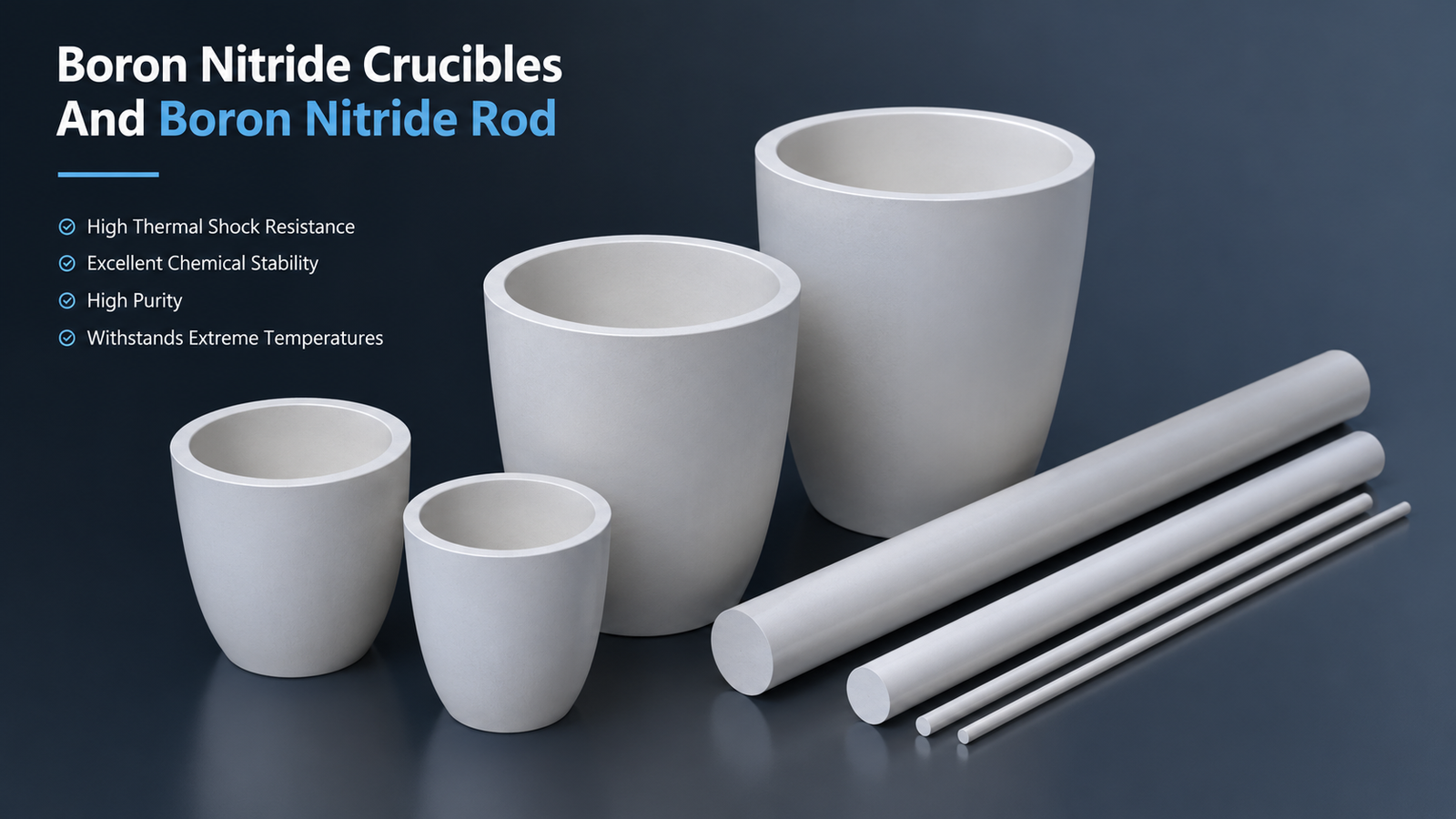
Boron nitride is an advanced ceramic used where conventional metals, graphite, alumina, and other materials may struggle. In hot-pressed hexagonal form, it combines high-temperature capability, electrical insulation, useful thermal conductivity, low thermal expansion, chemical stability, lubricity, and excellent machinability. These qualities make Boron Nitride Crucibles and Boron Nitride Rod valuable in semiconductor processing, vacuum furnaces, molten-metal handling, laboratories, aerospace systems, and specialised thermal equipment.
What Makes Boron Nitride an Important Engineering Material?
Hexagonal boron nitride, or hBN, has a layered crystal structure often compared with graphite, but it is electrically insulating. Hot-pressed BN can also be machined into complex shapes. Depending on grade, key benefits include high dielectric strength, thermal-shock resistance, low friction, chemical inertness, non-wetting behaviour, and dimensional stability.
Important performance advantages include:
- Excellent resistance to rapid heating and cooling
- High electrical resistivity and dielectric strength
- Good heat-transfer capability
- Low coefficient of thermal expansion
- Chemical stability in many severe environments
- Natural lubricating behaviour
- Good machinability for custom components
High-purity grades can exceed 2,000°C in suitable inert or vacuum environments, although actual limits depend on grade, atmosphere, load, and geometry.
Boron Nitride Crucibles: Purpose and Performance
Boron Nitride Crucibles are specialised containers for melting, holding, evaporating, or processing materials at elevated temperatures. Their value extends beyond heat resistance. Correctly selected BN crucibles can reduce unwanted interactions between the vessel and the processed material.
High-purity boron nitride is particularly useful where contamination control matters. Its non-wetting behaviour and chemical resistance can support cleaner processing of molten metals and sensitive materials.
Why Choose Boron Nitride Crucibles?
A quality Boron Nitride Crucible may provide several advantages:
- Reduced contamination in purity-sensitive processes.
- Strong thermal-shock resistance during rapid temperature changes.
- Electrical insulation around high-temperature equipment.
- Low adhesion with many processed materials.
- Custom machining for cavities, ports, lids, slots, and special geometries.
Typical applications include metal melting, vacuum evaporation, crystal growth, ceramic processing, semiconductor manufacturing, laboratory research, and high-temperature material development. Chemical compatibility should always be checked against the exact melt, atmosphere, and operating temperature.
Boron Nitride Rod: A Versatile Machinable Ceramic Form
Boron Nitride Rod is cylindrical stock used directly or machined into finished parts. It gives engineers flexibility because it can be shaped into insulators, spacers, sleeves, supports, nozzles, fixtures, furnace components, and electrical isolation parts.
Hot pressing can align BN platelets, making some properties anisotropic. This means thermal, electrical, or mechanical performance can vary with orientation. Critical designs should therefore specify the required material direction during purchasing and machining.
Machining Boron Nitride Rod
Machinability is one of the strongest advantages of Boron Nitride Rod. Several BN grades can be dry-machined using conventional tools, while harder composite grades may need carbide or diamond tooling.
Good machining practice includes:
- Using sharp tools and controlled cutting forces
- Applying light cuts to reduce edge chipping
- Supporting thin walls and delicate features
- Avoiding unnecessary coolant where dry machining is specified
- Using effective dust extraction
- Following supplier tolerances and orientation recommendations
Boron Nitride Crucibles vs Boron Nitride Rod
| Feature | Boron Nitride Crucibles | Boron Nitride Rod |
| Primary role | Material containment | Machinable stock |
| Typical form | Cup, boat, cylinder | Solid cylindrical bar |
| Main benefit | Clean high-temperature processing | Design flexibility |
| Common uses | Melting, evaporation, research | Nozzles, spacers, insulators |
| Customisation | Cavities, walls, ports, lids | Diameter, grooves, threads |
How to Select the Correct Boron Nitride Grade
Not every BN ceramic performs identically. Purity, binder chemistry, strength, moisture resistance, thermal conductivity, dielectric behaviour, and temperature capability vary between grades.
Before ordering, evaluate operating temperature, furnace atmosphere, chemical compatibility, required purity, electrical insulation, thermal cycling, mechanical load, dimensions, machining tolerances, and preferred orientation. Manufacturer datasheets should be reviewed because grade composition can significantly affect performance.
Storage and Handling
Keep boron nitride components clean and dry. Some binder-containing grades can absorb moisture, which may influence behaviour during heating. Store components carefully, avoid impact damage, and use clean handling practices for purity-sensitive applications. Saint-Gobain recommends dry storage for its solid BN ceramics and notes that moisture exposure can affect certain grades.
Frequently Asked Questions
What are Boron Nitride Crucibles used for?
They are used for melting, evaporation, crystal growth, laboratory processing, semiconductor applications, and high-temperature containment.
Can Boron Nitride Crucibles handle extreme heat?
Yes. Selected high-purity grades can operate above 2,000°C in appropriate inert or vacuum conditions.
Is boron nitride electrically conductive?
Hexagonal boron nitride is generally an electrical insulator while offering useful thermal conductivity.
What is Boron Nitride Rod used for?
It is machined into insulators, nozzles, sleeves, spacers, furnace fixtures, supports, and specialised ceramic parts.
Can Boron Nitride Rod be machined?
Yes. Its machinability is a major advantage, although tooling requirements vary by grade.
Is boron nitride resistant to thermal shock?
Yes. Low thermal expansion and favourable heat-transfer properties provide excellent thermal-shock resistance.
Are all boron nitride grades identical?
No. Purity, binders, strength, moisture behaviour, and thermal properties differ substantially.
Can BN crucibles hold molten metals?
Many grades are suitable for molten-metal applications because of non-wetting behaviour and chemical stability, but compatibility must be verified.
Does boron nitride oxidise in air?
High-temperature performance depends strongly on atmosphere. Air exposure can limit service temperature, so supplier guidance is important.
How should I choose a boron nitride supplier?
Compare grade data, purity, dimensions, tolerances, machining capability, quality documentation, technical support, and application experience.
Read more – https://newsgrow.blogspot.com/2026/09/boron-nitride-crucibles-and-boron.html