
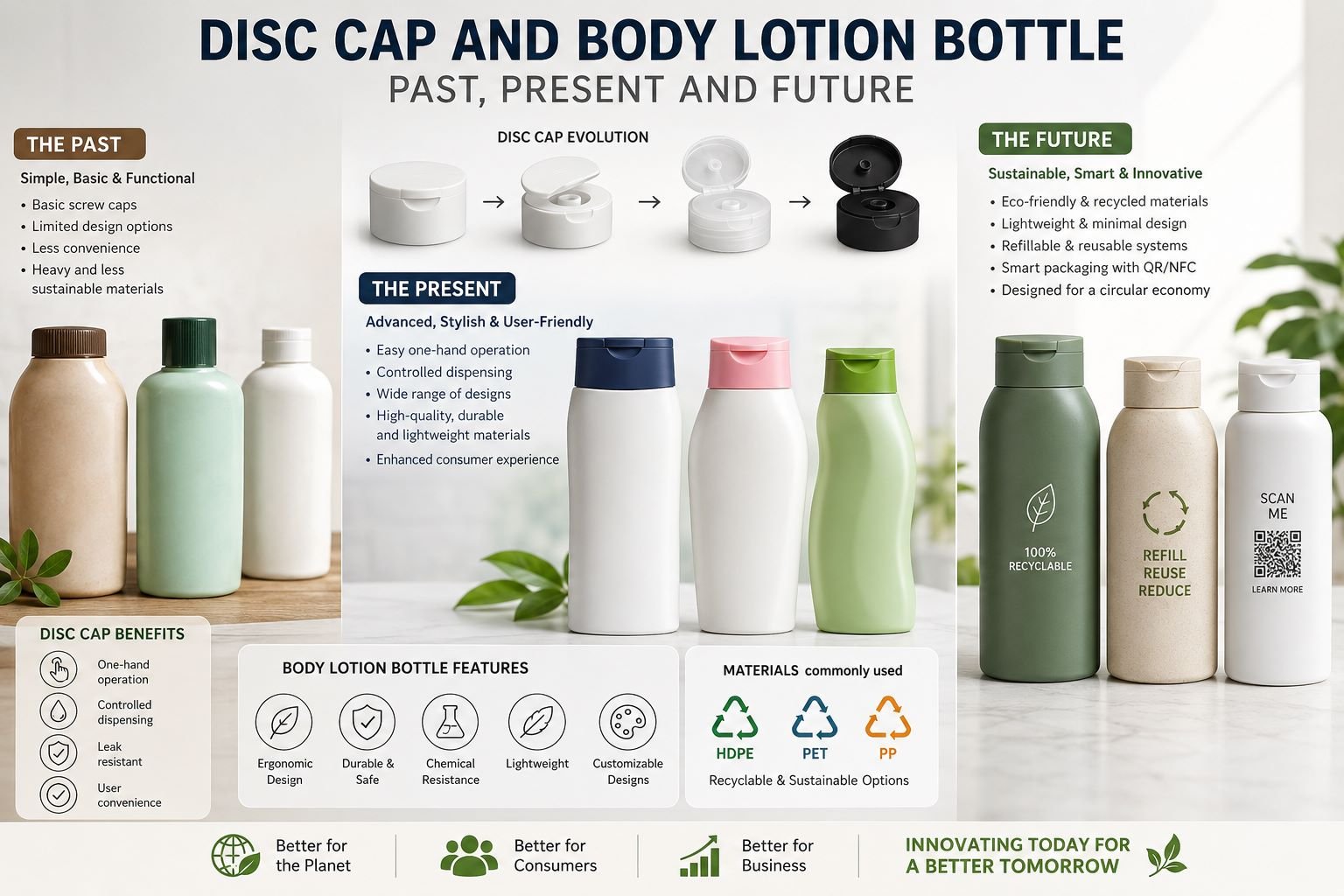
Packaging plays a major role in how personal care products are stored, dispensed, transported, and experienced by customers. Two commonly used packaging components in the cosmetics and personal care industry are the disc cap and body lotion bottle. Together, they provide a practical dispensing system for lotions, creams, moisturizers, shampoos, conditioners, and other liquid or semi-viscous formulations.
Choosing the right packaging is not simply about appearance. Manufacturers must consider product viscosity, bottle material, closure compatibility, leakage protection, dispensing convenience, branding, transportation, and recyclability. A carefully selected disc cap combined with a suitable body lotion bottle can improve both product performance and customer satisfaction.
What Is a Disc Cap?
A disc cap, also known as a disc-top closure, is a dispensing closure commonly installed on cosmetic and personal care bottles. It generally features a circular top section that operates through a press-to-open mechanism.
When one side of the disc is pressed, the opposite side rises and exposes the dispensing opening. After use, the raised portion can be pressed down again to close the opening.
This simple mechanism allows consumers to dispense lotion without completely removing the closure.
Disc caps are widely used for:
- Body lotions
- Shampoos
- Conditioners
- Face cleansers
- Massage lotions
- Liquid soaps
- Hair care formulations
- Cosmetic creams
- Sunscreen products
The convenience of single-handed operation makes this closure particularly suitable for frequently used personal care products.
Important Features of a Quality Disc Cap
Not every closure performs in the same way. A properly manufactured disc cap should provide reliable functionality throughout the expected life of the product.
Important characteristics include:
Secure Closure Performance
The closure must fit the bottle neck correctly. A proper fit helps reduce accidental opening and leakage during storage and transportation.
Controlled Product Dispensing
The opening size affects how quickly the product leaves the bottle. Thicker lotion normally requires a dispensing design capable of providing sufficient flow without forcing the customer to apply excessive pressure.
Easy Opening and Closing
Consumers should be able to operate the cap comfortably with a thumb or finger. A difficult mechanism can negatively affect the overall packaging experience.
Durable Construction
Disc caps are commonly manufactured from plastic materials such as polypropylene because of their strength, processing characteristics, and suitability for many packaging applications.
The final material specification should always be checked against the formulation that will come into contact with the closure.
Understanding the Body Lotion Bottle
A body lotion bottle is designed to store and dispense skincare formulations such as moisturizing lotion, hand lotion, body moisturizer, massage lotion, and similar personal care products.
These bottles may be manufactured in different shapes, capacities, colors, and plastic materials depending on the intended application.
Common bottle materials include:
| Material | Typical Characteristics | Common Packaging Use |
| HDPE | Strong and relatively rigid | Lotion and personal care bottles |
| PET | Clear appearance and good visual presentation | Cosmetic and beauty packaging |
| PP | Durable and chemically resistant for many uses | Selected cosmetic containers |
| PCR Plastic | Contains recycled plastic content | Sustainability-focused packaging |
Material selection should be based on formulation compatibility, appearance requirements, manufacturing process, transportation conditions, and applicable regulations.
How Disc Caps and Lotion Bottles Work Together
The disc cap and body lotion bottle must function as one complete packaging system.
A high-quality closure cannot solve problems caused by an incompatible bottle neck. Similarly, an excellent bottle may still leak when fitted with an unsuitable closure.
Several factors should therefore be evaluated together.
Neck Finish
Bottle neck dimensions and closure specifications must match. Manufacturers should verify parameters such as thread configuration, neck diameter, sealing surfaces, and closure dimensions.
Product Viscosity
A thin formulation flows differently from a thick moisturizer. The dispensing orifice and bottle flexibility should be chosen according to the viscosity of the formulation.
Bottle Squeezability
Many lotion bottles are designed to allow controlled squeezing. This helps move the formulation toward the dispensing opening while giving customers greater control over the quantity released.
Packaging Testing
Before commercial production, complete bottle-and-closure combinations should be evaluated with the actual formulation whenever possible. Compatibility, leakage, dispensing, storage, transportation, and environmental conditions may all influence packaging performance.
Benefits of Using a Disc Cap for Lotion Packaging
The popularity of the disc cap comes from its balance of simplicity, convenience, and cost-efficient packaging design.
Key benefits can include:
- Convenient operation: Consumers can often open and close the package using one hand.
- Controlled dispensing: The small opening helps customers regulate the amount of lotion used.
- Reduced handling: There is usually no need to unscrew and remove the entire closure.
- Clean presentation: The compact closure creates a neat appearance suitable for cosmetic packaging.
- Multiple design possibilities: Caps can be produced in different sizes, finishes, and colors.
- Broad application range: Disc-top closures can work with several personal care formulations when correctly specified.
Choosing the Right Body Lotion Bottle Design
The best body lotion bottle depends on both technical requirements and the intended market positioning.
Manufacturers should first determine the required filling capacity. Small bottles may suit samples, travel kits, hotels, and promotional packs, while larger bottles are more appropriate for regular household use.
Bottle shape also affects usability and branding. Cylindrical bottles provide a classic appearance, while oval, rectangular, and custom-profile containers can help differentiate products on retail shelves.
Color is another important consideration. Transparent packaging allows customers to see the formulation, whereas opaque or colored packaging can create a stronger visual identity and may be selected where additional light protection is desired.
Decoration and Branding Possibilities
Packaging serves as an important communication surface for a personal care brand. A body lotion bottle may support several decoration techniques depending on its material and shape.
Options can include:
- Pressure-sensitive labels
- Screen printing
- Shrink sleeves
- Hot stamping
- Printed branding
- Embossed or molded details
- Custom-colored bottles and closures
The selected decoration method should remain durable under expected storage and handling conditions.
Sustainability Considerations
Sustainability has become an important part of packaging development. Businesses can evaluate opportunities to reduce material usage, increase recycled content, improve recyclability, or simplify packaging structures.
A lightweight body lotion bottle can potentially reduce material consumption, but reducing weight should never compromise required structural performance.
Brands considering recycled plastic should also evaluate appearance, consistency, regulatory requirements, product compatibility, and supply availability.
The disc cap should likewise be considered as part of the overall packaging system rather than as an isolated component.
Quality Checks Before Bulk Production
Before placing a large packaging order, businesses should conduct appropriate testing.
Important evaluations may include:
- Bottle and closure fit
- Leakage resistance
- Dispensing performance
- Drop testing
- Closure opening performance
- Label adhesion
- Product compatibility
- Transportation simulation
- Storage stability
- Visual inspection
Testing finished packaging with the actual lotion formulation provides more useful information than evaluating an empty container alone.
Frequently Asked Questions
1. What is a disc cap used for?
A disc cap is used to conveniently dispense products such as lotion, shampoo, conditioner, cleanser, and other personal care formulations.
2. How does a disc cap open?
One side of the top disc is pressed downward, causing the dispensing side to rise and expose the opening.
3. Is a disc cap suitable for body lotion?
Yes. It is commonly used for lotion when the closure opening and bottle design are compatible with the formulation’s viscosity.
4. Which material is best for a body lotion bottle?
HDPE, PET, PP, and other suitable plastics may be used. The correct choice depends on formulation compatibility, appearance, performance, and manufacturing requirements.
5. Can lotion bottles be customized?
Yes. Manufacturers can customize aspects such as capacity, color, shape, decoration, and closure selection depending on production capabilities and order quantities.
6. Are disc caps leak-proof?
A properly designed and matched closure can provide good leakage resistance, but actual performance depends on the bottle, closure, sealing system, formulation, filling process, and transportation conditions.
7. Can thick lotion be used with a disc cap?
It can, provided the dispensing opening and bottle flexibility are appropriate for the product viscosity.
8. What bottle sizes are available for body lotion?
Lotion bottles are produced in many capacities, ranging from small travel containers to larger family-size packaging.
9. Can the cap color match the bottle?
Yes. Customized color matching is commonly possible subject to the packaging manufacturer’s production requirements and minimum quantities.
10. Should packaging be tested before ordering in bulk?
Yes. Samples should be tested for compatibility, leakage, dispensing, appearance, storage performance, and transportation before full-scale production.