
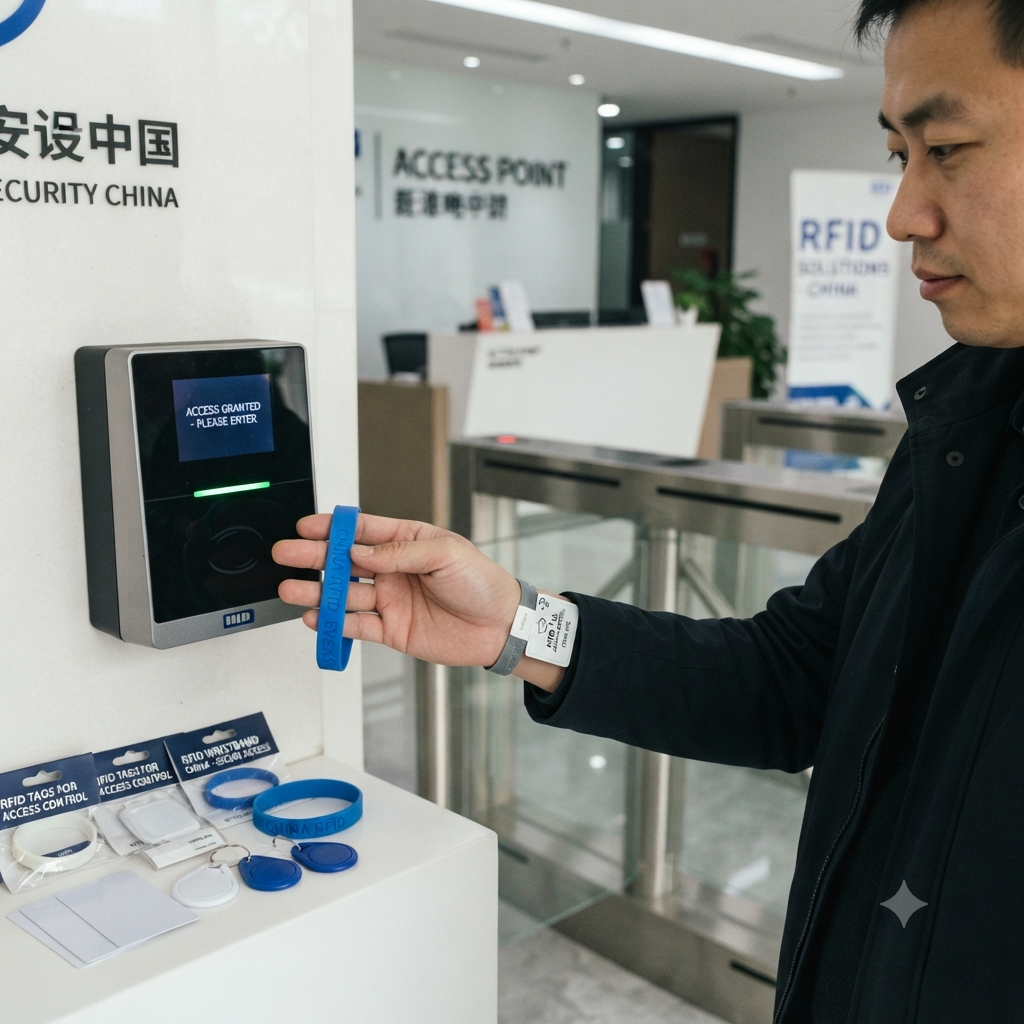
RFID technology replaces manual verification with fast contactless identification across workplaces, hotels, healthcare facilities, gyms, events, and other controlled environments.
Two popular solutions are RFID tags for access control and RFID wristband China products, each suited to different applications and operating conditions.
Understanding RFID Tags for Access Control
RFID tags for access control contain a chip and antenna that communicate with a compatible reader. Each credential stores an identifier or protected data. When a user presents the tag near a reader, the access system checks permission and decides whether a door, gate, turnstile, locker, or restricted area should open.
Common RFID credentials include cards, key fobs, stickers, tokens, and wristbands.
For higher-security applications, modern contactless platforms can provide authentication and encryption rather than relying only on a simple serial number. NXP lists MIFARE DESFire for applications including access control, identity, ticketing, and micropayment, with ISO/IEC 14443 support and cryptographic security features.
Benefits of RFID Access Technology
RFID makes credential verification quick and contactless. Users can tap or present a credential instead of entering a password or waiting for manual checks.
Key benefits include:
- Faster access at doors and checkpoints
- Easy deactivation of lost credentials
- Centralized permission management
- Time-based and zone-based access rules
- Reduced dependence on mechanical keys
- Better visitor and attendance tracking
- Integration with lockers, turnstiles, and smart doors
- Support for loyalty or cashless applications
RFID Wristband China for Events and Facilities
RFID wristband China products are widely sourced by buyers seeking customizable wristbands at scale. These wristbands are used in hotels, water parks, hospitals, resorts, gyms, festivals, events, and membership facilities.
RFID wristbands can be made from silicone, PVC, fabric, or disposable synthetic materials.
A wristband is especially useful when carrying a card is inconvenient. It can remain on the user’s wrist for room access, locker opening, event admission, identification, or closed-loop payment.
Choosing the Right RFID Frequency
Frequency selection should begin with reader compatibility rather than price or appearance.
| RFID Type | Typical Characteristics | Common Uses |
| LF | Short-range identification | Legacy access, simple control |
| HF / 13.56 MHz | Close-range contactless communication | Offices, hotels, events, memberships |
| UHF | Longer range and fast multi-tag reading | Logistics, vehicles, inventory |
The selected chip must match the reader, software, and security architecture.
Materials and Wristband Styles
Silicone wristbands are reusable, comfortable, and suitable for gyms, resorts, clubs, and long-term membership programs. Disposable wristbands suit single-day events, while fabric bands are popular for festivals because they combine comfort and branding.
A reliable RFID wristband China supplier should provide chip specifications, material details, operating conditions, sample testing, and customization options before mass production.
Security Should Come First
An RFID credential should not be selected only by appearance or unit price. Security depends on the complete system, including the credential, reader configuration, backend authorization, encryption, key management, and operating procedures.
Basic identifier-only tags can serve low-risk applications, while sensitive environments may require authenticated credentials. NXP’s DESFire family includes AES-based security and mutual authentication features for secure contactless applications.
How to Choose a Reliable RFID Supplier
Before ordering in bulk, verify technical specifications carefully.
- Confirm the RFID chip and frequency.
- Test compatibility with your installed reader.
- Request samples before production.
- Verify memory, UID, encoding, and security needs.
- Check printing and waterproof performance.
- Confirm personalization and numbering options.
- Review minimum order quantity and lead time.
- Approve a final sample before mass manufacturing.
Implementation Checklist
A successful RFID project connects hardware, software, and credentials. Test real entry points during busy periods and define processes for lost or replacement credentials.
Deployment Tip
Always test the exact production wristband or tag. Antenna design, chip selection, material thickness, and reader tuning can affect reliability.
RFID Tags vs RFID Wristbands
| Factor | RFID Tags | RFID Wristbands |
| Form | Card, fob, label, token | Wearable band |
| Best For | Employees, offices, facilities | Events, resorts, gyms, healthcare |
| Convenience | Easy to carry | Stays on the wrist |
| Reuse | Usually reusable | Reusable or disposable |
| Branding | Moderate | Strong branding potential |
Frequently Asked Questions
What are RFID tags for access control?
They are contactless credentials used with RFID readers to confirm whether a person has permission to enter a controlled area.
Are RFID wristbands suitable for access control?
Yes. They can work as wearable credentials when the chip technology matches the installed reader.
Why source RFID wristbands from China?
Buyers often choose Chinese manufacturers for scalable production, customization, and multiple chip options.
Are RFID wristbands waterproof?
Many silicone and PVC models are designed for wet environments, but buyers should confirm material and testing specifications.
Can RFID wristbands include a logo?
Yes. Manufacturers may offer printing, laser marking, embossing, numbering, or full-color customization.
Can RFID wristbands support cashless payment?
Yes, when the chip and backend platform support closed-loop payment or stored-value functions.
What frequency is common for access control?
HF 13.56 MHz is common in contactless human-access applications, but compatibility with the existing reader is essential.
Can one wristband open multiple areas?
Yes. Access-control software can assign different permissions for rooms, gates, lockers, or VIP zones.
What should be tested before bulk ordering?
Check read performance, chip type, frequency, encoding, comfort, print quality, waterproofing, and reader compatibility.
Are all RFID tags equally secure?
No. Security ranges from basic identifier-based tags to advanced credentials supporting authentication and cryptographic protection.