
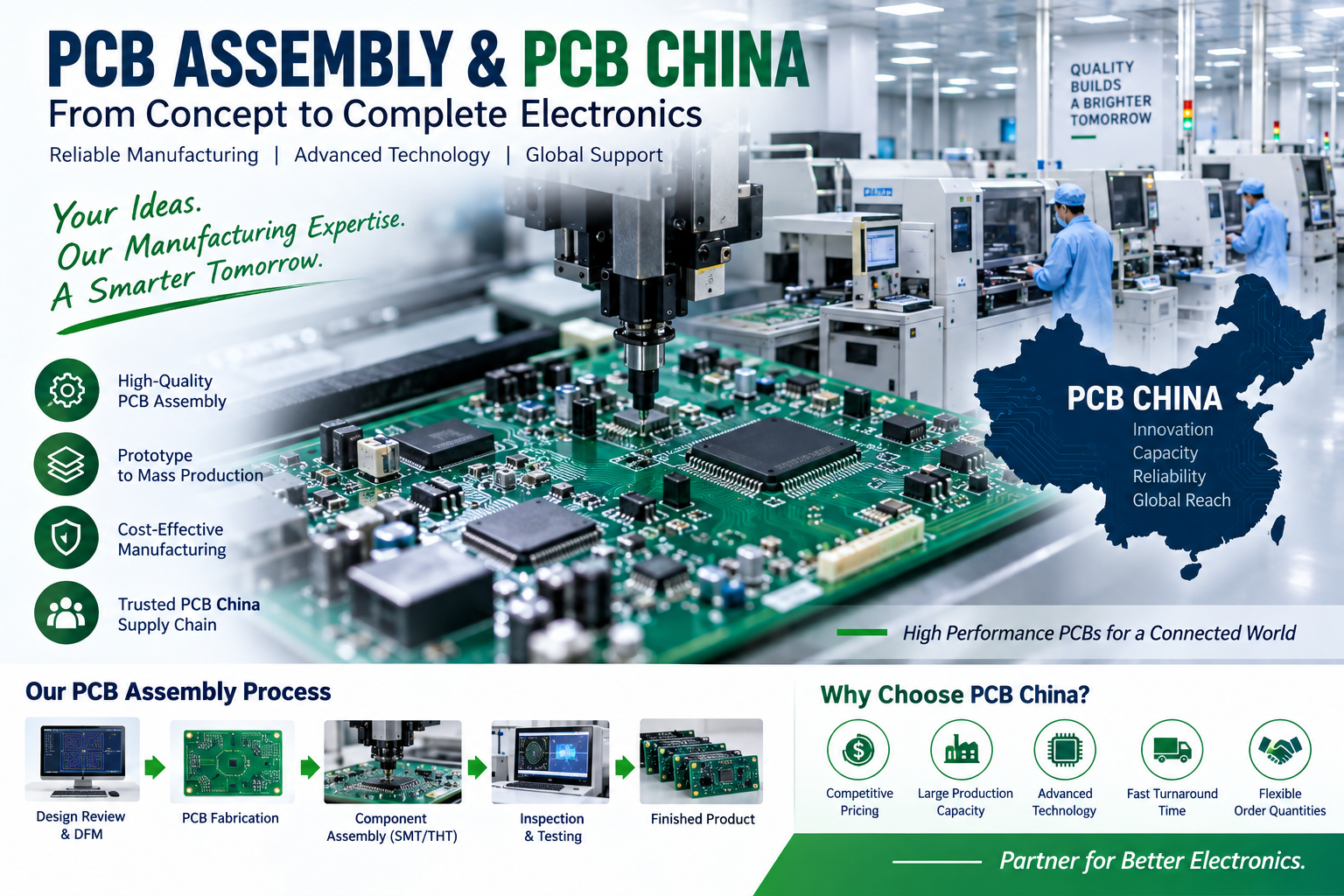
The performance of an electronic product depends heavily on what happens inside its printed circuit board. A well-designed PCB may look perfect on a computer screen, but its real value is proven only when components are accurately placed, soldered, inspected, and tested. This is why professional pcb assembly is an essential part of modern electronics manufacturing.
For companies sourcing internationally, pcb china manufacturing has become an important option because China has developed a broad ecosystem for PCB fabrication, electronic component sourcing, assembly, testing, and volume production. However, successful sourcing requires more than choosing the lowest-cost supplier.
Understanding the manufacturing process, quality controls, testing methods, and supplier capabilities can help businesses reduce risks and achieve more consistent electronic products.
How PCB Assembly Turns a Design Into a Working Product
PCB assembly is the stage where a bare printed circuit board becomes an operational electronic circuit.
A fabricated PCB contains copper tracks, pads, holes, and insulating materials. Electronic components must then be installed according to the design specifications.
Typical components include:
- Resistors
- Capacitors
- Integrated circuits
- Microcontrollers
- Diodes
- Transistors
- Sensors
- Connectors
- Relays
- Power components
The accuracy of component placement and soldering directly influences electrical performance and long-term reliability.
Key Stages of Professional PCB Assembly
Modern PCB production follows a controlled sequence rather than simply placing components on a board.
Solder Paste Application
A stainless-steel stencil is positioned above the PCB, and solder paste is applied to specific component pads.
The correct amount of solder paste is important because excessive or insufficient solder can lead to manufacturing defects.
Automated Component Placement
Pick-and-place machines position electronic components onto the board according to digital placement data.
Modern equipment can handle extremely small components and place them rapidly with high accuracy.
Reflow Soldering
After placement, the board travels through a reflow oven.
A controlled temperature profile heats the solder paste until it melts and creates strong electrical and mechanical connections.
Through-Hole Assembly
Components with leads passing through drilled PCB holes may require wave soldering, selective soldering, or manual soldering.
A professional pcb assembly provider may use both SMT and through-hole technologies on the same product.
Why PCB China Manufacturing Has a Strong Global Presence
The pcb china industry supports a wide variety of electronics applications, including telecommunications, industrial systems, consumer devices, smart appliances, automotive electronics, lighting, IoT products, and power equipment.
One major advantage is the availability of interconnected manufacturing services.
A buyer may be able to source:
- Bare PCB fabrication
- Electronic components
- SMT assembly
- Through-hole assembly
- Cable assemblies
- Functional testing
- Product enclosure manufacturing
- Final packaging
This integrated supply network can simplify manufacturing and support faster product development.
However, capabilities differ significantly between suppliers, so proper qualification remains essential.
Prototype PCB Assembly and Its Importance
Moving directly from design to mass production creates unnecessary risk.
Prototype pcb assembly helps engineering teams verify whether the design performs correctly before committing to large quantities.
Prototype production can identify problems such as:
- Incorrect footprints
- Wrong component orientation
- Routing mistakes
- Thermal management issues
- Connector alignment problems
- Component availability concerns
- Assembly difficulties
A successful prototype provides valuable information for improving both the product and manufacturing process.
When working with a new pcb china supplier, prototype orders also provide an opportunity to evaluate workmanship, communication, documentation, and delivery performance.
SMT and Through-Hole Assembly Comparison
Different components require different assembly methods.
| Feature | SMT Assembly | Through-Hole Assembly |
| Component placement | Surface mounted | Leads inserted through holes |
| Production speed | High | Lower |
| Automation | Highly automated | Partially automated |
| Board density | Very high | Moderate |
| Mechanical strength | Good | Excellent |
| Common use | Compact electronics | Connectors and power components |
Many modern electronic products use a combination of both technologies.
Component Procurement Can Determine Product Reliability
Good manufacturing equipment cannot compensate for poor-quality components.
Component sourcing is therefore one of the most important parts of turnkey pcb assembly.
Reliable manufacturers should maintain controlled purchasing procedures and source critical components from approved channels.
A complete Bill of Materials should contain:
- Exact manufacturer name
- Manufacturer part number
- Component value
- Package type
- Quantity
- Approved replacement parts
- Special sourcing instructions
When sourcing through a pcb china supplier, buyers should clearly define whether substitutions are permitted.
Unapproved component replacements may change electrical characteristics, thermal performance, product lifetime, or regulatory compliance.
Essential Testing During PCB Production
Inspection should not be treated as a final step only. Quality control should occur throughout manufacturing.
Automated Optical Inspection
AOI systems use cameras to inspect component placement, solder joints, polarity, and visible defects.
X-Ray Inspection
X-ray systems are especially useful for checking components whose solder joints cannot be seen directly, including BGAs.
Electrical Testing
Electrical testing can identify open circuits, short circuits, and incorrect connections.
Functional Testing
Functional testing checks whether the assembled PCB behaves as intended under real operating conditions.
A reliable pcb assembly supplier should recommend suitable testing according to product complexity and application.
Important Questions to Ask a PCB China Manufacturer
Before selecting a pcb china manufacturing partner, buyers should request detailed information about the supplier’s capabilities.
Ask about:
- Maximum PCB layer count
- Supported PCB materials
- Minimum trace and spacing
- Copper thickness options
- Surface finish options
- SMT placement capability
- Smallest supported component
- BGA capability
- Inspection equipment
- Testing services
- Production capacity
- Quality certifications
- Component traceability
- Lead times
These questions provide a clearer picture of whether the factory can reliably manufacture the required product.
Turnkey PCB Assembly Can Simplify Supply Chain Management
Turnkey manufacturing allows one supplier to manage most or all production stages.
A full turnkey service may include:
- PCB fabrication
- Component purchasing
- pcb assembly
- Programming
- Inspection
- Electrical testing
- Functional testing
- Packaging
This approach reduces the number of suppliers the buyer needs to coordinate.
It can also improve scheduling because PCB fabrication, purchasing, and assembly are managed within one production plan.
How to Reduce PCB Manufacturing Problems
Many production failures begin with incomplete documentation rather than manufacturing equipment.
Businesses can reduce risk by following a few practical steps.
Before Production
Confirm that all Gerber files, BOM documents, placement files, schematics, and assembly drawings represent the latest design revision.
During Prototype Production
Review assembly quality and perform functional testing before approving larger quantities.
Before Mass Production
Agree on component sources, testing methods, acceptable quality standards, packaging requirements, and delivery schedules.
After Production
Maintain manufacturing records and track recurring failures so that corrective actions can be implemented.
Clear documentation helps both the customer and pcb china manufacturer work efficiently.
FAQ About PCB Assembly and PCB China
1. What is PCB assembly used for?
PCB assembly transforms a bare circuit board into a functional electronic assembly by installing and soldering components.
2. What is the difference between PCB fabrication and assembly?
PCB fabrication creates the bare circuit board, while assembly installs the electronic components.
3. Why do companies source PCBs from China?
The pcb china industry offers broad manufacturing capacity, component access, prototype services, and scalable production options.
4. Is SMT suitable for high-volume manufacturing?
Yes. SMT is highly automated and commonly used for medium- and high-volume electronics production.
5. Can PCB manufacturers handle small prototype orders?
Many manufacturers support prototype quantities before larger production runs.
6. What is a BOM?
A Bill of Materials lists the electronic components required to manufacture the PCB assembly.
7. Why is functional testing necessary?
Functional testing confirms whether the assembled circuit operates according to its intended design.
8. What causes PCB assembly defects?
Common causes include incorrect component placement, soldering problems, poor-quality components, outdated files, and unsuitable process settings.
9. What is turnkey PCB assembly?
Turnkey service means the manufacturer manages PCB fabrication, component sourcing, assembly, and often testing.
10. How can buyers reduce sourcing risks?
Use verified documentation, approve component sources, produce prototypes, define testing requirements, and evaluate supplier quality systems.