
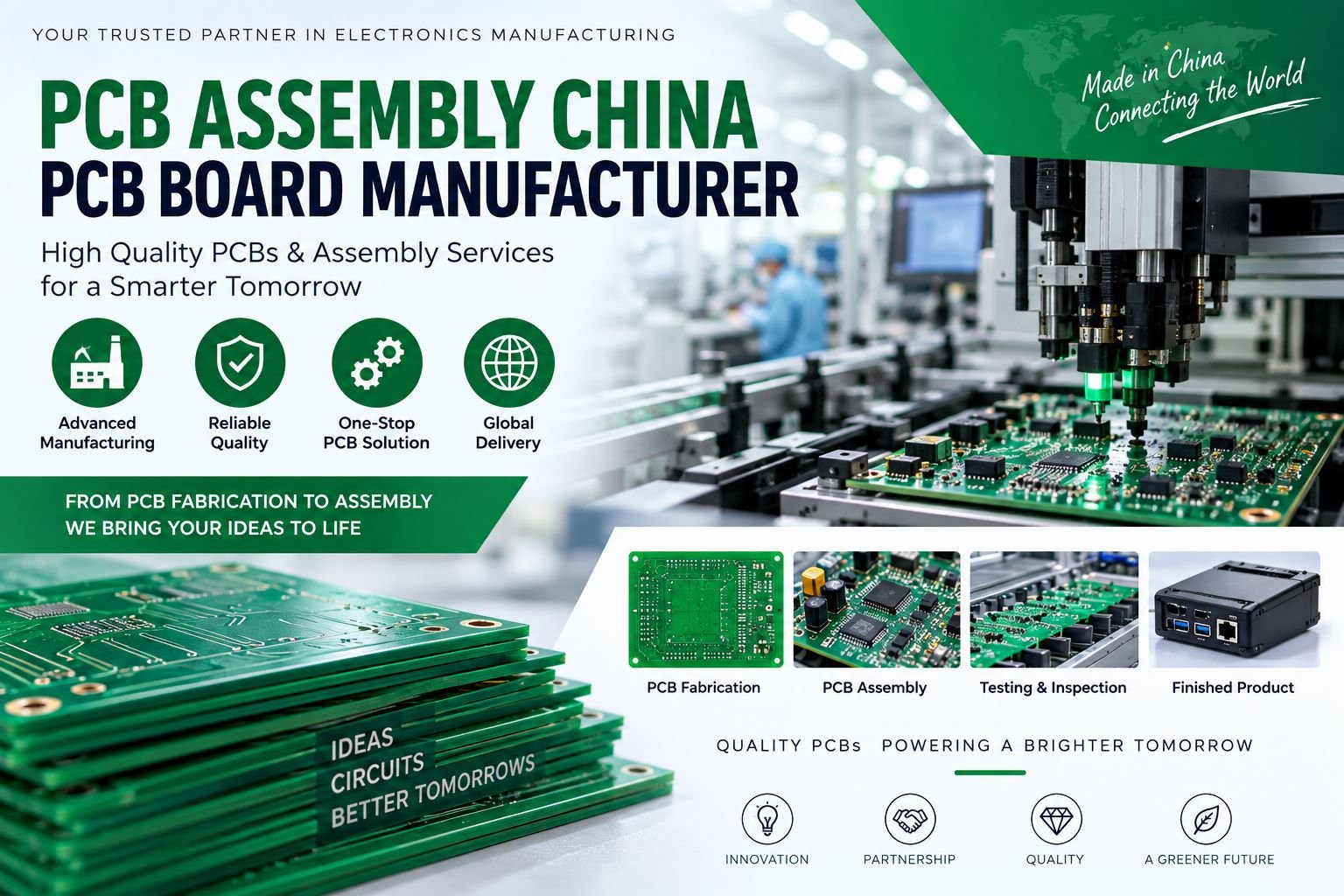
At the center of this transformation are pcb assembly china services and the evolving capabilities of every advanced pcb board manufacturer supporting international OEMs, technology brands, industrial companies, and product developers.
From electric vehicles and artificial intelligence hardware to medical devices, smart appliances, communication equipment, robotics, and IoT systems, printed circuit boards remain one of the most critical building blocks in modern electronics.
Manufacturers are now investing heavily in automation, high-density PCB technology, advanced inspection, digital traceability, and faster prototyping to meet increasingly complex customer requirements.
PCB Manufacturing Industry Shifts Toward Higher Complexity
The PCB manufacturing sector is no longer focused only on producing basic single-layer or double-layer circuit boards.
Demand is moving toward multilayer designs, high-density interconnect boards, fine-pitch components, advanced via structures, controlled impedance, and compact circuit layouts.
A modern pcb board manufacturer may now be expected to handle:
- Multilayer PCB fabrication
- HDI PCB technology
- Blind and buried vias
- Microvias
- Heavy copper boards
- Controlled impedance
- Fine-line circuits
- Specialized PCB materials
This shift is being driven by electronics that require more processing power while occupying less physical space.
For manufacturers, tighter tolerances mean production controls must become more accurate at every stage.
China PCB Assembly Sector Expands Automation
Automation continues to reshape pcb assembly china operations.
Traditional assembly lines required significant manual handling, but modern factories are increasingly using automated solder paste printing, high-speed component placement, intelligent inspection, barcode tracking, and real-time manufacturing data.
Surface Mount Technology remains one of the most important assembly methods.
Production generally starts with stencil printing, where solder paste is applied to PCB pads. Automated pick-and-place machines then position components before boards enter reflow ovens.
Modern lines can process complex boards containing hundreds or even thousands of electronic components.
AI and Smart Inspection Become More Important
Quality inspection is also becoming more sophisticated.
Factories increasingly combine several inspection technologies because no single system can identify every possible defect.
Common methods include:
| Inspection Technology | Primary Function |
| SPI | Measures solder paste quality |
| AOI | Detects visible assembly defects |
| X-ray | Inspects hidden solder joints |
| ICT | Checks electrical performance |
| Functional Testing | Verifies actual operation |
AOI systems can detect missing components, polarity errors, incorrect placement, and visible solder problems.
For BGA and QFN components, X-ray inspection becomes particularly valuable because their solder joints are hidden below the component package.
A technically advanced pcb assembly china supplier may combine automated inspection data with process monitoring to identify recurring manufacturing problems before they affect large production quantities.
Component Supply Chain Remains a Key Industry Issue
Electronic component availability continues to influence PCB production planning.
Semiconductors, processors, memory devices, power components, connectors, sensors, and passive components can experience changes in availability, pricing, and lifecycle status.
As a result, component sourcing has become an important part of PCB manufacturing strategy.
A strong supplier should verify:
- Manufacturer part numbers
- Component authenticity
- Supplier documentation
- Date codes where relevant
- Package specifications
- Approved alternative components
Using unauthorized substitutions can create compatibility problems or reduce long-term reliability.
Customers are therefore increasingly asking manufacturers for better component traceability.
PCB Board Manufacturers Focus More on DFM
Design for Manufacturing is becoming a key step before production.
Instead of immediately manufacturing the files supplied by a customer, an experienced pcb board manufacturer may first review the design for possible fabrication problems.
Engineers typically examine trace spacing, hole sizes, copper clearances, solder mask dimensions, board thickness, stack-up design, and manufacturing tolerances.
Early DFM analysis can prevent production delays and redesign costs.
DFM Reduces Prototype Failures
A PCB may work perfectly in a design environment while still being difficult to manufacture consistently.
For example, extremely small spacing between copper features may increase production risk.
Improper component spacing may create assembly difficulties.
Manufacturers that identify these problems early can help customers improve both reliability and production yield.
Engineering Collaboration Is Becoming More Valuable
The relationship between the designer and manufacturer is becoming more collaborative.
Instead of treating PCB production as a simple purchasing activity, companies are increasingly involving manufacturing engineers earlier in the development process.
Prototype Demand Continues to Grow
Rapid product development has increased demand for prototype PCB assembly.
Technology companies often need small quantities of boards before approving mass production.
The typical process now includes:
- Design validation
- Prototype manufacturing
- Functional testing
- Engineering revisions
- Pilot production
- Mass manufacturing
This phased strategy allows engineers to identify problems before investing in larger production runs.
For pcb assembly china providers, supporting prototypes and volume production under one manufacturing system can create a smoother transition between development stages.
Advanced PCB Materials Gain Attention
PCB materials are also becoming more important as electronic systems operate at higher frequencies and temperatures.
Standard FR-4 remains widely used, but some applications require materials with different electrical or thermal properties.
Material selection can affect:
- Signal loss
- Thermal stability
- Mechanical strength
- Moisture resistance
- Electrical performance
- Product lifetime
High-frequency communication equipment, automotive electronics, power systems, and industrial products may require carefully selected laminates.
A knowledgeable pcb board manufacturer should review material requirements according to the final application.
Traceability Becomes a Major Quality Requirement
Manufacturers are placing greater emphasis on digital traceability.
Production records can now connect finished assemblies to specific component lots, manufacturing batches, test results, production lines, and inspection records.
Traceability can include:
- PCB batch information
- Component supplier records
- Assembly date
- Machine data
- Inspection results
- Repair records
- Testing reports
This information is especially valuable when companies need to investigate failures or improve future production.
Cost Competition Shifts Toward Manufacturing Efficiency
PCB sourcing has traditionally been strongly influenced by unit price.
However, buyers are increasingly evaluating total manufacturing cost instead.
A cheaper board may become expensive if it causes assembly failures, rework, delays, or product returns.
Manufacturers are therefore focusing more on process efficiency.
Cost can often be reduced through better panel utilization, standard materials, optimized layer counts, automated assembly, readily available components, and improved DFM.
FAQ: PCB Manufacturing Industry Update
What is PCB assembly China?
pcb assembly china refers to PCB assembly services provided by Chinese electronics manufacturing companies, including component placement, soldering, inspection, and testing.
What does a PCB board manufacturer produce?
A pcb board manufacturer fabricates bare printed circuit boards according to engineering specifications.
Why is PCB automation increasing?
Automation improves placement accuracy, production speed, consistency, traceability, and manufacturing efficiency.
What is HDI PCB technology?
HDI uses higher wiring density, fine traces, microvias, and compact interconnections to support smaller electronic designs.
Why is X-ray inspection used?
X-ray systems inspect hidden solder joints underneath components such as BGA packages.
What is PCB DFM?
Design for Manufacturing evaluates whether a PCB design can be produced reliably using available manufacturing processes.
Why is component traceability important?
It allows manufacturers to track component sources and production history if quality problems appear later.
Are prototypes necessary before mass production?
Prototype production is strongly recommended for new products because it helps identify design and manufacturing problems before scaling.
What affects PCB manufacturing cost?
Layer count, materials, dimensions, copper thickness, vias, surface finish, component selection, testing, and production volume can all influence cost.
What should buyers evaluate in a PCB supplier?
Buyers should review technical capabilities, quality controls, engineering support, sourcing systems, testing resources, traceability, and production capacity.