
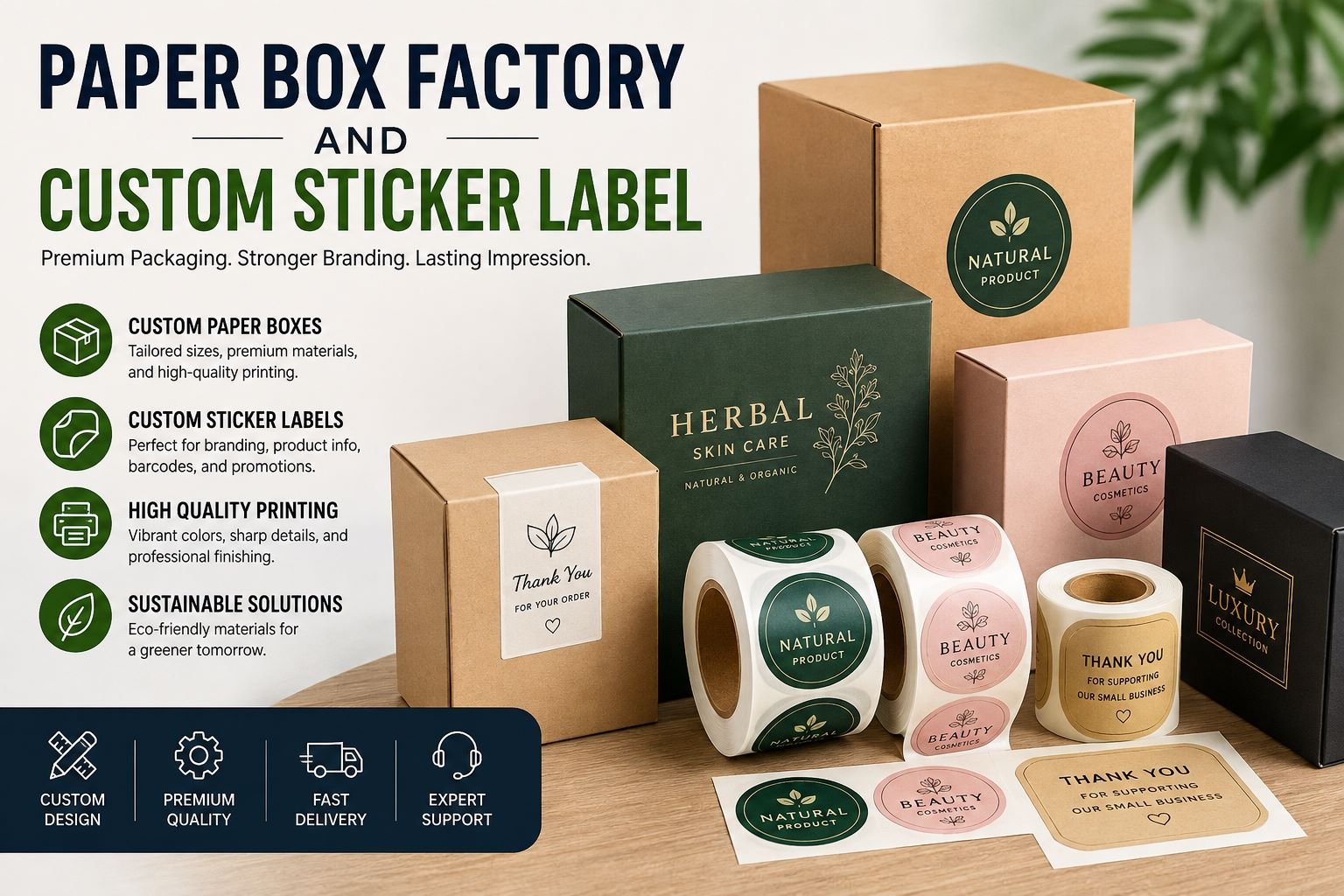
It has become an important part of branding, customer experience, product safety, and marketing. Businesses that want professional packaging often depend on a reliable Paper Box Factory for durable boxes and a quality Custom Sticker Label solution for branding, identification, and product information.
When these two packaging elements work together, even a simple product can look premium and market-ready. From cosmetics and food products to electronics, apparel, gifts, and e-commerce shipments, customized boxes and labels help brands communicate value before customers even open the package.
Why Modern Brands Need Better Packaging
Consumers often see packaging before they experience the actual product. Poor-quality boxes, unclear labels, or inconsistent branding may create a negative first impression.
Professional packaging can help businesses:
- Protect products during transportation
- Improve shelf presentation
- Increase brand recognition
- Communicate important product information
- Create memorable unboxing experiences
- Support promotional campaigns
- Differentiate products from competitors
Working with an experienced Paper Box Factory allows brands to develop packaging that matches product dimensions, weight, shipping conditions, and visual identity.
What Does a Paper Box Factory Produce?
A Paper Box Factory manufactures packaging using different grades of paperboard, cardboard, kraft paper, corrugated materials, and specialty papers.
Manufacturers may provide packaging for retail, industrial, e-commerce, gifting, and promotional applications.
Common box styles include:
- Folding cartons
- Corrugated shipping boxes
- Rigid gift boxes
- Kraft packaging boxes
- Product display boxes
- Cosmetic packaging
- Food packaging cartons
- Electronics boxes
- Subscription boxes
- Custom printed mailer boxes
The correct box style depends on product requirements rather than appearance alone.
Important Factors When Selecting Paper Boxes
Packaging development should begin with the product itself. Dimensions, fragility, weight, storage conditions, distribution channels, and customer expectations must all be considered.
A professional manufacturer evaluates factors such as paper thickness, structural design, printing methods, finishing, and transportation requirements.
For example, lightweight cosmetic products may work well with folding cartons, while heavier e-commerce products may require stronger corrugated packaging.
Brands should also consider storage efficiency. Boxes designed intelligently can reduce unused space during shipping and simplify warehouse management.
How Custom Sticker Labels Improve Packaging
A Custom Sticker Label provides a flexible method of adding branding and product information without redesigning the entire package.
Labels can display:
- Brand logos
- Product names
- Barcodes
- QR codes
- Ingredients
- Instructions
- Promotional messages
- Batch information
- Manufacturing dates
- Contact details
This makes customized labels particularly useful for businesses with multiple product variants.
Instead of printing completely different packaging for every variation, companies can sometimes use standardized boxes with separate labels.
Paper Boxes vs Custom Sticker Labels
Both packaging solutions perform different but complementary functions.
| Feature | Paper Boxes | Custom Sticker Labels |
| Primary purpose | Product protection and presentation | Branding and information |
| Customization | Size, shape, printing, structure | Shape, color, text, adhesive |
| Production cost | Usually higher | Generally lower |
| Product protection | High | Minimal |
| Branding potential | Excellent | Excellent |
| Best application | Primary or shipping packaging | Identification and promotion |
Combining professionally designed boxes with a Custom Sticker Label often gives businesses greater flexibility.
Choosing the Right Label Material
Labels must remain attractive throughout transportation, storage, and product use.
Paper labels are commonly used for dry indoor products because they are economical and easy to print. Vinyl and synthetic materials provide better resistance to moisture, handling, and environmental exposure.
Businesses should evaluate:
- Surface material
- Temperature exposure
- Moisture levels
- Required lifespan
- Adhesive strength
- Printing quality
- Indoor or outdoor usage
Selecting the wrong adhesive may cause labels to peel, curl, or detach.
Printing and Finishing Options for Premium Packaging
Modern packaging manufacturers offer numerous printing technologies, including offset printing, digital printing, flexographic printing, and screen printing.
Businesses can also use finishing techniques to create distinctive packaging.
Popular options include:
- Matte lamination
- Gloss lamination
- Spot UV
- Embossing
- Debossing
- Foil stamping
- Die cutting
- Window cutting
A skilled Paper Box Factory can recommend finishes according to production volume, budget, product category, and branding goals.
Sustainability Is Changing Packaging Decisions
Environmental responsibility is increasingly influencing packaging development.
Businesses are exploring recyclable paper, responsibly sourced materials, reduced plastic components, water-based inks, and packaging designs that use less material.
Paper packaging provides opportunities for brands seeking more environmentally conscious solutions.
However, sustainability should consider the complete packaging lifecycle. A lightweight package that protects products effectively may prevent damage and reduce product waste, which can also improve environmental performance.
How Packaging Supports E-Commerce Growth
Online businesses face different packaging challenges compared with traditional retail stores.
Products may travel through warehouses, sorting facilities, delivery vehicles, and multiple handling points before reaching customers.
Strong boxes can reduce transportation damage, while branded labels help identify shipments and create a more recognizable customer experience.
A thoughtfully designed Custom Sticker Label can also encourage repeat engagement by including QR codes linking customers to product instructions, warranty registration, social media channels, or special offers.
Questions to Ask Before Choosing a Manufacturer
Before placing a large packaging order, businesses should discuss several details with potential suppliers.
Ask about:
- Minimum order quantity
- Available paper materials
- Printing capabilities
- Prototype availability
- Production lead time
- Quality inspection
- Custom dimensions
- Finishing options
- Shipping arrangements
- Sustainability certifications
Testing samples before full production can prevent expensive mistakes.
Frequently Asked Questions
1. What is a Paper Box Factory?
A Paper Box Factory manufactures cartons, rigid boxes, corrugated boxes, kraft boxes, and other paper-based packaging for commercial products.
2. Can paper boxes be customized?
Yes. Businesses can customize dimensions, printing, colors, structure, inserts, finishes, and branding.
3. What is a Custom Sticker Label?
A Custom Sticker Label is an adhesive printed label designed with specific branding, product information, graphics, or identification details.
4. Which industries commonly use paper packaging?
Food, cosmetics, healthcare, fashion, electronics, retail, gifts, and e-commerce industries widely use paper packaging.
5. Can sticker labels include QR codes?
Yes. QR codes can connect customers to websites, videos, manuals, promotions, or verification pages.
6. What determines paper box pricing?
Material thickness, dimensions, printing, finishing, order quantity, box structure, and additional inserts affect pricing.
7. Are custom labels waterproof?
Some synthetic and vinyl labels offer strong moisture resistance. Material selection depends on the intended environment.
8. Can small businesses order customized packaging?
Yes. Many manufacturers offer lower minimum quantities through digital printing and flexible manufacturing methods.
9. Why are packaging prototypes important?
Prototypes allow businesses to test dimensions, structural strength, graphics, usability, and product fit before mass production.
10. Can boxes and labels use the same branding?
Yes. Matching colors, typography, logos, and graphics across boxes and labels improves brand consistency.