
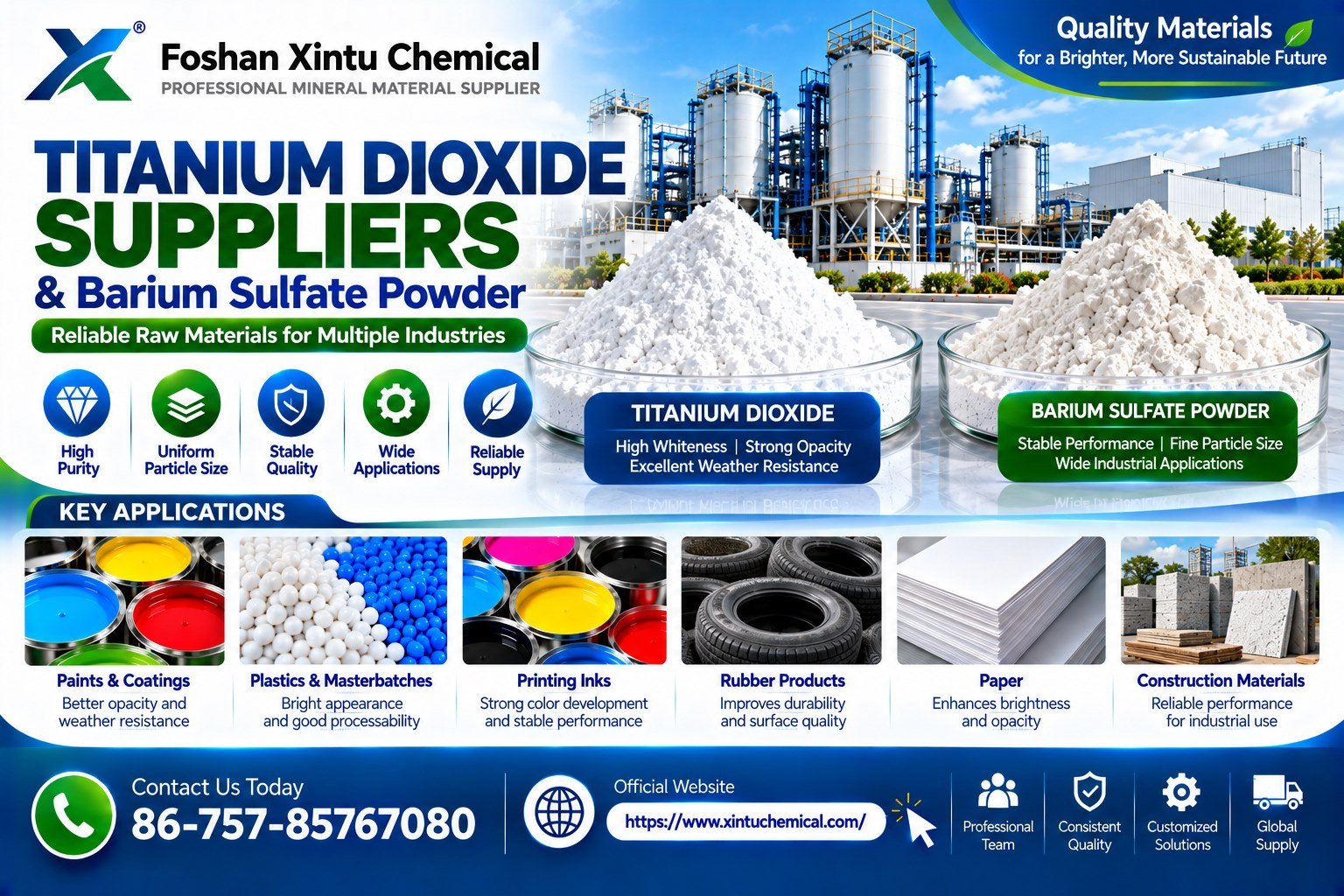
Manufacturers in paints, coatings, plastics, masterbatches, printing inks, rubber, paper, and construction materials continue to demand raw materials that offer reliable quality and predictable processing. This is increasing attention on experienced Titanium Dioxide Suppliers and dependable Barium Sulfate Powder, especially where whiteness, opacity, density, dispersion, and batch consistency directly affect finished-product performance.
Titanium dioxide and barium sulfate serve different functions, but they are often used within the same industrial sectors. Titanium dioxide is primarily valued as a high-performance white pigment, while barium sulfate is widely used as a stable mineral filler. Choosing the correct grade of each material can help manufacturers improve formulation efficiency and product quality.
Why Titanium Dioxide Suppliers Matter
Professional Titanium Dioxide Suppliers do more than deliver white pigment. They help manufacturers obtain grades suited to particular applications, processing conditions, and performance targets.
Titanium dioxide is widely used because of its strong light-scattering ability and high refractive index. Depending on grade and treatment, it can contribute to:
- High whiteness
- Strong opacity
- Excellent hiding power
- Bright appearance
- Tinting strength
- Weather resistance
- UV-related durability
Different industries may require different TiO₂ properties, which makes technical grade selection important.
Major Applications of Titanium Dioxide
Titanium dioxide is used in numerous industrial formulations.
Paints and Coatings
It can help improve hiding power, brightness, and visual consistency in decorative and industrial coatings.
Plastics and Masterbatches
TiO₂ is commonly used to provide whiteness, opacity, and consistent color in polymer products.
Printing Inks
White and light-colored ink systems may rely on titanium dioxide for coverage and contrast.
Paper
Suitable pigment grades may contribute to brightness and opacity.
Rubber and Industrial Compounds
Titanium dioxide may also be used where white coloration or appearance control is required.
The best Titanium Dioxide Suppliers should therefore understand that performance expectations can vary significantly by industry.
Rutile and Anatase Grade Selection
Titanium dioxide is commonly supplied in rutile and anatase crystal forms.
Rutile grades are often preferred for applications requiring stronger weather resistance, opacity, and outdoor durability.
Anatase grades can remain useful for selected indoor and specialized applications.
The right choice depends on:
- Final application
- Resin or polymer system
- Exposure conditions
- Processing temperature
- Required whiteness
- Durability targets
Buyers should avoid treating all TiO₂ grades as interchangeable.
What Is Barium Sulfate Powder?
Barium Sulfate Powder is a white mineral material composed primarily of BaSO₄.
It is widely used as a functional filler because of characteristics such as:
- High specific gravity
- Low chemical reactivity
- Very low water solubility
- Good thermal stability
- Neutral coloration
- Chemical resistance
- Weather stability
These properties make it useful in coatings, plastics, rubber, printing inks, adhesives, and specialty industrial formulations.
Applications of Barium Sulfate Powder
Barium Sulfate Powder can support several types of products.
Coatings
It may contribute to film density, smoothness, hardness, and formulation stability.
Powder Coatings
Fine, consistent grades can help support surface appearance and processing performance.
Plastics
Barium sulfate may be used to increase density and improve dimensional stability.
Rubber
It can function as a stable mineral filler in certain rubber compounds.
Printing Inks
It may help modify rheology and support controlled pigment distribution.
Its exact effect depends on particle size, purity, surface characteristics, and loading level.
Why Titanium Dioxide and Barium Sulfate Are Often Used Together
Although their functions differ, both materials may appear in the same coating or plastic formulation.
Titanium dioxide provides strong optical properties, while barium sulfate may support filler balance and physical properties.
In a coating system, for example:
Titanium Dioxide → Whiteness and Hiding Power
Barium Sulfate → Density, Surface Control, and Filler Performance
The interaction between pigments, fillers, resin, solvents, and additives should be evaluated as a complete system.
Particle Size Is Critical
Particle size affects both materials.
For titanium dioxide, particle control is important for efficient light scattering and opacity.
For Barium Sulfate Powder, particle size may influence:
- Dispersion
- Surface smoothness
- Viscosity
- Processing behavior
- Final appearance
The smallest particle size is not automatically the best choice. The grade should be matched to the intended manufacturing process.
Dispersion Influences Final Performance
Good dispersion allows pigments and fillers to perform effectively.
Poor dispersion may cause:
- Agglomeration
- Uneven color
- Reduced opacity
- Surface defects
- Processing instability
Reliable Titanium Dioxide Suppliers should provide technical information that helps customers choose grades compatible with their formulations.
Similarly, barium sulfate should be selected based on how well it disperses in the intended resin or binder system.
Quality Specifications Buyers Should Review
Industrial purchasers should compare technical data carefully.
For titanium dioxide, useful specifications may include:
- TiO₂ content
- Crystal type
- Whiteness
- Tinting strength
- Oil absorption
- Surface treatment
- Moisture
- Particle characteristics
- pH
For Barium Sulfate Powder, relevant properties may include:
- BaSO₄ content
- Particle-size distribution
- Whiteness
- Specific gravity
- Oil absorption
- Moisture
- pH
- Soluble impurities
The most important values depend on the application.
Why Batch Consistency Matters
Raw-material variation can create expensive production problems.
Changes between batches may influence:
- Color
- Opacity
- Viscosity
- Processing
- Surface appearance
- Product acceptance
This makes quality consistency a major factor when evaluating Titanium Dioxide Suppliers and mineral filler providers.
A slightly lower raw-material price may not deliver savings if inconsistent quality increases waste or formulation adjustments.
Supply Reliability Is Equally Important
Industrial production depends on timely and dependable raw-material availability.
Buyers should consider:
- Supply capacity
- Packaging quality
- Technical documentation
- Communication
- Delivery planning
- Long-term availability
- Customer support
Reliable supply can be as important as technical product performance.
Storage and Handling
Both titanium dioxide and barium sulfate should generally be stored in dry and clean conditions.
Recommended practices can include:
- Keeping packaging properly closed
- Avoiding moisture exposure
- Preventing cross-contamination
- Following supplier storage instructions
- Applying suitable industrial dust-control procedures
Users should always consult the appropriate safety documentation for handling guidance.
Sustainability and Material Efficiency
Manufacturers are increasingly focused on using raw materials efficiently.
Better pigment and filler selection can support:
- Lower production waste
- More consistent processing
- Optimized loading levels
- Improved product quality
- Fewer rejected batches
Material efficiency can therefore support both operational and sustainability goals.
Frequently Asked Questions
What do Titanium Dioxide Suppliers provide?
Titanium Dioxide Suppliers provide TiO₂ pigment grades for paints, coatings, plastics, masterbatches, inks, paper, rubber, and other industrial uses.
What is Barium Sulfate Powder?
Barium Sulfate Powder is a stable white mineral filler used in coatings, plastics, rubber, inks, and other industrial formulations.
What is the main difference between titanium dioxide and barium sulfate?
Titanium dioxide is primarily a white pigment, while barium sulfate is mainly used as a mineral filler.
Can both materials be used in the same product?
Yes. They may complement each other in coatings, plastics, and other formulations.
Why is titanium dioxide used in paints?
It provides whiteness, brightness, hiding power, and opacity.
Why is barium sulfate used in coatings?
It can support density, surface finish, mechanical properties, and filler balance.
Why does particle size matter?
Particle size affects dispersion, appearance, viscosity, opacity, and processing behavior.
What should buyers check when purchasing titanium dioxide?
Review TiO₂ content, crystal form, whiteness, tinting strength, surface treatment, and application suitability.
What should buyers check for barium sulfate?
Check purity, BaSO₄ content, particle size, whiteness, oil absorption, and consistency.
How should industrial suppliers be evaluated?
Evaluate technical quality, batch consistency, documentation, communication, delivery reliability, and application support.
Media Contact
Industrial Materials & Business Enquiries
Contact: 86-757-85767080
Official Website: https://www.xintuchemical.com/