
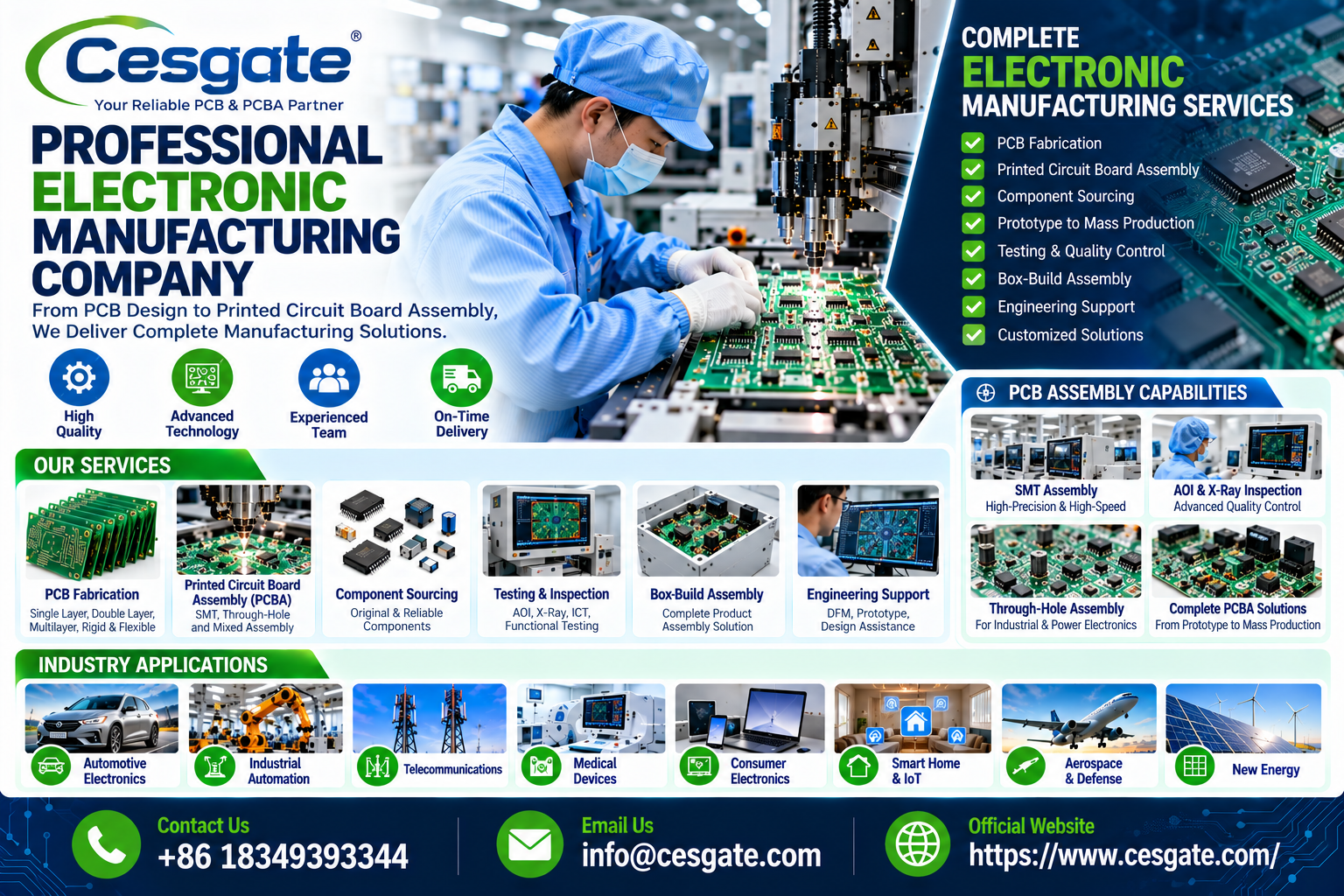
As businesses accelerate development across automotive electronics, industrial automation, telecommunications, medical devices, consumer technology, smart-home products, and connected systems, choosing the right electronic manufacturing company has become a critical production decision. At the same time, demand for dependable printed circuit board assembly continues to rise as electronic products become smaller, faster, more complex, and increasingly integrated.
Modern electronics manufacturing involves much more than attaching components to a PCB. It requires accurate sourcing, engineering coordination, controlled assembly, inspection, testing, documentation, and scalable production processes.
What Does an Electronic Manufacturing Company Do?
An electronic manufacturing company provides outsourced production services for electronic products and assemblies.
Depending on its capabilities, services may include:
- PCB fabrication
- PCB assembly
- Component sourcing
- SMT production
- Through-hole assembly
- Prototype manufacturing
- Testing and inspection
- Firmware programming
- Box-build assembly
- Final packaging
Some manufacturers also provide engineering support to help customers move from early design concepts to production-ready products.
This integrated approach can reduce the need to coordinate multiple vendors for PCB production, assembly, testing, and product integration.
Why Electronics Manufacturers Are Important to Product Development
Product design and manufacturing must work together.
An electronic device may perform perfectly during engineering development but become difficult or expensive to manufacture at scale if production requirements are not considered early.
A professional electronic manufacturing company can help identify potential issues related to:
Component Availability
Selected components may have long lead times or limited market availability.
PCB Manufacturability
Small clearances, difficult footprints, or complex stack-ups can influence cost and yield.
Assembly Process
Different components may require SMT, through-hole, selective soldering, or manual assembly.
Testing Requirements
Test methods and fixtures may need to be designed before volume production begins.
What Is Printed Circuit Board Assembly?
printed circuit board assembly is the process of installing and soldering electronic components onto a fabricated PCB.
Once populated, the board is commonly known as a PCBA.
The assembly process can include:
- Solder paste application
- Automated component placement
- Reflow soldering
- Through-hole insertion
- Wave or selective soldering
- Optical inspection
- X-ray inspection where required
- Electrical or functional testing
The exact sequence depends on product design, component package types, board complexity, and production volume.
Surface Mount Technology in PCB Assembly
Surface Mount Technology, or SMT, is widely used in modern printed circuit board assembly.
SMT components are mounted directly onto PCB pads, allowing manufacturers to produce compact, high-density assemblies.
Common SMT applications include:
- IoT devices
- Automotive modules
- Communication equipment
- Consumer electronics
- Industrial controllers
- Medical electronics
Automated pick-and-place equipment can position components rapidly and consistently, making SMT suitable for both prototype and high-volume production.
Through-Hole Assembly Still Plays an Important Role
Although SMT is widely used, through-hole components remain important for many products.
Through-hole parts have leads inserted through drilled holes before soldering.
They are commonly used for:
- Connectors
- Relays
- Transformers
- High-power components
- Mechanically stressed parts
Many products combine SMT and through-hole technologies.
A capable electronic manufacturing company should therefore be able to manage mixed-technology production efficiently.
Component Sourcing and BOM Control
Component sourcing can have a major impact on production quality and schedule.
A Bill of Materials, or BOM, typically includes:
- Component manufacturer
- Part number
- Value
- Package
- Reference designator
- Quantity
A strong manufacturing partner should review the BOM before production and communicate clearly about unavailable, obsolete, or long-lead-time components.
Substitutions should be approved carefully, particularly when electrical performance or regulatory requirements may be affected.
PCB Fabrication and Assembly Integration
One advantage of working with a manufacturer that offers both PCB fabrication and printed circuit board assembly is simplified project coordination.
Integrated manufacturing can help align:
- PCB stack-up
- Surface finish
- Component footprints
- Assembly tolerances
- Panelization
- Testing requirements
When bare-board manufacturing and assembly teams work together, production issues can often be identified earlier.
This can be particularly useful for multilayer, flexible, rigid-flex, high-density, or specialty PCB projects.
Automated Optical Inspection
Automated Optical Inspection, or AOI, is commonly used during PCB production.
AOI systems can help identify:
- Missing components
- Incorrect orientation
- Placement errors
- Visible solder defects
- Polarity problems
This makes inspection faster and more consistent for assemblies containing many components.
However, AOI is not suitable for every hidden connection.
X-Ray Inspection for Complex Components
Some component packages have solder joints underneath the body of the device.
Examples may include BGAs and other bottom-terminated packages.
X-ray inspection can help detect potential issues such as:
- Hidden solder bridges
- Voids
- Misalignment
- Incomplete connections
A qualified electronic manufacturing company should select inspection methods based on actual board complexity rather than relying on one technique for every project.
Functional Testing Confirms Product Performance
A visually correct assembly is not automatically a functional assembly.
Functional testing verifies that the electronic product operates as expected.
Testing may involve:
- Power-up verification
- Voltage measurement
- Communication testing
- Sensor response checks
- Interface testing
- Firmware validation
Customers should ideally define pass/fail criteria before production begins.
Clear test requirements help manufacturing teams build appropriate fixtures and procedures.
Prototype Manufacturing Before Volume Production
Prototype production allows engineers to validate both design and manufacturability.
A small pilot quantity can be used to review:
- Electrical functionality
- Component placement
- Mechanical fit
- Thermal performance
- Firmware operation
- Manufacturing yield
This stage is valuable because problems discovered during prototyping are generally easier to resolve than issues found after large-scale manufacturing begins.
Printed Circuit Board Assembly for Automotive Electronics
Automotive systems use electronics in a growing number of areas, including:
- Lighting
- Infotainment
- Control modules
- Sensors
- Battery management
- Charging systems
These products may operate under vibration, temperature variation, and long service cycles.
Manufacturing requirements may therefore include greater emphasis on process control, traceability, reliability, and material selection.
Industrial Electronics Manufacturing
Industrial automation also depends heavily on reliable electronic assemblies.
Applications may include:
- PLC systems
- Robotics
- Motor controllers
- Sensors
- Power electronics
- Measurement equipment
Industrial devices are often expected to operate continuously in demanding environments.
A professional printed circuit board assembly process should therefore consider the conditions in which the final product will be used.
Medical and Communication Electronics
Electronics manufacturers may also support products used in:
- Diagnostic equipment
- Monitoring systems
- Laboratory devices
- Routers
- Wireless gateways
- Smart sensors
Medical projects may require stronger documentation and traceability, while communication products may require careful handling of high-speed signals, wireless modules, and dense PCB layouts.
Manufacturing processes should always align with the technical requirements of the specific application.
Box-Build and Final Product Assembly
Some customers need more than a completed PCB.
Box-build services can integrate the PCBA with:
- Enclosures
- Displays
- Wiring
- Connectors
- Switches
- Mechanical components
- Labels
This can help businesses receive a more complete product rather than coordinating several assembly stages separately.
For companies seeking end-to-end production support, this capability can simplify logistics and supplier management.
Choosing the Right Electronic Manufacturing Company
Selecting the right supplier requires more than comparing price.
Businesses should review:
- SMT capability
- Through-hole assembly
- PCB fabrication
- Component sourcing
- Testing methods
- Inspection equipment
- Engineering support
- Production capacity
- Lead time
- Communication
- Quality-control procedures
A low initial quote may not provide real savings if poor quality results in rework, shipment delays, or field failures.
Frequently Asked Questions
What is an electronic manufacturing company?
An electronic manufacturing company provides outsourced manufacturing services such as PCB fabrication, assembly, sourcing, testing, box-build production, and engineering support.
What is printed circuit board assembly?
printed circuit board assembly is the process of mounting and soldering electronic components onto a bare PCB.
What is the difference between PCB and PCBA?
A PCB is the bare printed circuit board. A PCBA is the board after electronic components have been installed.
What is SMT?
SMT is a manufacturing process in which surface-mount components are placed directly onto PCB pads.
What is through-hole assembly?
Through-hole assembly uses components whose leads pass through holes in the PCB before soldering.
Can electronics manufacturers produce prototypes?
Yes. Many manufacturers support prototype, pilot, low-volume, and mass-production quantities.
Why is AOI used?
AOI helps identify visible component-placement and soldering defects.
When is X-ray inspection required?
X-ray inspection is useful for components with hidden solder joints, such as BGAs.
What is box-build assembly?
Box-build assembly integrates PCB assemblies with enclosures, wiring, displays, connectors, and other mechanical parts.
What files are needed for PCB assembly?
Typical requirements include Gerber files, BOM, pick-and-place data, assembly drawings, and testing instructions.
Media Contact
Electronics Manufacturing & PCB Assembly Enquiries
Contact: +86 18349393344
Email: info@cesgate.com
Official Website: https://www.cesgate.com/
