
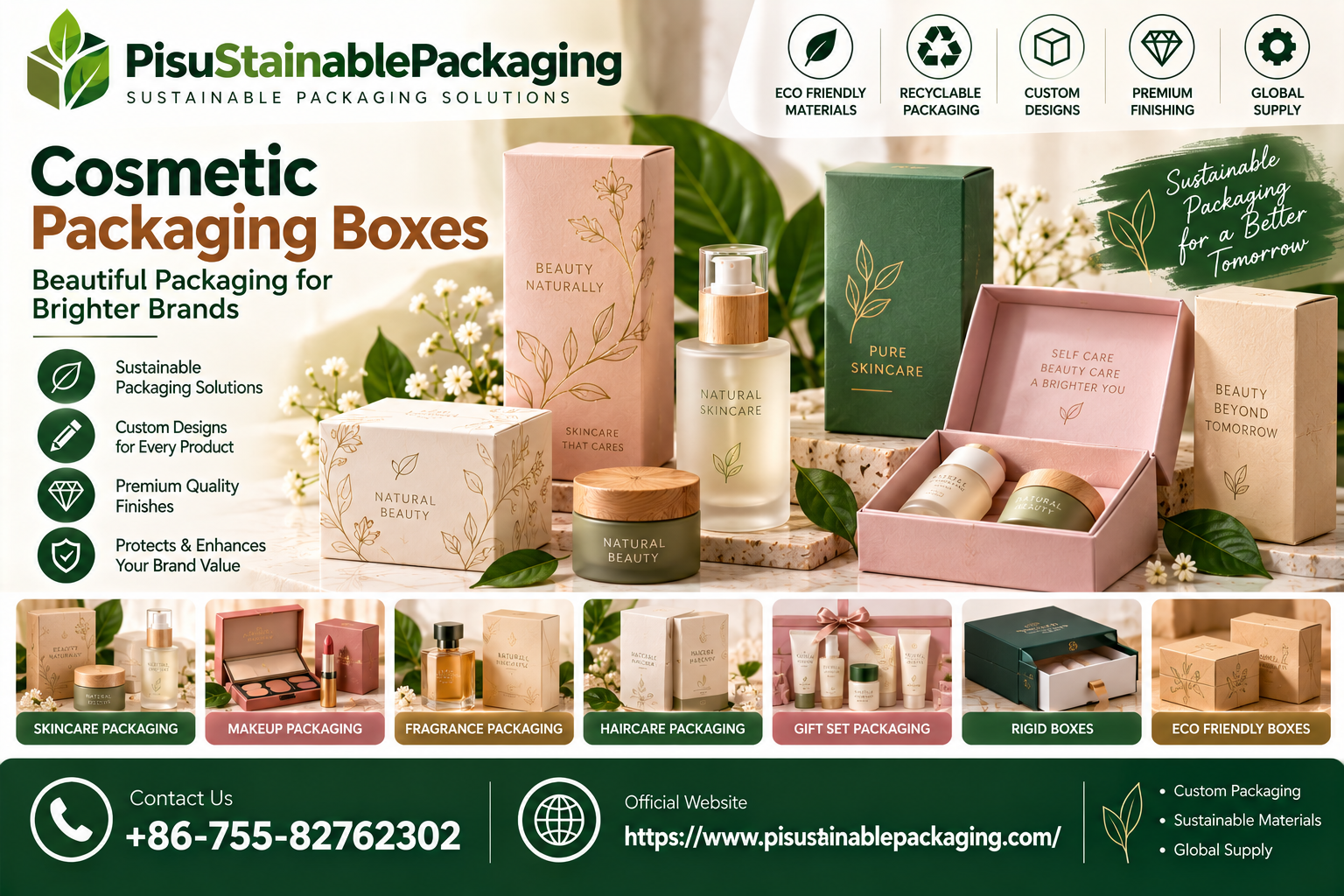
Packaging is playing an increasingly important role in the beauty and personal care sector as brands seek solutions that combine product protection, distinctive presentation, and responsible material selection.
From skincare creams and facial serums to makeup collections and premium gift sets, cosmetic packaging boxes help businesses present products professionally while supporting safe storage, handling, and transportation.
At the same time, modern cosmetic packaging extends beyond attractive designs. Material quality, structural performance, customization, labeling, and environmental considerations all influence packaging decisions.
For skincare manufacturers, beauty retailers, and private-label businesses, understanding these factors can help develop packaging that supports product quality and customer expectations.
What Are Cosmetic Packaging Boxes?
Cosmetic packaging boxes are protective and decorative containers designed to hold, display, and transport cosmetic and personal care products.
They are commonly manufactured from paperboard, rigid cardboard, corrugated board, or other suitable materials.
Different box structures accommodate various product categories, including:
- Skincare creams and moisturizers.
- Facial serums and essential oil bottles.
- Makeup palettes and foundations.
- Lipsticks and lip care products.
- Perfumes and fragrances.
- Beauty gift sets.
- Haircare and personal care collections.
Their purpose is to combine suitable product protection with attractive retail presentation.
Why Cosmetic Packaging Matters for Beauty Brands
A carefully designed packaging system influences how products are presented, stored, and handled.
Product Protection
Suitable boxes help protect containers against selected impacts, scratches, and movement during transportation.
Brand Recognition
Consistent colors, typography, logos, and design elements can make products easier to recognize.
Customer Experience
Thoughtful box structures and opening mechanisms can improve the unboxing experience.
Product Information
Packaging provides space for ingredient information, directions, warnings, and other legally required labeling.
Retail Presentation
Attractive packaging can help products stand out in stores and online product photography.
These benefits depend on the complete packaging design and its suitability for the intended product.
Popular Types of Cosmetic Packaging Boxes
Different box formats serve different commercial purposes.
Folding Carton Boxes
Lightweight folding cartons are commonly used for skincare products, makeup, and retail cosmetics.
Rigid Cosmetic Boxes
Rigid boxes provide structured presentation and are often considered for premium cosmetics and gift collections.
Drawer-Style Boxes
Sliding drawer structures create a distinctive opening experience for selected products.
Window Packaging Boxes
Boxes with transparent windows allow customers to view part of the packaged product.
Cosmetic Gift Set Boxes
Multi-compartment boxes organize several items within a coordinated presentation.
E-commerce Shipping Boxes
Corrugated packaging supports the transportation of cosmetic products through distribution networks.
The appropriate design depends on product dimensions, protection requirements, and commercial objectives.
Materials Used in Modern Cosmetic Packaging
Material selection affects appearance, strength, cost, and end-of-life management.
| Material | Main Characteristics | Common Applications |
| Paperboard | Lightweight and printable | Retail folding cartons |
| Rigid cardboard | Strong structured presentation | Premium gift boxes |
| Corrugated board | Cushioning and stacking support | Shipping boxes |
| Recycled paperboard | Can incorporate recovered fibers | Suitable retail packaging |
| Molded fiber | Shaped protective inserts | Selected product arrangements |
Businesses should verify material specifications instead of assuming that every paper-based package offers identical protection.
Customization Options for Beauty Packaging
Customized cosmetic packaging boxes allow businesses to develop recognizable visual identities.
Popular customization techniques include:
- Offset Printing: Produces detailed graphics and brand colors.
- Digital Printing: Supports suitable shorter production runs and design variations.
- Embossing: Creates raised logos or decorative elements.
- Debossing: Produces recessed patterns and branding.
- Foil Stamping: Adds selected decorative finishes.
- Matte and Gloss Finishes: Creates different surface appearances.
- Custom Inserts: Helps secure individual products.
- Die-Cut Windows: Provides product visibility when appropriate.
Excessive decorative materials may increase costs and complicate recycling, making careful design choices important.
Primary vs Secondary Cosmetic Packaging
Understanding packaging layers helps brands select the correct materials.
Primary packaging directly contains the formulation, such as a cream jar, serum bottle, or cosmetic tube.
Secondary packaging surrounds that container, commonly using printed cartons or protective boxes.
Tertiary packaging supports bulk handling, warehousing, and transportation.
A secondary box does not replace the need to test primary packaging for formulation compatibility, leakage resistance, and product stability.
Sustainable Packaging Considerations
Brands exploring environmentally responsible cosmetic packaging may consider recycled paperboard, reduced material consumption, reusable boxes, and simpler structures.
However, environmental performance depends on more than material selection.
Relevant considerations include manufacturing impacts, transportation weight, protective performance, and disposal infrastructure.
Plastic windows, laminated finishes, adhesives, and mixed-material inserts can affect recyclability.
Claims such as recyclable, compostable, or eco-friendly should be supported by suitable evidence and relevant local conditions.
How to Choose the Right Cosmetic Packaging Supplier
Businesses purchasing packaging should follow a structured evaluation process.
- Define Product Dimensions: Confirm accurate container measurements.
- Select Materials: Match board strength and structure to the product.
- Review Printing Requirements: Specify colors, graphics, and finishes.
- Request Samples: Evaluate physical appearance and product fit.
- Check Structural Strength: Test protection under expected conditions.
- Confirm Labeling Space: Allow room for required consumer information.
- Discuss Order Quantities: Review minimum orders and production requirements.
- Verify Commercial Terms: Confirm delivery schedules and acceptance criteria.
Approved samples and written specifications can help prevent unexpected production variations.
Quality Control in Cosmetic Box Manufacturing
Quality inspection is essential for maintaining consistent packaging.
Manufacturers may evaluate print registration, color consistency, board thickness, folding accuracy, adhesive strength, and dimensional tolerances.
For products sold online, transportation testing can help identify packaging weaknesses.
Suitable inspection procedures support packaging reliability across repeated production orders.
Frequently Asked Questions (FAQs)
1. What are cosmetic packaging boxes?
They are protective and decorative boxes used for storing, presenting, and transporting cosmetic products.
2. What is cosmetic packaging?
It includes containers, closures, cartons, and protective materials used to package beauty and personal care products.
3. Which materials are used for cosmetic boxes?
Common materials include paperboard, rigid cardboard, corrugated board, and suitable recycled-content materials.
4. Can cosmetic packaging boxes be customized?
Yes. Options may include dimensions, colors, printing, logos, finishes, and protective inserts.
5. Are paper cosmetic boxes recyclable?
Some are recyclable, depending on coatings, mixed materials, and available local recycling facilities.
6. What is the difference between primary and secondary packaging?
Primary packaging directly contains the product, while secondary packaging surrounds or protects the primary container.
7. Are rigid boxes suitable for luxury cosmetics?
Yes. Suitable rigid boxes can provide structured presentation for premium cosmetic products.
8. What is sustainable cosmetic packaging?
It involves packaging choices that consider material use, product protection, production impacts, and end-of-life management.
9. What affects cosmetic packaging box prices?
Material quality, dimensions, printing, finishing, customization, quantity, and transportation influence pricing.
10. How can brands choose a reliable packaging supplier?
Compare physical samples, material specifications, manufacturing quality, customization options, and delivery arrangements.
Media Contact
Industry: Cosmetic Packaging, Beauty Packaging & Sustainable Retail Packaging
Service Enquiries: Cosmetic Packaging Boxes, Custom Cosmetic Packaging, Rigid Boxes, Folding Cartons, Beauty Gift Boxes & Sustainable Packaging Solutions
Contact Number: +86-755-82762302
Email: marketing@pisustainablepackaging.com
Official Website: https://www.pisustainablepackaging.com/