
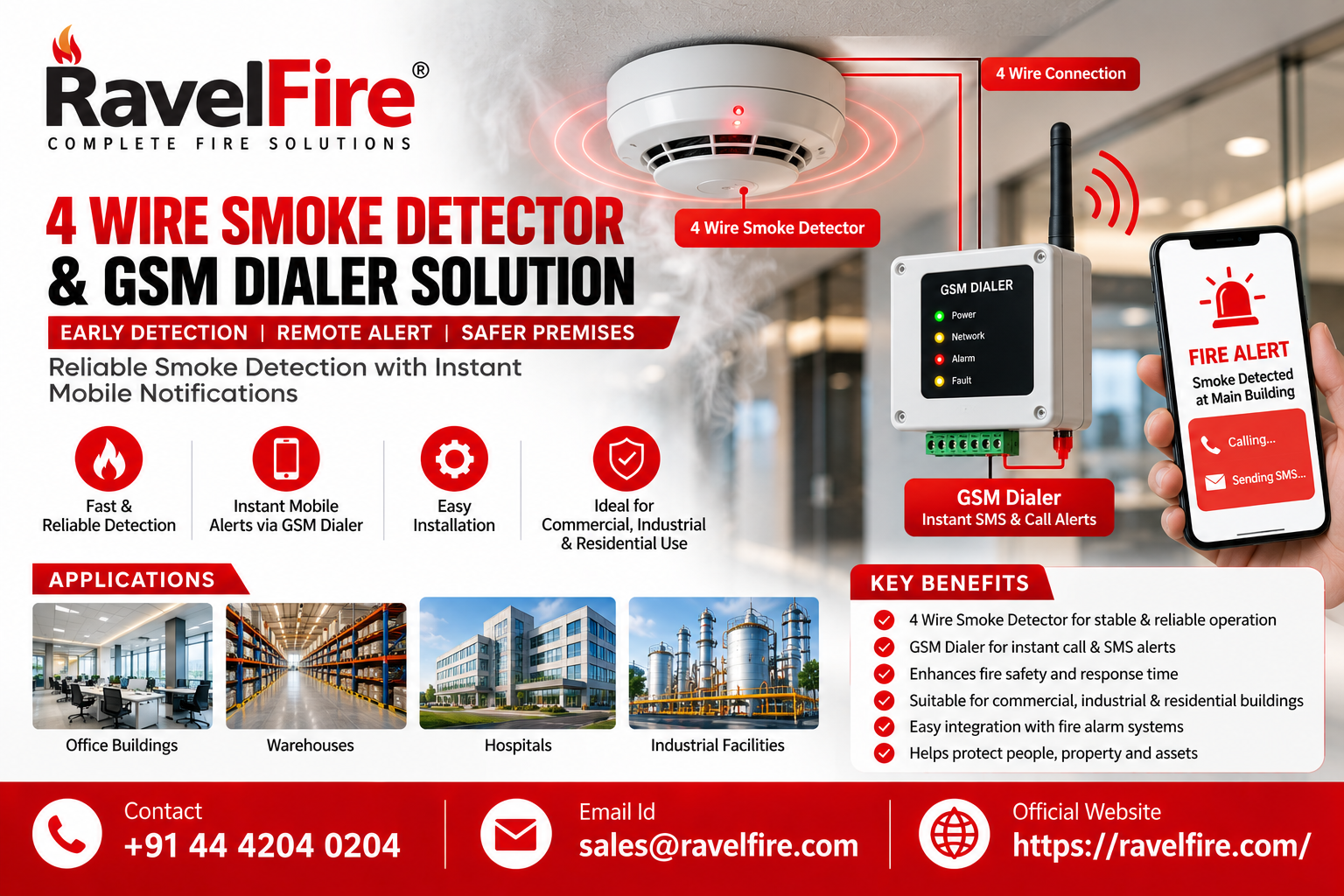
Growing awareness of fire hazards across residential, commercial, and industrial properties is encouraging businesses to evaluate reliable detection and emergency communication technologies. As buildings become increasingly connected, fire safety professionals are focusing on equipment that supports early warning, dependable alarm transmission, and efficient system monitoring.
A 4 wire smoke detector provides automatic smoke detection using separate power and alarm circuit connections.
Meanwhile, a gsm dialer can transmit notifications through a compatible cellular network when activated by supported alarm equipment.
Together, these technologies can support broader fire protection strategies when correctly selected, professionally installed, and integrated with approved safety systems.
What Is a 4 Wire Smoke Detector?
A 4 wire smoke detector is a fire detection device that typically uses two wires for electrical power and two wires for alarm signaling.
Unlike certain two-wire detectors that share power and signaling over the same circuit, four-wire designs use separate connections for these functions.
This arrangement can offer installation flexibility for compatible fire alarm and security systems.
Common applications include:
- Commercial office buildings.
- Industrial facilities.
- Warehouses and storage areas.
- Educational institutions.
- Hotels and hospitality properties.
- Residential security installations.
- Small commercial premises.
The detector must be approved and compatible with its intended control equipment.
How Does a 4 Wire Smoke Detector Work?
A four-wire smoke detector receives power through a dedicated electrical pair.
The remaining pair typically connects to alarm contacts or an appropriate signaling circuit.
When smoke reaches the detector’s sensing chamber and meets its alarm criteria, the device changes its alarm output state.
The connected control panel can then recognize the condition and initiate configured responses.
Depending on the detector, additional requirements may include power supervision, end-of-line components, and a suitable reset mechanism.
These arrangements vary by product and system design.
Installers must follow the manufacturer’s instructions because incorrect wiring can compromise alarm or fault monitoring.
What Is a GSM Dialer?
A gsm dialer is a communication device that uses a supported cellular network to transmit notifications when triggered by compatible alarm equipment.
Depending on its capabilities, the device may send text messages, initiate voice calls, or communicate with a designated monitoring service.
Such devices can be considered for security installations, equipment monitoring, and selected alarm notification applications.
However, not every GSM dialer is certified or suitable for fire alarm signaling.
Where emergency communication is required by regulation, the selected equipment and transmission arrangement must satisfy the applicable standards.
How Can Smoke Detectors and GSM Dialers Work Together?
A compatible smoke detector communicates its alarm condition to a control panel.
The panel may then activate an approved communication interface connected to a suitable cellular notification device.
This can help transmit information to authorized personnel when an alarm occurs.
For example, a commercial facility may use a properly designed arrangement to notify designated staff members.
However, cellular notification should not be treated as a replacement for required local alarms, supervised fire alarm transmission, or emergency response procedures.
4 Wire Smoke Detector vs GSM Dialer
Although both can contribute to an alarm installation, their functions differ significantly.
| Feature | 4 Wire Smoke Detector | GSM Dialer |
| Primary purpose | Detect smoke | Communicate triggered notifications |
| Operating method | Smoke sensing technology | Cellular communication |
| Main connection | Power and alarm circuits | Alarm interface and cellular network |
| Typical application | Fire detection | Remote alarm notification |
| Detects smoke directly | Yes | No |
| Key requirement | Detector and panel compatibility | Network and interface compatibility |
A GSM dialer does not independently detect fire unless incorporated into equipment with separate detection capabilities.
Why Four-Wire Smoke Detection Remains Relevant
Four-wire detectors can offer a practical option for compatible installations requiring separate power and signaling circuits.
They may be considered when integrating smoke detection into certain control panels or existing infrastructure.
However, equipment compatibility is essential.
Some control systems require specific detector types, circuit supervision arrangements, or approved reset procedures.
Designers should also consider standby power and the ability to identify wiring faults.
A properly selected detector contributes to early warning, but cannot guarantee detection of every possible fire condition.
Benefits and Limitations of GSM Alarm Communication
Cellular notification equipment can provide communication flexibility where wired communication services are unavailable or unsuitable.
Potential benefits include remote notifications, connectivity for selected installations, and communication with designated contacts.
However, reliability depends on several factors:
- Cellular signal coverage.
- Compatible network technology.
- Active SIM and service arrangements.
- Adequate backup power.
- Appropriate alarm interface design.
- Communication testing and maintenance.
Older GSM equipment may depend on 2G networks, which are not available indefinitely in every country.
Businesses should verify current operator support and consider suitable newer cellular communication technologies where necessary.
Important Features to Consider Before Purchasing
Selecting appropriate fire detection and communication equipment requires careful technical evaluation.
Detector Compatibility: Verify approval for the intended control panel.
Power Requirements: Confirm voltage, current, and standby power arrangements.
Alarm Output: Review relay contacts and signaling specifications.
Circuit Supervision: Ensure appropriate monitoring of power and alarm connections.
Communication Support: Check available cellular networks and notification methods.
Product Approvals: Verify certifications applicable to the installation.
Maintenance Requirements: Review inspection, testing, and replacement procedures.
These considerations help minimize installation problems and unsupported performance expectations.
Applications in Commercial and Industrial Buildings
A 4 wire smoke detector may be suitable for designated office rooms, equipment areas, commercial premises, and other approved environments.
A compatible gsm dialer may support supplementary communication with maintenance personnel or monitoring teams.
Industrial facilities may also use cellular communication for appropriate noncritical equipment notifications.
For life-safety applications, however, notification and monitoring arrangements must follow the building’s approved fire alarm design.
Professional assessment is necessary to ensure that all components operate together correctly.
Installation and Maintenance Best Practices
Fire detection equipment should be installed by qualified personnel according to applicable codes and manufacturer instructions.
Commissioning must verify detector operation, alarm signaling, circuit supervision, and any authorized communication functions.
Periodic maintenance should include inspections, functional testing, power supply checks, and verification of communication paths.
Changes to telephone services or cellular networks may require reviewing existing dialer equipment.
Building owners should maintain emergency response procedures and ensure occupants understand required actions when an alarm activates.
Frequently Asked Questions (FAQs)
1. What is a 4 wire smoke detector?
It is a smoke detector typically using separate wire pairs for power and alarm signaling.
2. What is a GSM dialer?
It is a device that uses cellular communication to transmit notifications triggered by compatible equipment.
3. How does a four-wire smoke detector detect fire?
It identifies smoke conditions using its sensing technology and sends an alarm signal when specified criteria are met.
4. Can a GSM dialer connect to a fire alarm panel?
Certain models can connect through compatible interfaces, subject to approval and system design requirements.
5. Does a GSM dialer detect smoke?
No. It communicates notifications and requires a separate source of alarm information.
6. What is the difference between two-wire and four-wire smoke detectors?
Two-wire designs commonly share power and signaling, while four-wire designs use separate connections.
7. Does a GSM dialer require a SIM card?
Many models require a compatible SIM card and an active cellular service.
8. Can a four-wire smoke detector work without a control panel?
That depends on its design, but many are intended for connection to compatible control equipment.
9. Do smoke detectors and GSM dialers require maintenance?
Yes. Both require appropriate testing, inspections, and checks of their power and communication arrangements.
10. How can businesses choose reliable fire alarm equipment?
They should evaluate product approvals, technical compatibility, installation requirements, maintenance support, and applicable safety standards.
Media Contact
Industry: Fire Safety, Smoke Detection, Alarm Communication & Building Protection
Service Enquiries: 4 Wire Smoke Detector, GSM Dialer, Fire Alarm Control Panels, Smoke Detection Equipment & Fire Alarm Accessories
Contact Number: +91 44 4204 0204
Email: sales@ravelfire.com
Official Website: https://ravelfire.com/