
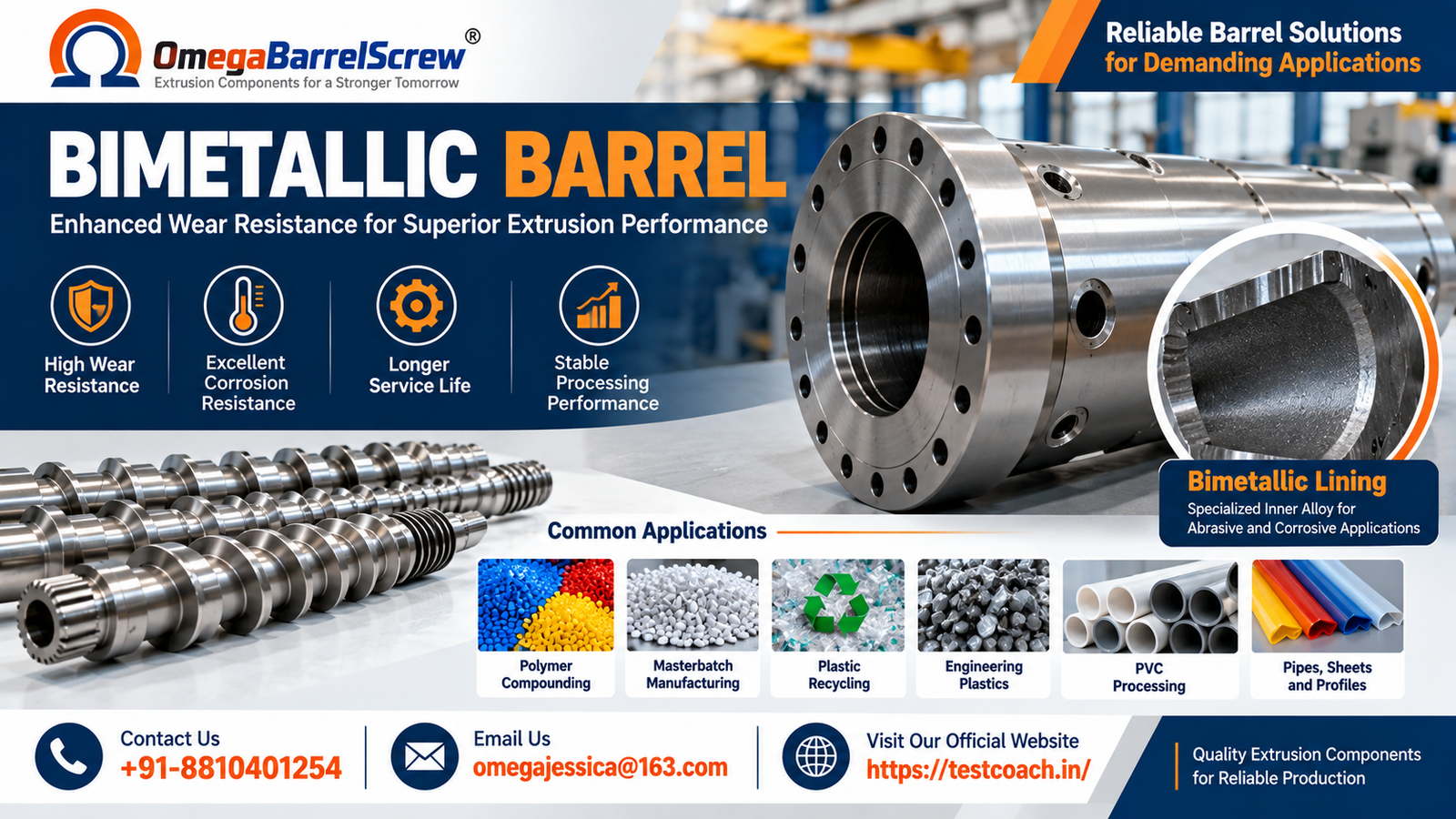
As polymer manufacturers, plastic recycling companies, and industrial equipment operators focus on production efficiency, equipment durability, and material consistency, advanced extrusion components continue to play a significant role in modern manufacturing.
A bimetallic barrel provides enhanced wear resistance through specialized material construction, while a screw element performs essential conveying, mixing, and kneading functions within compatible extrusion systems.
Both components influence processing performance, equipment reliability, and production quality. Understanding their construction, applications, and maintenance requirements helps manufacturers make informed equipment decisions.
What Is a Bimetallic Barrel?
A bimetallic barrel is an extrusion machinery component constructed using a structural metal body and a specialized internal wear-resistant alloy layer.
The inner lining is designed to withstand demanding processing conditions, including abrasive fillers, elevated temperatures, and certain chemically aggressive materials.
Unlike conventional barrels made from a single principal material, bimetallic constructions combine different material properties to improve performance in suitable applications.
Key Features of Bimetallic Barrels
- Wear Resistance: Specialized internal alloys help reduce abrasive damage.
- Structural Strength: The outer body supports mechanical loads.
- Corrosion Resistance: Selected lining materials withstand particular processing environments.
- Dimensional Stability: Proper manufacturing helps maintain operating clearances.
- Processing Compatibility: Suitable for selected polymer formulations.
- Extended Service Potential: Wear-resistant construction can reduce replacement frequency under appropriate conditions.
Understanding Screw Element Technology
A screw element is an individual modular component installed on a compatible screw shaft in an extrusion machine.
These elements are particularly common in modular twin-screw extruders, where different configurations control material conveying, melting, mixing, and pressure development.
Their geometry influences processing efficiency and the quality of the final material.
Common Types of Screw Elements
Conveying Elements: Transport raw materials through the extrusion barrel.
Kneading Elements: Support melting, shear generation, and material mixing.
Mixing Elements: Help distribute additives and improve formulation uniformity.
Reverse Elements: Create flow resistance for specific processing functions.
Specialized Elements: Provide customized processing characteristics for selected applications.
The arrangement of elements must be engineered according to material properties and equipment specifications.
How Bimetallic Barrels Improve Extrusion Performance
Extrusion machinery frequently processes polymers containing fillers, pigments, reinforcements, and chemical additives.
Some of these ingredients can create substantial wear inside the barrel.
A properly selected bimetallic barrel provides a wear-resistant internal surface that helps protect the component during processing.
Important Performance Benefits
Reduced Abrasion: Suitable linings resist damage caused by abrasive materials.
Consistent Processing: Maintaining appropriate internal dimensions supports stable material movement.
Maintenance Efficiency: Reduced wear may decrease the frequency of certain component replacements.
Material Versatility: Different lining alloys can be selected for specific applications.
Equipment Reliability: Durable construction supports dependable operation when combined with proper maintenance.
However, performance depends on the selected alloy, formulation, operating conditions, and equipment design.
Bimetallic Barrel vs. Screw Element: Key Differences
| Feature | Bimetallic Barrel | Screw Element |
| Primary function | Contains and supports material processing | Controls conveying and mixing |
| Construction | Structural body with specialized internal lining | Machined modular component |
| Main location | Extruder barrel assembly | Rotating screw shaft |
| Key benefit | Wear and corrosion resistance | Processing flexibility |
| Common application | Demanding extrusion environments | Modular twin-screw extrusion |
| Selection factor | Lining material and dimensions | Geometry and shaft compatibility |
These components perform different functions but must work together within a properly designed extrusion system.
Materials Used in Extrusion Components
Material engineering is essential for maintaining machinery performance.
Wear-Resistant Alloys
Specialized nickel-based, iron-based, or other suitable alloys may be used in barrel linings, depending on the application.
Alloy Steel
Selected alloy steels provide mechanical strength for screw elements and other processing components.
Nitrided Steel
Nitriding treatments can improve the surface hardness of suitable steel components.
Corrosion-Resistant Materials
Specialized materials may be necessary when processing formulations containing chemically aggressive ingredients.
Industrial Applications of Bimetallic Barrels and Screw Elements
These components support several industrial processes.
Plastic Compounding
Extrusion equipment combines polymers with fillers, pigments, and performance additives.
Masterbatch Manufacturing
Specialized screw configurations help distribute pigments and additives throughout polymer materials.
Plastic Recycling
Suitable extrusion systems process recovered polymer materials that may contain abrasive impurities.
Engineering Plastics
Certain reinforced polymers require wear-resistant processing components.
Specialty Polymer Manufacturing
Advanced screw configurations support formulations requiring carefully controlled mixing.
Each application requires technical evaluation before selecting machine components.
Manufacturing and Quality Control
Professional extrusion component manufacturing demands accurate dimensions and consistent material properties.
Bimetallic barrels may be produced using processes such as centrifugal casting of a specialized internal alloy lining, depending on the design.
Screw elements require precise machining to maintain proper compatibility with shafts and adjoining components.
Important Quality Checks
- Dimensional Inspection: Verifies critical component measurements.
- Material Verification: Confirms specified alloy characteristics.
- Hardness Testing: Evaluates relevant material properties.
- Surface Inspection: Identifies manufacturing defects.
- Fit Verification: Checks compatibility with the extrusion machine.
- Lining Assessment: Evaluates relevant barrel-lining characteristics.
Quality-control procedures should reflect product specifications and intended operating conditions.
How to Select the Right Extrusion Components
Manufacturers should examine processing requirements before purchasing replacement components.
For a bimetallic barrel, important factors include barrel dimensions, lining composition, processing temperature, and expected abrasive exposure.
When selecting a screw element, buyers should evaluate shaft dimensions, element geometry, material properties, and processing objectives.
Essential Purchasing Considerations
- Extruder model and technical specifications
- Polymer formulation and additive content
- Operating temperature and pressure
- Required screw configuration
- Wear and corrosion conditions
- Manufacturing tolerances
- Quality documentation
- Replacement compatibility
Accurate technical information helps minimize component-selection errors.
Maintenance and Equipment Reliability
Extrusion machinery requires regular inspection because its components operate under continuous thermal and mechanical stress.
Barrels should be checked for internal wear and dimensional changes.
Screw elements require evaluation for surface damage, excessive wear, and mechanical compatibility.
Operators should monitor processing pressure, temperature, vibration, and changes in material quality.
All maintenance must follow appropriate shutdown, cooling, and equipment-isolation procedures.
Frequently Asked Questions (FAQs)
1. What is a bimetallic barrel?
It is an extrusion barrel featuring a structural metal body and a specialized internal alloy lining.
2. What is a screw element?
A screw element is a modular extrusion component used for material conveying, mixing, or kneading.
3. Why are bimetallic barrels used?
They are used to improve wear resistance in suitable demanding extrusion applications.
4. Where are screw elements commonly installed?
They are installed on compatible screw shafts, particularly in modular twin-screw extruders.
5. Are bimetallic barrels suitable for abrasive polymers?
Suitable designs can process abrasive formulations, depending on the lining material and operating conditions.
6. Can screw elements be customized?
Yes. Different element geometries can be designed for specific processing requirements.
7. What materials are used in bimetallic barrels?
They may incorporate steel structural bodies and specialized wear-resistant alloy linings.
8. What causes extrusion barrel wear?
Abrasive fillers, mechanical contact, corrosive ingredients, and operating conditions can contribute to wear.
9. Can worn screw elements be replaced?
Yes, using replacement components compatible with the machine’s specifications.
10. How should manufacturers choose an extrusion component supplier?
Evaluate material quality, manufacturing accuracy, inspection procedures, engineering capabilities, and technical support.
Media Contact
Department: Extrusion Components and Industrial Machinery Communications
Email: omegajessica@163.com; 965425705@qq.com
Contact: +86-15021464410
Official Website: https://www.omegabarrelscrew.com/