
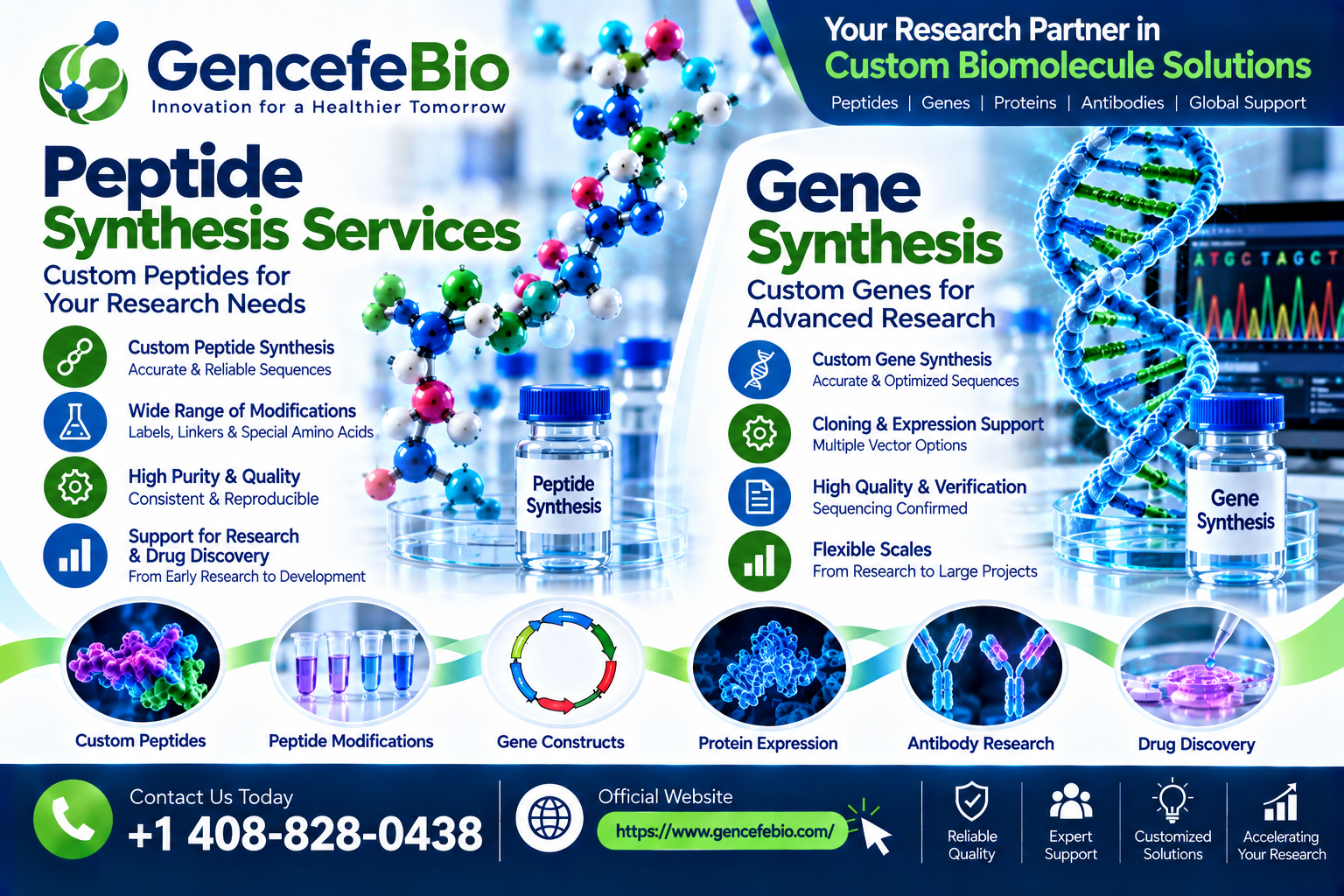
Scientists investigating protein function, molecular recognition, and engineered biological systems require specialised materials that support carefully designed experiments.
Peptide synthesis services enable researchers to obtain customised amino acid sequences for targeted molecular studies. Meanwhile, gene synthesis provides artificially manufactured DNA sequences that can support genetic engineering, recombinant protein research, and selected synthetic biology applications.
Although these technologies produce fundamentally different molecules, both help researchers investigate biological processes through precisely defined molecular designs.
For biotechnology companies, academic laboratories, and pharmaceutical research organisations, understanding their complementary applications can improve scientific planning and support more informed research decisions.
A Growing Focus on Sequence-Driven Biotechnology Research
Modern molecular research often begins with a sequence-based question.
Scientists may want to understand how a particular amino acid region interacts with another molecule or investigate the biological function associated with a defined genetic sequence.
Different experiments require different molecular materials.
Synthetic peptides allow researchers to study selected amino acid sequences directly, while synthetic genes provide DNA templates for suitable expression-based investigations.
This principle encourages laboratories to evaluate molecular design alongside experimental objectives.
What Are Peptide Synthesis Services?
Peptide synthesis services involve manufacturing customised peptides according to specified amino acid sequences and research requirements.
Peptides consist of amino acids connected through peptide bonds. Their properties depend on sequence composition, length, structural characteristics, and chemical modifications.
Custom synthesis provides access to defined molecules for specialised scientific investigations.
Common Research Applications
- Protein Interaction Studies: Investigating selected amino acid regions involved in molecular recognition.
- Epitope Research: Examining candidate antibody-binding sequences.
- Biochemical Assays: Preparing suitable peptides for analytical research.
- Structure-Activity Studies: Evaluating how selected sequence variations influence molecular properties.
- Reference Materials: Providing characterised peptides for laboratory comparisons.
The appropriate peptide specification depends on the intended application and experimental requirements.
Understanding Gene Synthesis
Gene synthesis is a biotechnology process used to manufacture DNA sequences according to a defined nucleotide design.
Unlike methods that depend entirely on isolating existing genetic material, synthetic DNA production allows researchers to obtain sequences developed for particular scientific purposes.
These sequences may support recombinant protein expression, genetic construct development, and selected synthetic biology research.
The process can provide flexibility when researchers require customised DNA constructs or specific sequence variations.
However, manufacturing an accurate DNA sequence does not automatically guarantee successful protein expression or biological activity.
Additional experimental evaluation may be necessary.
From Genetic Design to Protein Function
One important distinction between these technologies involves the relationship between DNA and proteins.
A synthetic gene contains nucleotide information that may be used to produce a corresponding protein through an appropriate expression system.
A chemically synthesised peptide, by contrast, provides an amino acid sequence directly without requiring biological expression.
This creates different research opportunities.
For example, researchers investigating a complete protein may require a suitable genetic construct, while those examining a short interaction region may prefer a synthetic peptide.
Both approaches can contribute to a broader understanding of molecular function.
Peptide Synthesis Services vs Gene Synthesis
| Research Factor | Peptide Synthesis Services | Gene Synthesis |
| Main Product | Custom amino acid sequences | Synthetic DNA sequences |
| Manufacturing Approach | Chemical peptide synthesis | DNA synthesis and assembly |
| Primary Research Focus | Peptide properties and interactions | Genetic design and expression research |
| Common Applications | Epitope and biochemical studies | Recombinant protein and molecular biology research |
| Key Quality Requirements | Identity, purity, and modifications | Sequence accuracy and DNA integrity |
The most suitable approach depends on whether the research objective requires a peptide molecule, a DNA construct, or both.
Why Molecular Design Decisions Matter
Research projects may involve multiple sequence variants designed to investigate specific biological characteristics.
Small changes in amino acid composition can influence peptide solubility, stability, and molecular interactions.
Similarly, changes in a synthetic gene may influence expression-related characteristics in an appropriate biological system.
However, predicted behaviour does not always match experimental results.
Researchers should therefore establish appropriate controls and evaluate material performance before drawing broader conclusions.
Quality Assurance in Custom Molecular Manufacturing
Quality evaluation plays an important role in both services.
For peptides, relevant analytical methods may include high-performance liquid chromatography and mass spectrometry.
These techniques can support the assessment of peptide purity and molecular identity.
For synthetic DNA, appropriate sequence verification and product characterisation help establish whether the material meets agreed specifications.
Quality expectations should be established before manufacturing begins.
A product that meets its chemical specifications may still require additional validation for the intended biological application.
Applications in Protein Engineering Research
Protein engineering involves studying or modifying proteins to investigate their structure, function, or molecular interactions.
Synthetic genes may support research involving designed protein variants expressed through suitable biological systems.
Synthetic peptides can complement these investigations by allowing scientists to examine selected sequence regions independently.
For example, a laboratory may compare peptides representing different protein regions to investigate candidate interaction sites.
The findings can inform additional studies using appropriately characterised protein materials.
However, results obtained from isolated peptides do not necessarily reproduce the behaviour of complete folded proteins.
Choosing the Right Custom Research Service
Research organisations should evaluate technical requirements before commissioning customised biological materials.
Important considerations include:
- Research Objective: Identify the biological question being investigated.
- Sequence Specifications: Confirm the required nucleotide or amino acid information.
- Product Format: Determine the appropriate DNA construct or peptide configuration.
- Quality Requirements: Establish relevant analytical acceptance criteria.
- Customisation Needs: Identify suitable modifications or sequence variations.
- Experimental Compatibility: Verify that the material suits the intended research method.
Clear project documentation can help reduce misunderstandings and support appropriate technical planning.
Building Effective Biotechnology Research Partnerships
Specialised molecular projects benefit from communication between researchers and manufacturing service providers.
Technical discussions should address sequence feasibility, product specifications, available analytical methods, and potential manufacturing limitations.
Certain peptides may present synthesis or solubility challenges, while particular gene constructs may require additional design considerations.
Researchers should also clarify confidentiality expectations when working with proprietary molecular sequences.
A productive partnership is based on transparent technical communication rather than assumptions about guaranteed experimental outcomes.
Frequently Asked Questions (FAQs)
1. What are peptide synthesis services used for?
They produce customised amino acid sequences for protein interaction studies, epitope research, biochemical assays, and other suitable molecular investigations.
2. What is gene synthesis in biotechnology?
Gene synthesis is the production of designed DNA sequences used in molecular biology, genetic engineering research, and suitable recombinant expression applications.
3. How are peptide synthesis and gene synthesis different?
Peptide synthesis produces amino acid chains directly, while gene synthesis produces DNA sequences that may serve as genetic templates for further research.
4. Can synthetic genes and peptides support the same research project?
Yes. They can support complementary investigations involving protein expression, sequence characteristics, and molecular interactions.
5. What should researchers verify before ordering custom molecular materials?
Important factors include sequence accuracy, product specifications, purity or identity requirements, analytical documentation, and experimental compatibility.
Media Contact
Department: Custom Peptide and Gene Synthesis Research Enquiries
Contact: +1 408-828-0438
Email: gene@gencefebio.com
Official Website: https://www.gencefebio.com/