
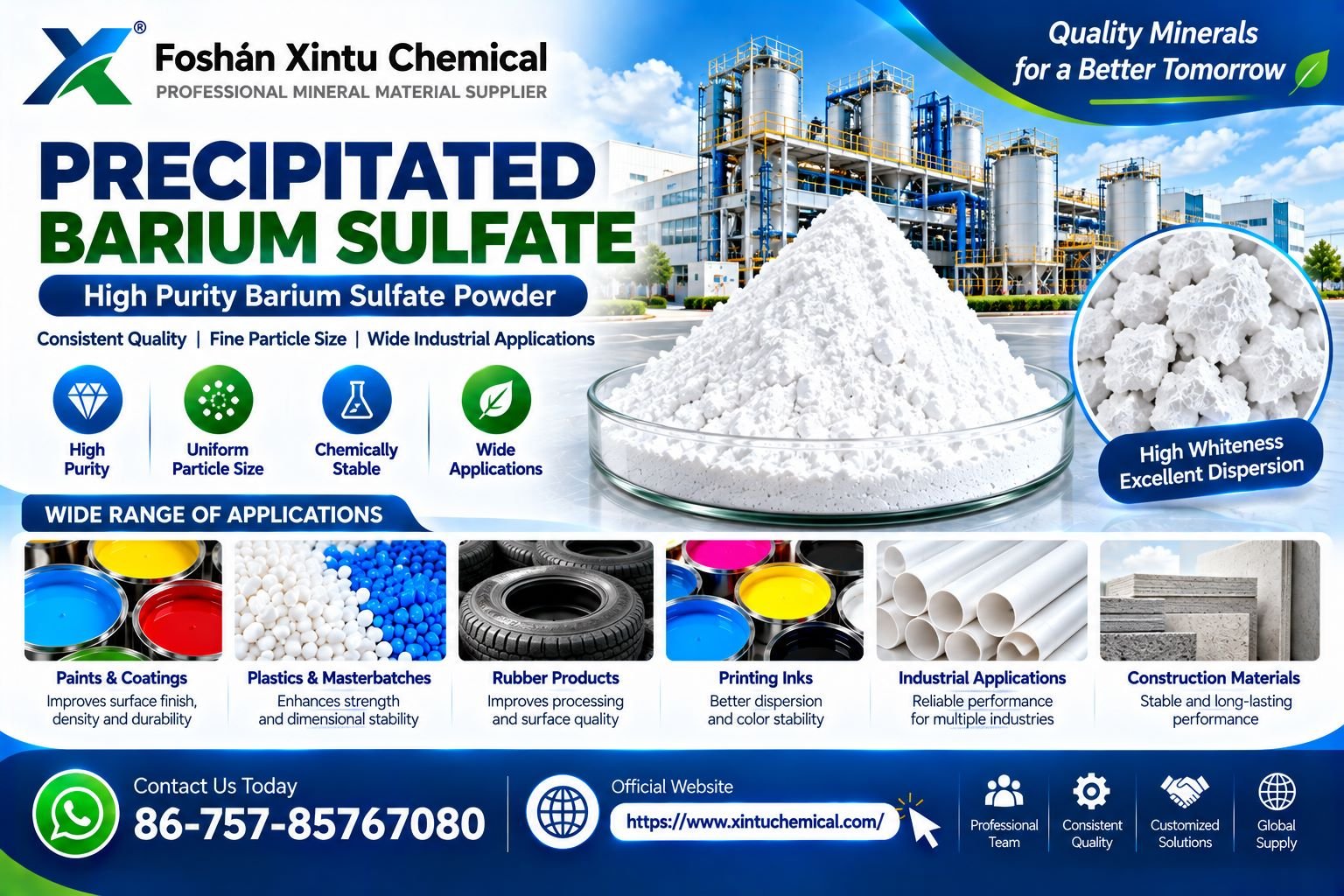
Industrial manufacturers are increasingly focusing on material consistency, formulation efficiency, and product performance when selecting specialty chemicals and mineral fillers. As industries demand reliable raw materials, the quality of functional powders has become an important consideration in manufacturing decisions.
Precipitated Barium Sulfate is a synthetically manufactured inorganic material used in paints, coatings, plastics, inks, and other industrial formulations. Its controlled particle characteristics, chemical stability, and high density make it valuable for selected manufacturing applications.
Meanwhile, Barium Sulfate Powder is widely recognised as a functional mineral material that can influence product appearance, processing behaviour, and physical properties.
For manufacturers, understanding the differences between powder grades, manufacturing methods, and performance characteristics is essential when developing cost-effective, high-quality products.
Why Specialty Mineral Fillers Matter in Industrial Manufacturing
Mineral fillers are no longer evaluated exclusively according to their purchasing cost.
Manufacturers increasingly consider how raw materials influence formulation stability, production efficiency, surface appearance, and finished-product quality.
An unsuitable filler may affect dispersion, viscosity, dimensional stability, or processing characteristics.
Conversely, an appropriately selected material can support consistent manufacturing and help achieve defined product specifications.
This principle explains why particle characteristics and manufacturing control deserve attention when selecting specialty mineral powders.
What Is Precipitated Barium Sulfate?
Precipitated Barium Sulfate is a synthetic form of barium sulfate, an inorganic compound with the chemical formula BaSO₄.
It is produced through controlled chemical precipitation rather than solely by grinding naturally occurring mineral deposits.
This manufacturing approach enables producers to control certain product characteristics, including particle size and purity, according to the process and intended grade.
Important Material Characteristics
- High Density: Useful where increased material density is desirable.
- Chemical Stability: Supports applications requiring resistance to many common chemical environments.
- Controlled Particle Characteristics: Can improve suitability for specific formulations.
- Whiteness: Certain grades offer favourable appearance characteristics.
- Low Water Solubility: Contributes to stability in appropriate applications.
- Formulation Compatibility: Can be selected for suitable coating, plastic, and ink systems.
Actual properties depend on the manufactured grade and supplier specifications.
Understanding Barium Sulfate Powder
Barium Sulfate Powder is a broader commercial term covering powdered barium sulfate materials, including natural and synthetic grades.
Naturally sourced barium sulfate is commonly obtained from barite mineral deposits through processing and grinding.
Synthetic grades are produced through chemical manufacturing methods.
Although both contain BaSO₄, their particle characteristics, impurity profiles, and application suitability can differ.
For this reason, manufacturers should not assume that every barium sulfate powder delivers identical performance.
Selecting the appropriate grade requires evaluation of the intended formulation and technical requirements.
Why Particle Size Distribution Influences Performance
Particle size distribution is an important factor in specialty powder applications.
It describes the range and relative proportion of particle sizes within a material.
In coatings, particle characteristics can influence dispersion, surface texture, and gloss.
In polymer applications, they may affect processing behaviour and mechanical properties.
Very fine particles can increase surface area and alter interactions with other formulation ingredients.
However, smaller particles are not automatically better.
Manufacturers should evaluate particle size alongside purity, surface properties, and processing conditions.
Applications in Paints and Coatings
Paint and coating manufacturers use selected mineral fillers to influence product properties and formulation costs.
Precipitated barium sulfate can serve as an extender in suitable coating systems.
Depending on the grade and formulation, it may contribute to surface smoothness, gloss characteristics, and consistent material distribution.
It is used in selected industrial, decorative, and specialty coating applications.
However, barium sulfate should not be considered a direct replacement for every pigment.
For example, its optical properties differ from those of titanium dioxide, which is commonly used where strong white opacity is required.
Laboratory testing helps determine the appropriate formulation balance.
Supporting Plastic and Polymer Manufacturing
Plastic manufacturers use mineral fillers to modify selected material characteristics.
Suitable barium sulfate grades may be incorporated into polymers to increase density, influence appearance, or adjust mechanical behaviour.
Applications can include injection-molded components, polymer compounds, and specialised plastic products.
The effect depends on filler loading, particle characteristics, polymer compatibility, and processing conditions.
For example, adding a dense mineral filler can increase product weight, which may be desirable in some applications but unsuitable in others.
Manufacturers should assess both performance benefits and potential trade-offs before selecting a formulation.
The Role of Powder Quality in Printing Inks
Printing ink formulations require carefully controlled material properties.
Selected barium sulfate grades may be used to influence ink body, consistency, and appearance.
Particle characteristics and dispersion quality are important because poorly dispersed materials can create processing difficulties or visible defects.
The appropriate grade also depends on the printing technology, binder system, and intended substrate.
Manufacturers should evaluate raw materials under representative production conditions rather than relying only on general product descriptions.
Comparing Natural and Precipitated Grades
| Evaluation Factor | Natural Barium Sulfate | Precipitated Barium Sulfate |
| Manufacturing Source | Processed barite mineral | Controlled chemical precipitation |
| Particle Characteristics | Depend on mineral processing and grinding | Can be controlled through precipitation and finishing |
| Purity | Varies by deposit and processing | Depends on synthesis and purification |
| Typical Selection Factors | Cost, particle size, mineral specifications | Particle consistency, purity, application requirements |
| Industrial Applications | Coatings, plastics, and other uses | Coatings, plastics, inks, and specialty formulations |
Neither category is universally superior. The appropriate choice depends on product requirements and commercial considerations.
How Manufacturers Should Evaluate Powder Suppliers
Selecting an industrial powder supplier requires careful assessment of technical documentation and material consistency.
Important considerations include:
- Chemical Purity: Confirm the required composition and impurity limits.
- Particle Size: Review relevant distribution measurements.
- Whiteness Requirements: Establish suitable appearance specifications where applicable.
- Dispersion Behaviour: Evaluate compatibility with the intended formulation.
- Batch Consistency: Review quality documentation and acceptance criteria.
- Packaging and Handling: Ensure suitable protection during storage and transportation.
Manufacturers should request representative samples and conduct application-specific trials before approving larger purchases.
Responsible Handling and Product Quality Assurance
Although barium sulfate is poorly soluble in water, industrial powder handling still requires appropriate workplace precautions.
Dust exposure should be controlled through suitable handling procedures, ventilation, and protective equipment where necessary.
Manufacturers should follow the relevant safety data sheet and applicable occupational safety requirements.
Industrial grades should not automatically be considered suitable for medical, pharmaceutical, or food-related applications.
Such uses require appropriate grade-specific standards and additional verification.
Frequently Asked Questions (FAQs)
1. What is Precipitated Barium Sulfate used for?
It is used in selected coatings, plastics, printing inks, and other industrial formulations as a functional inorganic filler.
2. Is Precipitated Barium Sulfate different from natural Barium Sulfate Powder?
Yes. Precipitated grades are chemically manufactured, while natural grades are typically processed from barite deposits. Their characteristics may differ.
3. Why is particle size important in barium sulfate applications?
Particle size influences dispersion, surface characteristics, processing behaviour, and performance in selected formulations.
4. Can barium sulfate be used in plastic manufacturing?
Yes. Suitable grades can be incorporated into certain polymer formulations to modify density, appearance, and other material characteristics.
5. What should buyers check before purchasing industrial barium sulfate?
Buyers should examine purity, particle size distribution, whiteness where relevant, quality documentation, application compatibility, and supplier consistency.
Media Contact
Department: Specialty Chemicals and Industrial Powder Enquiries
Contact: +86-757-85767080
Email: sales@xintuchemical.com
Official Website: https://www.xintuchemical.com/