
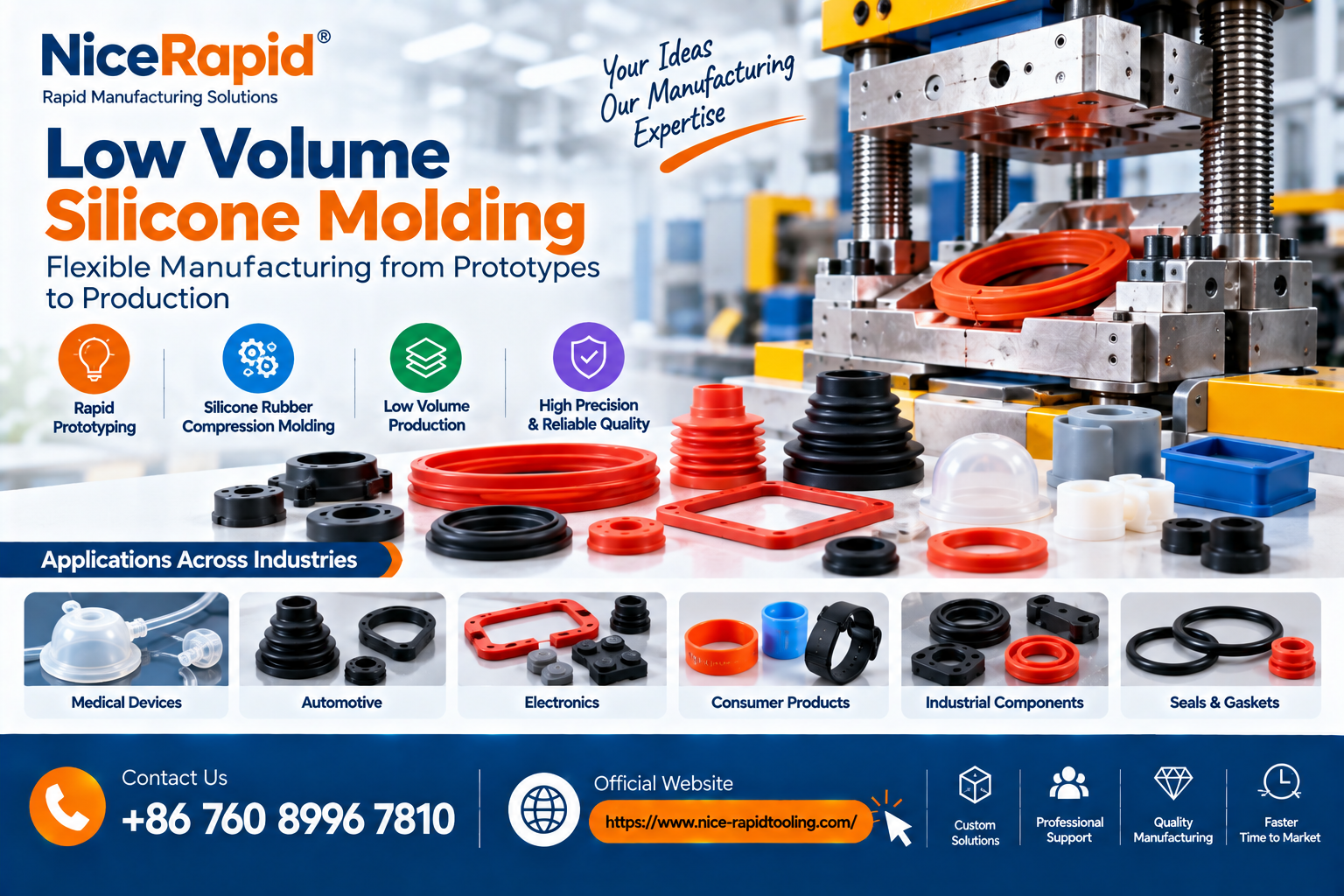
Industrial manufacturers are exploring more flexible approaches to component sourcing as equipment maintenance, specialised product requirements, and replacement-part availability become increasingly important.
For businesses operating specialised machinery, obtaining small quantities of custom rubber components can present challenges. Traditional mass-production arrangements may not be economical when only a limited number of parts are required.
Low volume silicone molding offers an alternative for manufacturing customised silicone components without committing to unnecessarily large production quantities.
Meanwhile, silicone rubber compression molding provides a manufacturing process capable of producing selected seals, gaskets, protective components, and other elastomeric parts.
For equipment manufacturers, maintenance teams, and engineering companies, combining small-batch production with appropriate material selection and dimensional verification can support more effective component replacement strategies.
Why Small-Batch Silicone Manufacturing Matters
Industrial equipment often contains rubber components that perform essential functions.
These parts may provide sealing, cushioning, insulation, or protection against environmental conditions.
Over time, components can experience wear, compression-related deformation, or deterioration caused by unsuitable operating conditions.
Finding replacements may become difficult when equipment models are discontinued or standard components are unavailable.
Small-batch manufacturing offers a potential solution when the required part can be accurately specified and safely reproduced.
However, replacement parts must satisfy the original application’s technical and safety requirements.
What Is Low Volume Silicone Molding?
Low volume silicone molding is the manufacturing of silicone rubber components in relatively small quantities according to defined product specifications.
Unlike high-volume production, the primary objective is to meet limited manufacturing requirements without producing unnecessary inventory.
The process may support industrial replacement parts, specialised equipment, prototype components, and custom product development.
Production quantities vary according to tooling requirements, part complexity, and manufacturing capabilities.
For manufacturers, the advantage is flexibility rather than a guarantee of lower costs or faster delivery.
The most suitable process must be selected according to the component and its intended application.
Understanding Silicone Rubber Compression Molding
Silicone rubber compression molding involves placing a measured quantity of silicone rubber compound into a suitably designed mold cavity.
The mold closes under pressure, and controlled curing conditions allow the material to form the required shape.
Once cured, the component is removed and inspected. Additional trimming or finishing may be necessary.
This approach can be suitable for producing certain industrial rubber components with defined geometries.
Common Component Applications
- Industrial Gaskets: Custom sealing components for suitable assemblies.
- Silicone Pads: Flexible contact or cushioning components.
- Protective Covers: Rubber parts designed to protect selected equipment surfaces.
- Rubber Grommets: Components supporting cable or opening protection.
- Custom Diaphragms: Flexible elements for appropriate mechanical applications.
- Replacement Components: Specialised parts requiring limited manufacturing quantities.
Each application requires appropriate engineering specifications and material verification.
Supporting Maintenance and Spare-Part Requirements
Equipment maintenance departments frequently face a choice between purchasing replacement components and commissioning custom manufacturing.
Standard replacement parts are generally preferable when suitable certified or original components remain available.
However, custom molding may be considered for certain nonstandard or obsolete parts.
Before manufacturing a replacement, engineers should confirm the component’s intended function, dimensions, material characteristics, and operating environment.
A worn part should not automatically be used as the only dimensional reference because wear or deformation may have changed its original shape.
This distinction is particularly important for parts involved in sealing or mechanical operation.
Material Compatibility Determines Component Performance
Silicone rubber is valued for properties such as flexibility, thermal resistance, and suitability for selected environmental conditions.
However, silicone compounds differ considerably in their formulation and performance.
A component exposed to elevated temperatures may require different material characteristics from one used in a low-temperature environment.
Similarly, contact with oils, solvents, fuels, or other chemicals can influence material suitability.
Engineers should evaluate hardness, compression set, tensile properties, and relevant chemical compatibility.
Silicone is not universally resistant to every industrial fluid.
Material selection must therefore reflect the application’s actual operating conditions.
Why Compression Set Matters for Silicone Seals
Compression set describes the extent to which an elastomer fails to recover its original thickness after being compressed under specified conditions.
For sealing components, excessive permanent deformation may reduce the ability to maintain effective contact pressure.
This can influence sealing reliability.
Manufacturers should consider material grade, component design, operating temperature, and expected compression conditions.
The appropriate test requirements depend on the intended application.
A silicone component that looks dimensionally correct may still perform poorly if its material properties are unsuitable.
Engineering Challenges in Small-Batch Production
Producing a limited quantity of components does not eliminate the need for technical planning.
Tool design, dimensional tolerances, parting lines, flash control, and curing requirements remain important.
A small production order may also involve engineering expenses that represent a significant proportion of the total project cost.
| Engineering Consideration | Why It Matters |
| Component Geometry | Influences mold design and demolding |
| Silicone Hardness | Affects flexibility and functional behaviour |
| Dimensional Tolerances | Supports correct assembly |
| Curing Conditions | Influence material properties |
| Surface Finish | Affects appearance and selected functional surfaces |
| Inspection Requirements | Help verify the delivered components |
Manufacturers should establish realistic acceptance criteria before production begins.
Managing Design Changes Without Excessive Inventory
One benefit of smaller production batches is the ability to evaluate product changes before committing to additional quantities.
Engineering teams may identify improvements involving geometry, material hardness, or assembly compatibility.
When modifications are necessary, a controlled manufacturing programme can help reduce the risk of accumulating unsuitable stock.
However, changing a molded component may require tooling modifications or replacement tooling.
Businesses should clarify these costs before authorising design changes.
Documented revisions also help prevent confusion between approved and outdated component versions.
Quality Verification for Custom Silicone Components
Consistent product quality requires measurable inspection procedures.
Depending on the application, manufacturers may need dimensional checks, hardness measurements, visual inspection, or mechanical testing.
Sealing components may also require functional testing under representative operating conditions.
For safety-critical equipment, replacement-part manufacture may demand additional qualification or original equipment manufacturer approval.
Small-batch production should never be treated as an exemption from relevant safety standards.
Manufacturers should retain appropriate product documentation and inspection records.
Selecting a Suitable Manufacturing Partner
Businesses considering silicone molding services should evaluate technical capabilities and project communication.
Important questions include:
- Can the manufacturer work with the required silicone grade?
- Is the component geometry suitable for compression molding?
- What tooling and engineering work will be necessary?
- Which dimensional and material tests are available?
- How are design revisions and sample approvals managed?
- What documentation accompanies the finished components?
A clear technical agreement helps align production expectations with actual project requirements.
Frequently Asked Questions (FAQs)
1. What is low volume silicone molding?
It is the manufacture of customised silicone components in smaller quantities for specialised products, engineering projects, and suitable replacement-part applications.
2. How does silicone rubber compression molding work?
A measured silicone compound is placed inside a mold and shaped under suitable pressure and curing conditions.
3. Can compression molding produce industrial replacement parts?
Yes, for suitable components, provided material compatibility, dimensions, functional requirements, and applicable safety specifications are verified.
4. Is low-volume molding always cheaper than mass production?
No. Total costs depend on tooling, part complexity, materials, finishing, inspection, and manufacturing quantities.
5. What information is needed for a custom silicone molding quotation?
Manufacturers typically need drawings or specifications, material requirements, expected quantities, dimensional tolerances, and relevant application details.
Media Contact
Department: Custom Silicone Molding and Industrial Component Enquiries
Contact: +86 760 8996 7810
Email: enquiry@nice-rapidtooling.com
Official Website: https://www.nice-rapidtooling.com/
Read More:-