
Packaging manufacturers and consumer product brands are exploring more flexible production strategies to meet changing product requirements, improve packaging efficiency, and maintain consistent quality.
As businesses introduce different product sizes, container formats, and packaging designs, selecting appropriate materials has become an important part of production planning.
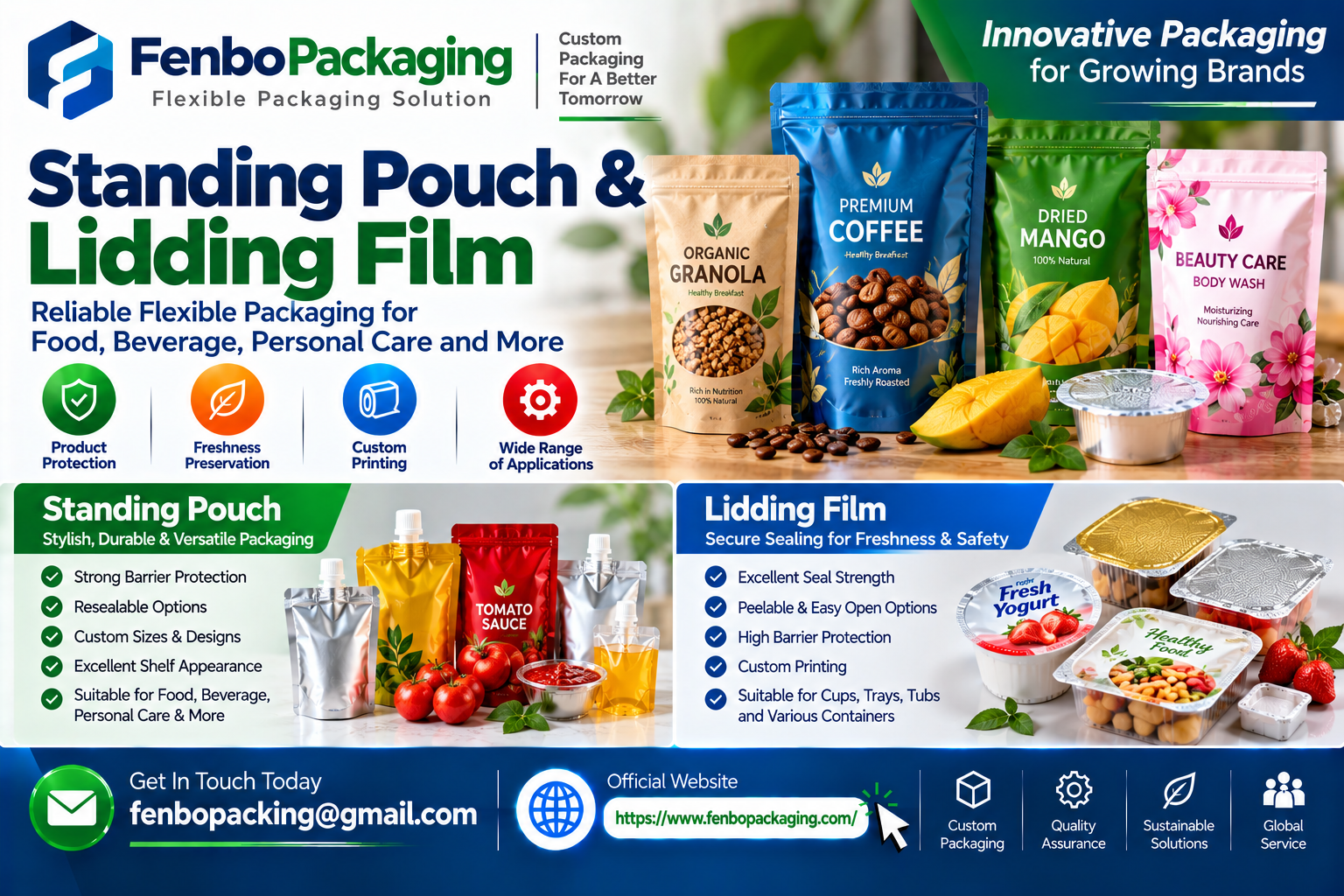
A standing pouch offers a flexible packaging solution designed to stand upright when suitably filled, providing practical advantages for product presentation, handling, and storage.
Meanwhile, Lidding Film plays an important role in sealing compatible trays, cups, and other rigid or semi-rigid containers used across food and consumer product applications.
Although these packaging formats serve different purposes, both can contribute to a broader packaging strategy focused on manufacturing efficiency, product protection, and convenient consumer experiences.
For food processors, packaging buyers, and product manufacturers, understanding how these solutions perform within production systems can help improve operational decisions.
Why Packaging Efficiency Matters for Manufacturers
Packaging is an essential part of the manufacturing process because it connects finished products with transportation, distribution, and retail presentation.
Poor packaging selection can create complications during filling, sealing, product handling, and storage.
For example, a flexible pouch with unsuitable dimensions may not operate correctly on the intended filling equipment.
Similarly, a lidding material that is incompatible with its container can create sealing problems.
This approach encourages manufacturers to evaluate the complete packaging process rather than selecting materials solely on appearance or price.
What Is a Standing Pouch?
A standing pouch, also commonly called a stand-up pouch, is a flexible package designed to remain upright when appropriately filled.
Its structure generally incorporates a bottom gusset that expands to create a supporting base.
Depending on product requirements, manufacturers may use single-material or multilayer film structures with suitable barrier and sealing characteristics.
Standing pouches can be used for snacks, coffee, powdered products, pet food, and selected liquid formulations.
Their design also provides a printable surface for branding and product information.
However, pouch stability depends on dimensions, filling weight, material stiffness, and gusset construction.
Understanding Lidding Film in Packaging
Lidding Film is a flexible material used to close compatible containers through an appropriate sealing process.
It is commonly associated with food trays, dairy cups, prepared meal containers, and other packaged products.
Depending on the application, lidding films may provide peelable, non-peelable, or other specialised sealing characteristics.
The selected film must be compatible with the container material, sealing equipment, and intended product conditions.
For example, a packaging application requiring easy opening may benefit from a properly engineered peelable seal.
However, easy opening must be balanced with adequate package integrity during handling and distribution.
How These Packaging Formats Support Different Product Lines
Standing pouches and lidding films can help manufacturers address different product requirements within a broader packaging portfolio.
| Packaging Factor | Standing Pouch | Lidding Film |
| Primary Function | Contains products in flexible packaging | Seals compatible containers |
| Typical Structure | Gusseted flexible pouch | Flexible sealing film |
| Common Applications | Snacks, coffee, powders, selected liquids | Ready meals, dairy cups, food trays |
| Packaging Equipment | Suitable pouch filling and sealing systems | Compatible tray or container sealing systems |
| Key Performance Concern | Pouch stability and seal integrity | Container compatibility and seal performance |
| Consumer Benefit | Convenient handling and possible reclosure | Suitable protection and opening functionality |
These formats are generally used as alternatives for different packaging systems rather than as interchangeable components.
Selecting the correct format depends on product characteristics and manufacturing objectives.
Why Packaging Machine Compatibility Is Essential
Packaging materials must perform consistently on the intended production equipment.
Standing pouches may require suitable feeding, opening, filling, and sealing arrangements.
Their dimensions, stiffness, and closure features can influence machine handling.
Lidding films may require specific sealing temperatures, pressure conditions, film tension, and accurate positioning.
Incompatible materials can contribute to interrupted operations or rejected packages.
Manufacturers should therefore conduct relevant equipment trials before approving new materials for commercial packaging.
The Importance of Packaging Changeover Management
Businesses manufacturing multiple product varieties may use different package sizes and material specifications.
Switching between these formats can require adjustments to filling equipment, sealing systems, or handling procedures.
Unnecessary complexity during changeovers may contribute to material waste and operational difficulties.
A structured changeover process helps production teams verify correct materials, equipment settings, and packaging specifications.
For example, switching between different lidding films may require confirmation of sealing compatibility.
Likewise, changing pouch dimensions may require adjustments to feeding and filling equipment.
Clearly documented procedures can support more consistent packaging operations.
Packaging Quality Control and Material Testing
Reliable packaging requires inspection procedures suited to the product and its intended distribution environment.
Important quality characteristics may include:
- Seal Strength: Evaluating the performance of relevant package seals.
- Dimensional Consistency: Confirming suitable pouch or film dimensions.
- Barrier Properties: Assessing protection against specified environmental influences.
- Leak Resistance: Identifying potential package integrity problems.
- Printing Quality: Reviewing legibility, appearance, and registration.
- Material Compatibility: Confirming suitability for the packaged contents.
Testing methods and acceptance criteria should reflect actual product requirements.
A package that appears visually acceptable may still require further evaluation before approval.
How Packaging Design Influences Retail Presentation
Packaging contributes significantly to how consumers identify and interact with products.
A standing pouch offers an upright presentation format that can display product graphics and information on flexible surfaces.
Lidding films can communicate branding and product details directly on compatible containers.
However, effective retail presentation also depends on correct labelling, readability, and suitable packaging dimensions.
Manufacturers should ensure that visual design does not interfere with required product information or functional packaging features.
Packaging should support customer understanding while maintaining appropriate product protection.
Sustainability and Packaging Material Selection
Material efficiency is an important consideration when developing packaging systems.
Flexible packaging may reduce material use in certain applications, but its environmental performance depends on construction and disposal conditions.
Multilayer films can create recycling challenges where suitable collection and processing infrastructure is unavailable.
Similarly, lidding films must be evaluated in relation to the complete container system.
Manufacturers should avoid unverified sustainability claims and consider material usage, product protection, potential waste, and local recovery options.
A responsible packaging strategy balances functional performance with realistic environmental considerations.
Frequently Asked Questions (FAQs)
1. What is a standing pouch used for?
A standing pouch is used to package suitable products such as snacks, coffee, powders, pet food, and selected liquids while providing upright shelf presentation.
2. What is Lidding Film?
Lidding film is a flexible sealing material used to close compatible cups, trays, and other containers through suitable sealing processes.
3. Can standing pouches be customised for different products?
Yes. Depending on manufacturing capabilities, suitable pouch structures can be customised in dimensions, material construction, printing, and closure features.
4. Why is sealing compatibility important for lidding films?
Sealing compatibility helps ensure that the film forms an appropriate seal with the container under the intended packaging conditions.
5. How should businesses choose between standing pouches and lidding films?
Businesses should consider product characteristics, packaging equipment, container requirements, seal performance, storage conditions, and consumer convenience.
Media Contact
Department: Flexible Packaging and Custom Packaging Solutions
Email: fenbopacking@gmail.com
Official Website: https://www.fenbopackaging.com/
Read More:-