
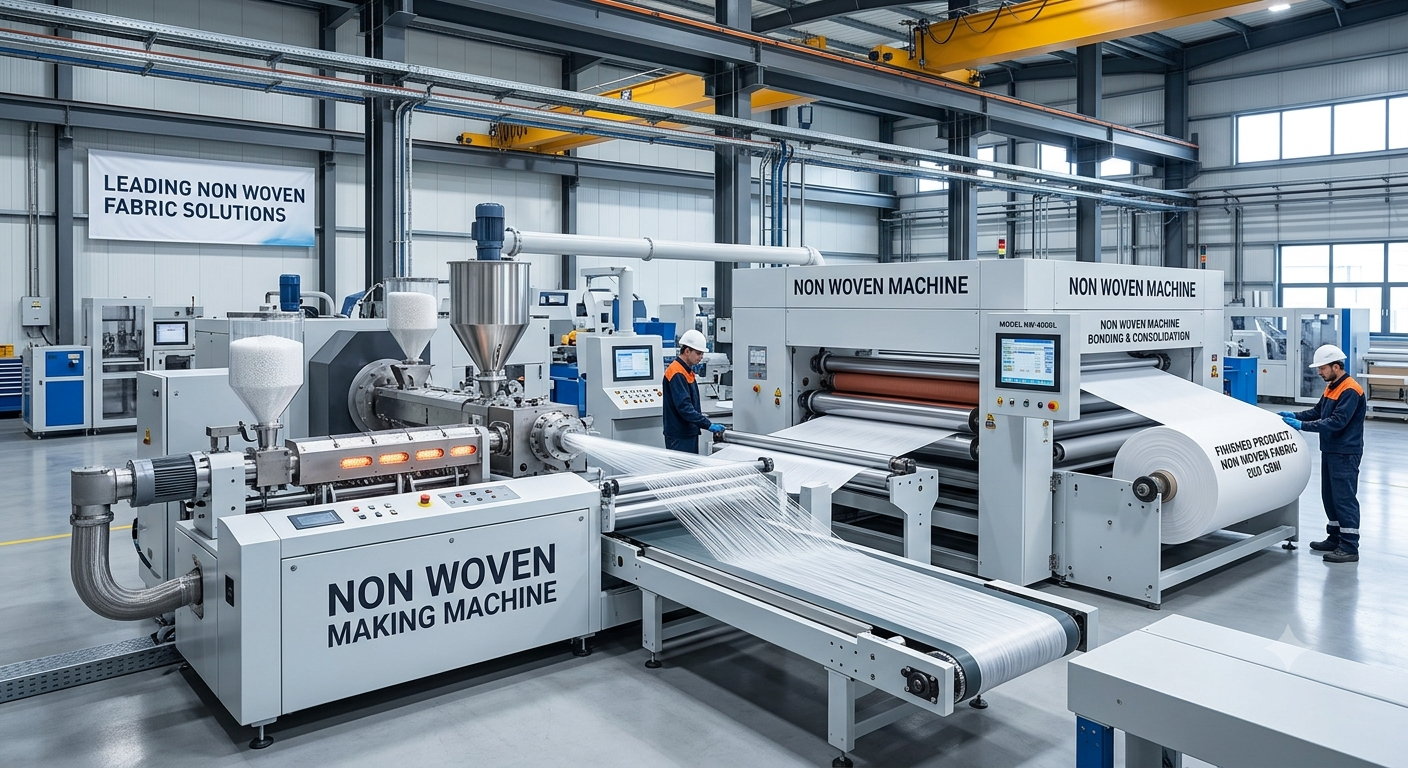
The demand for non woven making machine technology has grown rapidly in recent years due to the increasing use of non woven fabrics across healthcare, packaging, agriculture, hygiene products, and construction industries. A non woven machine is designed to manufacture fabric without traditional weaving or knitting, instead bonding fibers through mechanical, thermal, or chemical processes.
This advanced manufacturing system has transformed textile production by offering faster output, lower costs, and highly customizable fabric properties suitable for multiple applications.
What is a Non Woven Machine?
A non woven machine is industrial equipment used to produce non woven fabric directly from synthetic or natural fibers without converting them into yarn. Instead of weaving threads, fibers are bonded together using heat, pressure, or adhesives.
Key Functions
- Fiber opening and blending
- Web formation (laying fibers into sheets)
- Bonding through thermal or mechanical processes
- Rolling finished fabric into jumbo rolls
Core Output Materials
- Spunbond non woven fabric
- Meltblown fabric
- Needle-punched fabric
- Spunlace fabric
What is a Non Woven Making Machine?
A non woven making machine refers to the complete production line that integrates multiple systems to convert raw polymer materials into finished non woven fabric rolls.
It typically includes extrusion systems, web forming units, bonding sections, and winding machines.
Main Purpose
- High-speed fabric production
- Uniform fiber distribution
- Controlled GSM (grams per square meter)
- Industrial-scale manufacturing efficiency
How Non Woven Machine Works in Manufacturing Industry
A non woven machine operates through a systematic multi-stage process that ensures consistency and quality.
Step-by-Step Production Process
- Polymer melting and extrusion
- Fiber spinning through spinnerets
- Cooling and fiber stretching
- Web formation on conveyor belts
- Bonding using heat or pressure
- Fabric finishing and rolling
Types of Bonding Methods
- Thermal bonding
- Chemical bonding
- Mechanical (needle punching)
- Hydroentanglement (spunlace technology)
Types of Non Woven Making Machine
Different industries require different machine configurations based on fabric application.
Spunbond Non Woven Machine
- Produces strong and lightweight fabric
- Used in medical masks, bags, and packaging
- High production speed
Meltblown Non Woven Machine
- Produces ultra-fine fibers
- Essential for filtration and medical masks
- High filtration efficiency
Needle Punching Machine
- Uses mechanical needles to bond fibers
- Used in carpets, geotextiles, and automotive fabrics
Spunlace Non Woven Machine
- Uses high-pressure water jets
- Produces soft and durable fabric
- Common in wipes and hygiene products
Key Features of Modern Non Woven Machine Systems
Modern non woven making machine setups are highly automated and efficient.
Advanced Features
- PLC-based control systems
- Energy-efficient motors
- Automatic GSM control
- Real-time monitoring systems
- High-speed production lines
- Low maintenance design
Applications of Non Woven Machine in Industries
The versatility of non woven machine technology makes it suitable for multiple sectors.
Major Applications
- Medical masks and PPE kits
- Sanitary napkins and diapers
- Shopping bags and packaging materials
- Agricultural crop covers
- Geotextiles for road construction
- Industrial filtration materials
Comparison Between Non Woven Making Machine and Traditional Textile Machine
| Feature | Non Woven Making Machine | Traditional Textile Machine |
| Production Method | Direct fiber bonding | Yarn weaving or knitting |
| Speed | Very high | Moderate |
| Cost Efficiency | Lower production cost | Higher production cost |
| Fabric Strength | Customizable | Fixed structure |
| Application Range | Wide industrial use | Apparel-focused |
Benefits of Using Non Woven Machine Technology
Industries prefer non woven making machine systems due to their efficiency and versatility.
Key Benefits
- Faster production cycles
- Reduced labor dependency
- Lower raw material waste
- High customization ability
- Eco-friendly production options
- Scalable industrial output
Factors to Consider Before Buying Non Woven Making Machine
Investing in a non woven machine requires careful evaluation.
Important Considerations
- Production capacity requirements
- Machine automation level
- Fabric type compatibility
- Energy consumption
- Maintenance support availability
- Spare parts accessibility
- Manufacturer reputation
Cost Efficiency and ROI in Non Woven Machine Industry
A non woven making machine is considered a high-return investment due to increasing demand for disposable and hygiene-based products.
ROI Advantages
- High market demand across sectors
- Continuous production capability
- Low operational waste
- Long machine lifespan
- Export opportunities for non woven fabrics
Future Trends in Non Woven Machine Technology
The industry is rapidly evolving with new innovations and sustainable solutions.
Emerging Trends
- Biodegradable non woven fabrics
- AI-based machine automation
- Smart energy-efficient systems
- Recycled polymer usage
- Advanced filtration-grade production
- Fully automated production lines
Frequently Asked Questions (FAQs)
1. What is a non woven making machine?
It is a production line used to manufacture non woven fabric directly from fibers without weaving or knitting.
2. What is a non woven machine used for?
It is used to produce fabrics for medical, packaging, hygiene, agriculture, and industrial applications.
3. What materials are used in non woven machine production?
Common materials include polypropylene (PP), polyester, and natural fibers.
4. Is non woven fabric eco-friendly?
Some modern non woven fabrics are biodegradable and recyclable depending on material type.
5. What is the difference between spunbond and meltblown machines?
Spunbond produces strong fabric, while meltblown produces fine filtration-grade material.
6. How fast is a non woven making machine?
High-speed machines can produce thousands of meters of fabric per hour.
7. What industries use non woven fabric?
Medical, hygiene, agriculture, automotive, packaging, and construction industries.
8. What is the lifespan of a non woven machine?
With proper maintenance, it can last many years with continuous operation.
9. Is maintenance required frequently?
Routine maintenance is needed, but modern machines are designed for low maintenance.
10. Is investing in a non woven making machine profitable?
Yes, due to high demand in hygiene and packaging industries, it offers strong ROI.