
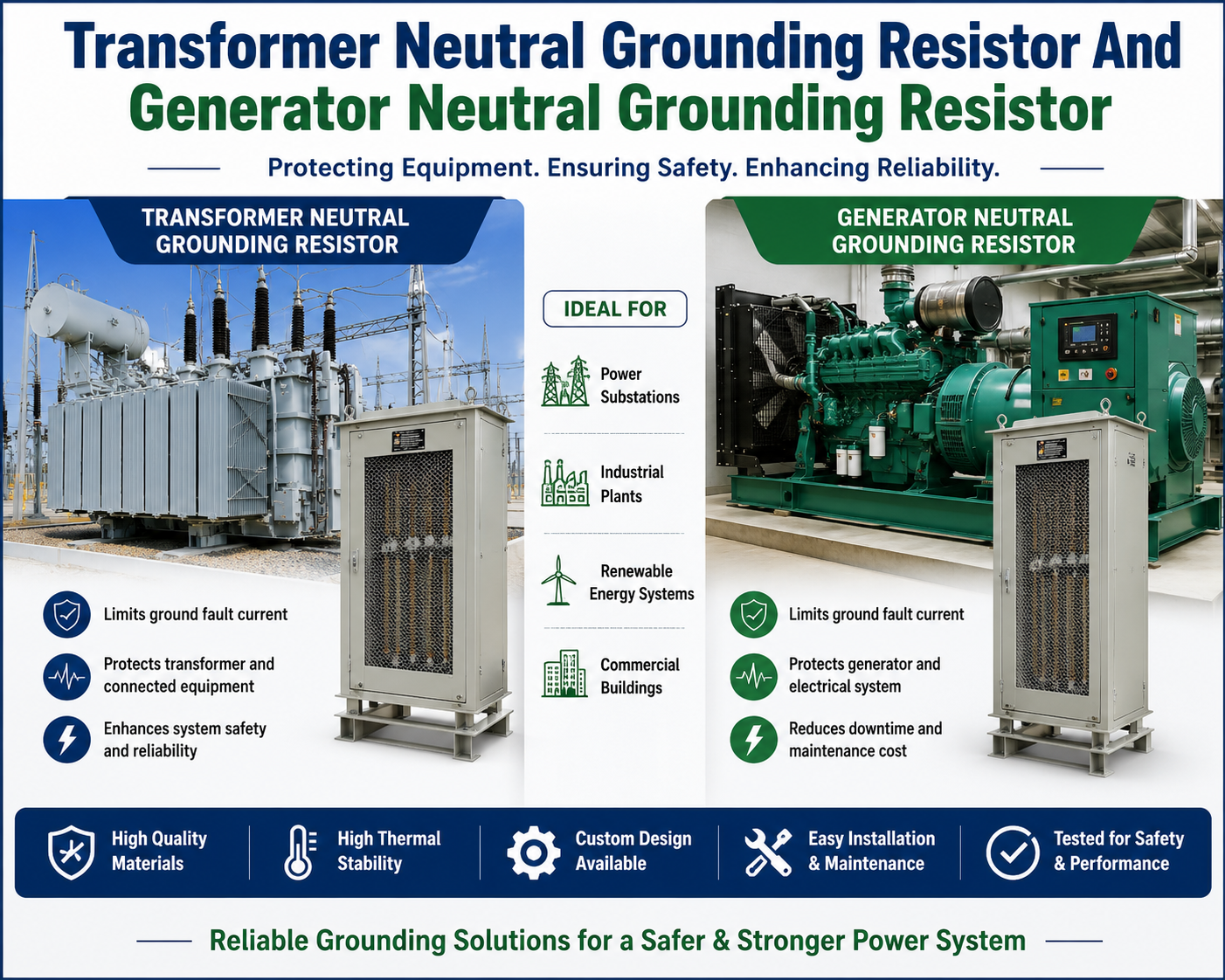
As industries become increasingly dependent on uninterrupted power systems, electrical protection technologies have become more important than ever. Among the most effective solutions for controlling ground fault currents are the Transformer Neutral Grounding Resistor and Generator Neutral Grounding Resistor. These components play a crucial role in protecting transformers, generators, switchgear, and other electrical equipment from the damaging effects of electrical faults.
From power plants and manufacturing facilities to commercial buildings and renewable energy projects, neutral grounding resistors are widely used to improve system reliability, enhance personnel safety, and minimize equipment damage during ground faults.
Understanding a Transformer Neutral Grounding Resistor
A Transformer Neutral Grounding Resistor is a specially designed resistor connected between the neutral point of a transformer and the ground. Its primary purpose is to limit the magnitude of ground fault current during a phase-to-ground fault.
By controlling fault current levels, the resistor reduces thermal and mechanical stress on electrical equipment and allows protection systems to detect and isolate faults efficiently.
Primary Functions
- Limits ground fault current
- Protects transformer windings
- Reduces equipment damage
- Improves electrical system safety
- Minimizes arc flash hazards
- Enhances fault detection capabilities
What Is a Generator Neutral Grounding Resistor?
A Generator Neutral Grounding Resistor performs a similar function but is specifically designed for generators and alternators. It connects the generator neutral point to ground through a resistance element that restricts fault current to a predetermined level.
This controlled grounding method prevents severe damage to generator windings and minimizes operational interruptions.
Key Objectives
- Protect generator stator windings
- Prevent catastrophic equipment failures
- Improve power system reliability
- Reduce maintenance costs
- Support selective fault coordination
Why Neutral Grounding Is Necessary in Electrical Systems
Ungrounded or improperly grounded systems can experience dangerous overvoltages during ground faults. Neutral grounding resistors help maintain system stability while protecting both equipment and personnel.
Benefits of Proper Grounding
- Enhanced electrical safety
- Controlled fault currents
- Reduced equipment downtime
- Improved system reliability
- Lower repair and replacement costs
- Better fault location and diagnosis
How a Transformer Neutral Grounding Resistor Works
During a ground fault, the resistor provides a controlled path for fault current to flow to the ground.
Working Principle
- A phase-to-ground fault occurs.
- Fault current attempts to flow through the neutral point.
- The grounding resistor limits the current to a safe level.
- Protective relays detect the fault.
- Circuit breakers isolate the faulty section.
This process significantly reduces the risk of equipment damage and system instability.
How a Generator Neutral Grounding Resistor Operates
The operation of a Generator Neutral Grounding Resistor is based on the same principle but is specifically optimized for generator protection.
Operational Benefits
- Controls stator ground fault current
- Prevents insulation damage
- Supports reliable power generation
- Reduces generator outage risks
- Improves protection system coordination
Applications of Transformer Neutral Grounding Resistor
These systems are widely used in various industries.
Major Applications
- Power generation plants
- Industrial manufacturing facilities
- Petrochemical industries
- Mining operations
- Commercial buildings
- Utility substations
- Renewable energy installations
Applications of Generator Neutral Grounding Resistor
Generator grounding resistors are commonly installed in:
- Diesel generator systems
- Gas turbine power plants
- Hydroelectric facilities
- Emergency backup systems
- Industrial captive power plants
- Renewable energy generation systems
Types of Neutral Grounding Resistors
Low Resistance Grounding (LRG)
Designed to limit fault currents to relatively low values while allowing protective devices to operate quickly.
High Resistance Grounding (HRG)
Limits fault current to very low levels and often allows systems to continue operating during the first ground fault.
Neutral Earthing Resistors with Monitoring Systems
Advanced solutions include temperature monitoring and fault indication systems for enhanced reliability.
Transformer Neutral Grounding Resistor vs Generator Neutral Grounding Resistor
| Feature | Transformer Neutral Grounding Resistor | Generator Neutral Grounding Resistor |
| Primary Equipment | Transformers | Generators |
| Main Purpose | Protect transformer windings | Protect generator stator windings |
| Fault Current Limitation | Yes | Yes |
| System Stability | Improved | Improved |
| Maintenance Requirement | Moderate | Moderate |
| Industrial Usage | Very high | Very high |
Advantages of Installing Neutral Grounding Resistors
1. Enhanced Equipment Protection
Reduces damage caused by ground faults.
2. Improved Personnel Safety
Minimizes the risk of arc flash incidents.
3. Lower Maintenance Costs
Reduces repair and replacement expenses.
4. Better Power System Reliability
Supports continuous operation and fault management.
5. Improved Fault Detection
Enables protective relays to identify and isolate faults accurately.
Factors to Consider When Selecting a Grounding Resistor
Choosing the right grounding resistor requires careful engineering evaluation.
Important Considerations
- System voltage
- Desired fault current level
- System grounding method
- Environmental conditions
- Duty cycle requirements
- Protection coordination requirements
- Installation location
Common Causes of Ground Faults
Understanding the causes of faults can help improve preventive maintenance.
Typical Reasons
- Insulation failure
- Moisture ingress
- Aging equipment
- Mechanical damage
- Cable deterioration
- Human error
- Environmental contamination
Maintenance Best Practices
Regular inspection and maintenance are essential for long-term reliability.
Recommended Practices
- Perform periodic visual inspections.
- Check resistor element condition.
- Verify electrical connections.
- Inspect insulation resistance.
- Monitor temperature levels.
- Test protective relay coordination.
- Keep maintenance records updated.
Emerging Trends in Neutral Grounding Technology
The electrical protection industry continues to adopt smarter technologies.
Latest Innovations
- IoT-enabled monitoring systems
- Remote condition monitoring
- Smart fault diagnostics
- Advanced thermal sensors
- Predictive maintenance systems
- Digital substation integration
- Real-time performance analytics
Frequently Asked Questions (FAQs)
1. What is a Transformer Neutral Grounding Resistor?
It is a resistor connected between the transformer neutral and ground to limit ground fault current.
2. What is a Generator Neutral Grounding Resistor?
It is a protective resistor used to control fault current in generator systems.
3. Why are neutral grounding resistors important?
They improve electrical safety and protect equipment from ground fault damage.
4. What is the difference between high resistance and low resistance grounding?
High resistance grounding limits current to very low values, while low resistance grounding allows higher currents for faster fault clearing.
5. Which industries use grounding resistors?
Power generation, manufacturing, mining, oil and gas, utilities, and commercial facilities.
6. Can grounding resistors prevent equipment failure?
Yes. They significantly reduce damage during ground faults.
7. How often should grounding resistors be inspected?
Periodic inspections should be conducted according to maintenance schedules and operating conditions.
8. What happens if a system is not properly grounded?
Improper grounding can result in equipment damage, overvoltages, and safety hazards.
9. Do grounding resistors require monitoring systems?
Modern installations increasingly use monitoring systems for improved reliability.
10. How do I select the correct grounding resistor?
Selection depends on system voltage, fault current requirements, and application-specific engineering considerations.