
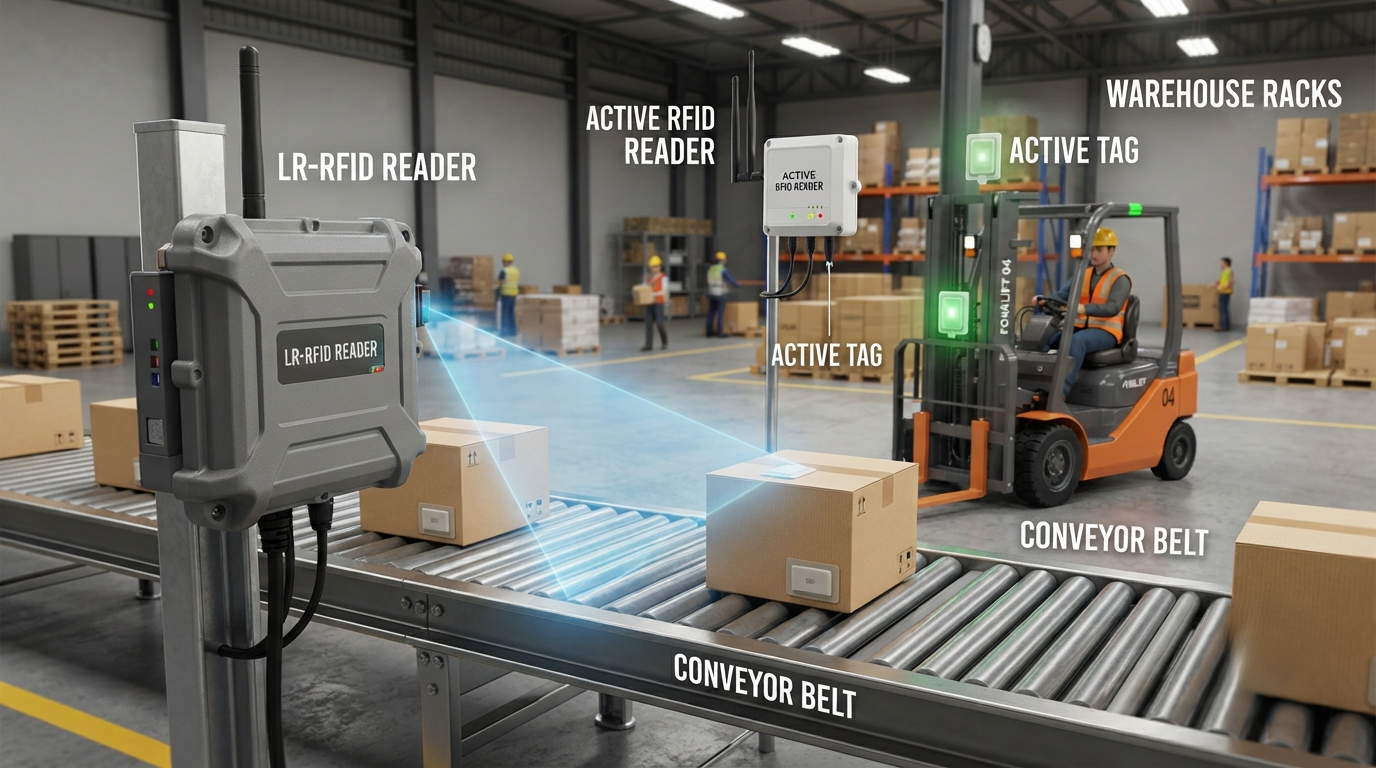
Businesses today need speed, visibility, and accuracy to stay competitive. From warehouse inventory to vehicle movement and secure access control, tracking technology plays a major role in daily operations. That is where the Long Range RFID Reader and Active RFID Reader become valuable.
These two RFID solutions help organizations identify assets without manual scanning, reduce errors, and improve real-time monitoring. While both support efficient tracking, they are built for different environments and use cases. Understanding how they work makes it easier to choose the right system for your business.
What RFID Technology Does
RFID stands for Radio Frequency Identification. It uses radio waves to exchange data between a tag and a reader. Unlike barcodes, RFID does not require line-of-sight, which makes it faster and more flexible.
A complete RFID setup usually includes:
- RFID tags
- RFID readers
- Antennas
- Software platform
- Data storage or reporting tools
Why RFID matters
RFID helps businesses automate tracking, improve stock accuracy, and monitor movement across large spaces.
What Is a Long Range RFID Reader?
A Long Range RFID Reader is designed to detect RFID tags from a considerable distance. Depending on the system, antenna setup, and environment, the range can stretch from several meters to more than 20 meters.
These readers are often used where assets, people, or vehicles must be recognized quickly without stopping the workflow.
Main advantages
- Extended reading distance
- Fast identification
- Ability to read many tags at once
- Strong performance in industrial settings
- Useful for access control and logistics
- Easy integration with tracking software
What Is an Active RFID Reader?
An Active RFID Reader works with battery-powered active tags. These tags send signals on their own, which gives them a much greater range than passive tags.
Because of this, active RFID systems are ideal for large facilities and real-time monitoring.
Main advantages
- Long communication distance
- Real-time asset visibility
- Strong signal performance
- Better tracking in complex environments
- Suitable for high-value assets
- Reliable for large-scale operations
Long Range RFID Reader vs Active RFID Reader
| Feature | Long Range RFID Reader | Active RFID Reader |
| Tag Type | Passive tags | Battery-powered active tags |
| Reading Range | Moderate to long | Very long |
| Tag Battery | Not required | Required |
| Cost | Lower | Higher |
| Maintenance | Minimal | Battery replacement needed |
| Tracking Style | Event-based | Real-time |
| Best Use | Gates, logistics, access control | Asset tracking, large facilities |
How a Long Range RFID Reader Works
A Long Range RFID Reader sends out radio signals through its antenna. When a tag enters the field, the tag responds with its stored ID. The reader captures that ID and sends it to software for processing.
Simple working process
- Reader emits radio waves.
- Tag receives the signal.
- Tag sends back its information.
- Reader collects the data.
- Software records the event.
This process happens quickly, allowing businesses to track movement with very little delay.
How an Active RFID Reader Works
An Active RFID Reader detects signals from active tags that contain a battery. Since the tag transmits on its own, the reader can pick up the signal across a larger area.
Best suited for
- Asset tracking in warehouses
- Fleet visibility
- Hospital equipment tracking
- Industrial yard monitoring
- Smart campus security
- Container and pallet movement
Benefits of Using RFID Solutions
Faster operations
RFID reduces time spent on manual checks and improves workflow speed.
Better accuracy
Automated identification lowers the chance of human error.
Improved visibility
Managers can monitor assets in real time and make better decisions.
Higher security
Unauthorized movement can be detected quickly.
Lower labor effort
Automation reduces repetitive manual work.
Where These Readers Are Used
Logistics and Warehousing
- Pallet tracking
- Inventory control
- Dock door monitoring
- Shipment verification
Manufacturing
- Tool tracking
- Work-in-progress monitoring
- Equipment management
Transportation
- Vehicle access control
- Container tracking
- Fleet movement monitoring
Healthcare
- Medical asset tracking
- Equipment location visibility
- Staff and patient identification
Education and Enterprise
- Attendance systems
- Secure entry points
- Campus asset monitoring
Which One Should You Choose?
The right choice depends on your goals.
Choose a Long Range RFID Reader if:
- You want a cost-effective solution
- You use passive tags
- You need gate or checkpoint scanning
- You track moderate distances
Choose an Active RFID Reader if:
- You need real-time location visibility
- You track high-value assets
- You operate across a large facility
- You need longer range and stronger signal performance
Practical Tips for Deployment
To get the best results, follow these steps:
- Study the site layout before installation.
- Place antennas carefully for maximum coverage.
- Test signal strength in real conditions.
- Select tags that match the environment.
- Connect the system with your software platform.
- Train staff to use and maintain the system.
- Review performance regularly.
H4: Small changes can improve results
Even the best RFID hardware performs better when installation and configuration are planned properly.
Future of RFID Tracking
RFID is becoming more advanced as companies adopt automation, IoT, and smart analytics. New systems are adding cloud dashboards, real-time alerts, predictive insights, and better integration with enterprise software.
Future RFID solutions will likely offer:
- Smarter asset analytics
- Improved data accuracy
- Cloud-based monitoring
- Better mobility
- More automation
- Stronger integration with business systems
FAQ
1. What is a Long Range RFID Reader?
It is a reader that detects RFID tags from a greater distance than standard systems.
2. What is an Active RFID Reader?
It is a reader that works with battery-powered active tags for longer-range tracking.
3. Are active RFID tags better than passive tags?
They are better for long-distance and real-time tracking, but they cost more.
4. Can a Long Range RFID Reader read many tags at once?
Yes, most modern readers support multi-tag reading.
5. Is RFID useful for warehouses?
Yes, it improves inventory accuracy and speeds up tracking.
6. Does Active RFID need battery maintenance?
Yes, active tags require battery replacement over time.
7. Can RFID work outdoors?
Yes, many RFID systems are built for outdoor and industrial use.
8. Is RFID secure?
Yes, most systems support secure data handling and access control features.
9. Which industries use RFID the most?
Logistics, manufacturing, healthcare, transportation, and retail use it widely.
10. How do I decide between the two?
Choose based on distance, budget, asset value, and whether you need real-time tracking.
Read more – https://newsgrow.blogspot.com/2026/08/long-range-rfid-reader-and-active-rfid.html