
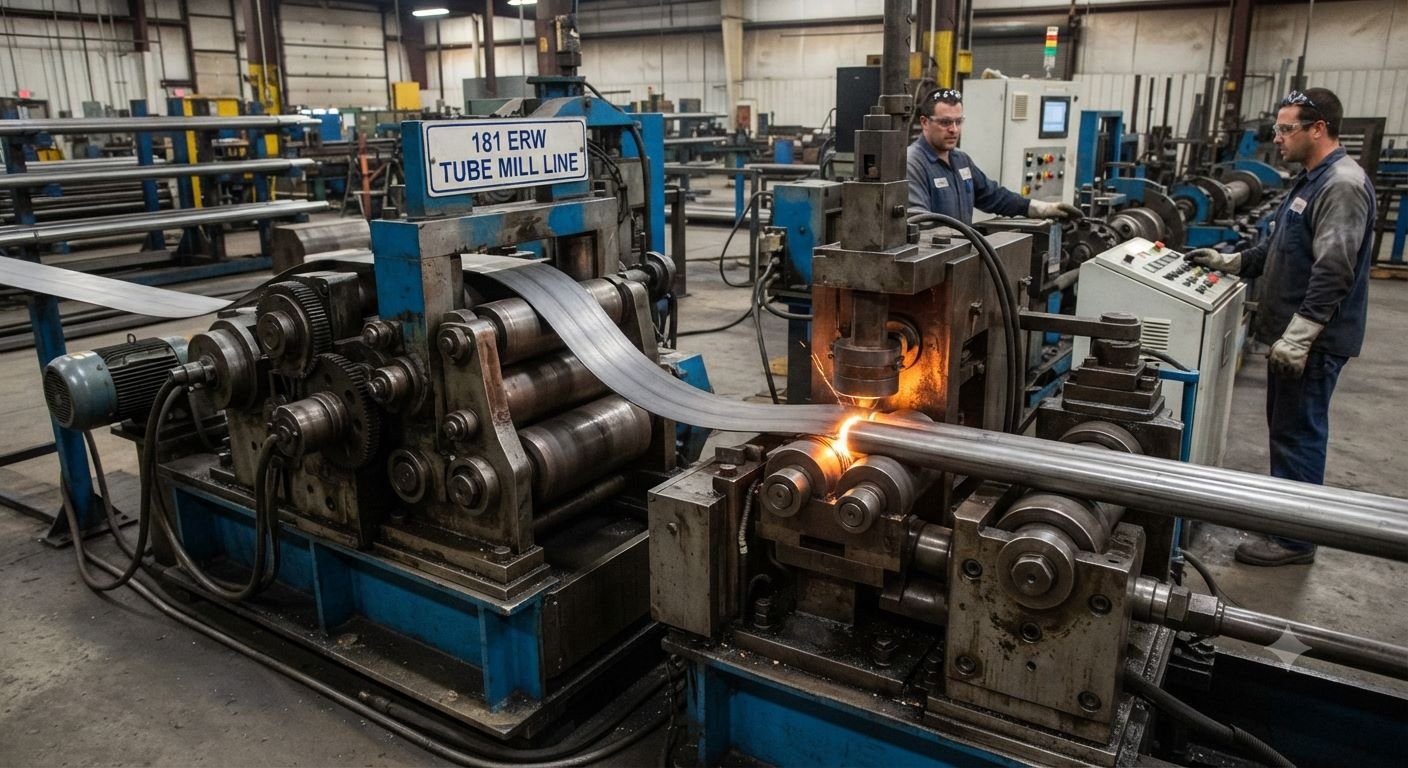
The global steel tube manufacturing sector is witnessing a steady transformation as advanced ERW Tube Mill Line and Tube Mill Line technologies redefine production efficiency, precision, automation, and product consistency. With industries demanding stronger, more accurate, and cost-effective tubular products, modern tube mill systems are becoming an important investment for manufacturers looking to strengthen their production capabilities.
The evolution of tube mill technology has been gradual but significant. Early manufacturing systems depended heavily on mechanical operations and manual adjustments. Today’s production lines combine precision forming, Electric Resistance Welding, automated sizing, high-speed cutting, digital controls, and quality monitoring. The next generation is expected to add artificial intelligence, predictive maintenance, connected machinery, and advanced energy management.
Steel Tube Manufacturing Enters a New Technological Phase
Steel tubes are widely used across construction, automotive, infrastructure, engineering, agriculture, furniture, machinery, and fabrication. Their ability to provide strength while maintaining practical manufacturing and installation characteristics has made them essential to numerous industries.
As demand has expanded, manufacturers have faced increasing pressure to produce more tubes without compromising quality. This has encouraged continuous improvements in tube mill equipment.
A modern Tube Mill Line is designed to address several production requirements simultaneously, including:
- Higher production efficiency
- Consistent tube dimensions
- Reliable welded seams
- Reduced material waste
- Faster product changeovers
- Improved production monitoring
- Lower unplanned downtime
These requirements are driving the industry toward increasingly sophisticated production systems.
From Traditional Tube Making to Continuous Production
The early stages of industrial tube production involved multiple operations that were often separated from one another. Operators had to manage forming, joining, cutting, and finishing processes individually.
As industrial production expanded, this approach became less practical. Manufacturers needed continuous equipment capable of producing long lengths of tube efficiently.
The development of roll forming addressed an important part of this challenge. Flat steel strip could be passed through multiple forming stands, with each stand gradually changing the strip into the desired tubular shape.
This created the basic foundation for today’s continuous tube mill.
ERW Technology Becomes a Key Manufacturing Solution
Electric Resistance Welding became an important advancement because it allowed the edges of continuously formed steel strip to be joined during production.
The process generates heat through electrical resistance at the edges of the material. Controlled pressure then brings the heated edges together to create the longitudinal weld.
The continuous nature of ERW makes it particularly suitable for industrial tube production.
Key Advantages of ERW Production
The technology can offer manufacturers:
- Continuous welding
- High production capability
- Consistent seam formation
- Efficient material processing
- Automation compatibility
- Reduced dependence on conventional filler materials
As electrical and control systems have developed, ERW equipment has become increasingly sophisticated.
Modern Tube Mills Combine Multiple Operations
Today’s production lines are designed as integrated systems rather than individual machines.
A typical line can include an uncoiler, entry equipment, accumulator, forming stands, high-frequency welding system, weld seam processing, sizing stands, straightening equipment, flying saw, inspection systems, and finished-product handling.
The manufacturing process generally follows a continuous sequence:
- Steel coil is loaded and prepared.
- Strip is uncoiled and fed into the line.
- Forming rolls gradually create the tubular profile.
- The strip edges are heated and joined through ERW welding.
- The welded tube is sized and straightened.
- Online systems monitor production conditions.
- The finished tube is automatically cut.
- Products are transferred for collection and further processing.
The integration of these operations helps reduce manual handling and improve production consistency.
Automation Raises the Standard for Production Control
Automation has become one of the most important developments in modern tube mill technology.
PLC-based control systems can coordinate production functions, while HMI interfaces provide operators with information about machine status and operating conditions. Sensors can monitor different sections of the line, while servo systems provide precise motion control.
This technology can help manufacturers achieve more repeatable production and reduce the possibility of manual operating errors.
Automation also changes the role of workers. Instead of performing constant manual adjustments, operators can focus on machine setup, quality supervision, troubleshooting, and process optimization.
Quality Monitoring Moves Closer to Real Time
Manufacturers are increasingly recognizing that quality should be controlled throughout production rather than checked only at the end.
Modern inspection technologies can monitor dimensions, surface characteristics, and other process conditions while tubes are being manufactured.
The Shift Toward Defect Prevention
Online inspection provides an important advantage. If a production deviation is detected early, corrective action can potentially be taken before large quantities of material are affected.
This approach can reduce:
- Scrap generation
- Rework
- Production delays
- Customer complaints
- Material losses
The result is a manufacturing strategy that focuses increasingly on prevention rather than correction.
The Next Generation of ERW Tube Mill Technology
The future of the ERW Tube Mill Line is expected to be strongly influenced by smart manufacturing.
Manufacturers are moving toward connected systems that can collect production data, analyze machine performance, and provide actionable information.
Artificial Intelligence Could Improve Process Decisions
AI and machine-learning technologies can potentially analyze large amounts of production information.
Data from welding systems, forming stands, motors, sensors, and inspection equipment can be examined to identify patterns and unusual conditions.
Future systems may assist operators by identifying possible quality problems, equipment deterioration, or opportunities for process optimization.
Predictive Maintenance Could Reduce Downtime
Unexpected machine failure is one of the biggest challenges in continuous production.
Predictive maintenance provides a different approach. Sensors can monitor vibration, temperature, electrical current, motor load, and other indicators of equipment health.
When abnormal behavior is detected, maintenance teams can investigate before the problem develops into a major breakdown.
This can contribute to:
- Improved machine availability
- More effective maintenance scheduling
- Longer component service life
- Reduced emergency repairs
- Lower production losses
Flexible Tube Production Becomes Increasingly Valuable
Modern customers often require a wider range of tube sizes and profiles. Manufacturers therefore need production systems that can handle different specifications efficiently.
Future tube mills are expected to offer greater flexibility through programmable recipes, improved tooling systems, automated adjustments, and faster changeovers.
For manufacturers producing multiple products, reducing setup time can significantly improve overall equipment utilization.
Energy Efficiency Supports the Future of Manufacturing
Energy management is becoming another important area of development.
Modern tube mill manufacturers are increasingly interested in efficient motors, optimized drives, improved welding systems, and energy monitoring.
Reducing scrap is equally important. Efficient use of steel reduces material costs and avoids wasting the energy already invested in producing defective material.
Future tube mills are therefore likely to combine production optimization with energy and material efficiency.
Choosing the Right Tube Mill for Long-Term Growth
A tube mill represents a substantial investment, so manufacturers should consider long-term business requirements before selecting equipment.
Important evaluation areas include:
| Factor | Importance |
| Product range | Determines machine and tooling requirements |
| Material thickness | Influences forming and welding capability |
| Production capacity | Determines expected output |
| Automation | Supports consistency and efficiency |
| Changeover time | Important for multiple product sizes |
| Inspection | Supports reliable quality control |
| Maintenance | Influences machine availability |
| Energy consumption | Affects operating costs |
| Technical support | Supports long-term operation |
| Upgrade potential | Allows future modernization |
A successful investment should provide more than immediate production capacity. It should also support future product development and changing market requirements.
Frequently Asked Questions
What is an ERW Tube Mill Line?
An ERW Tube Mill Line is an integrated manufacturing system that forms steel strip into tubes and joins the edges using Electric Resistance Welding.
What industries depend on tube mill products?
Construction, automotive, infrastructure, furniture, engineering, agriculture, machinery, and general fabrication industries use welded steel tubes.
What makes ERW suitable for continuous manufacturing?
ERW allows the strip edges to be joined while the material moves continuously through the production line.
What does a forming section do?
The forming section gradually bends flat steel strip into a tubular or profile shape.
Why is weld monitoring important?
Stable welding conditions are essential for producing consistent longitudinal seams and maintaining product quality.
What is the purpose of sizing equipment?
Sizing rolls refine the final dimensions and geometry of the tube after welding.
Why are flying saws used?
They cut continuously moving tubes into specified lengths while reducing production interruptions.
How can automation improve productivity?
Automation can increase repeatability, reduce manual intervention, improve monitoring, and simplify production control.
How can AI be used in tube manufacturing?
AI can analyze production data to support quality monitoring, process optimization, fault detection, and predictive maintenance.
What is the future direction of Tube Mill Lines?
Future development is expected to focus on smart automation, AI-assisted manufacturing, predictive maintenance, online inspection, flexible production, energy efficiency, and connected factory systems.
Read more – https://tandtlawassociates.com/past-and-future-of-erw-tube-mill-line-and-tube-mill-line/