
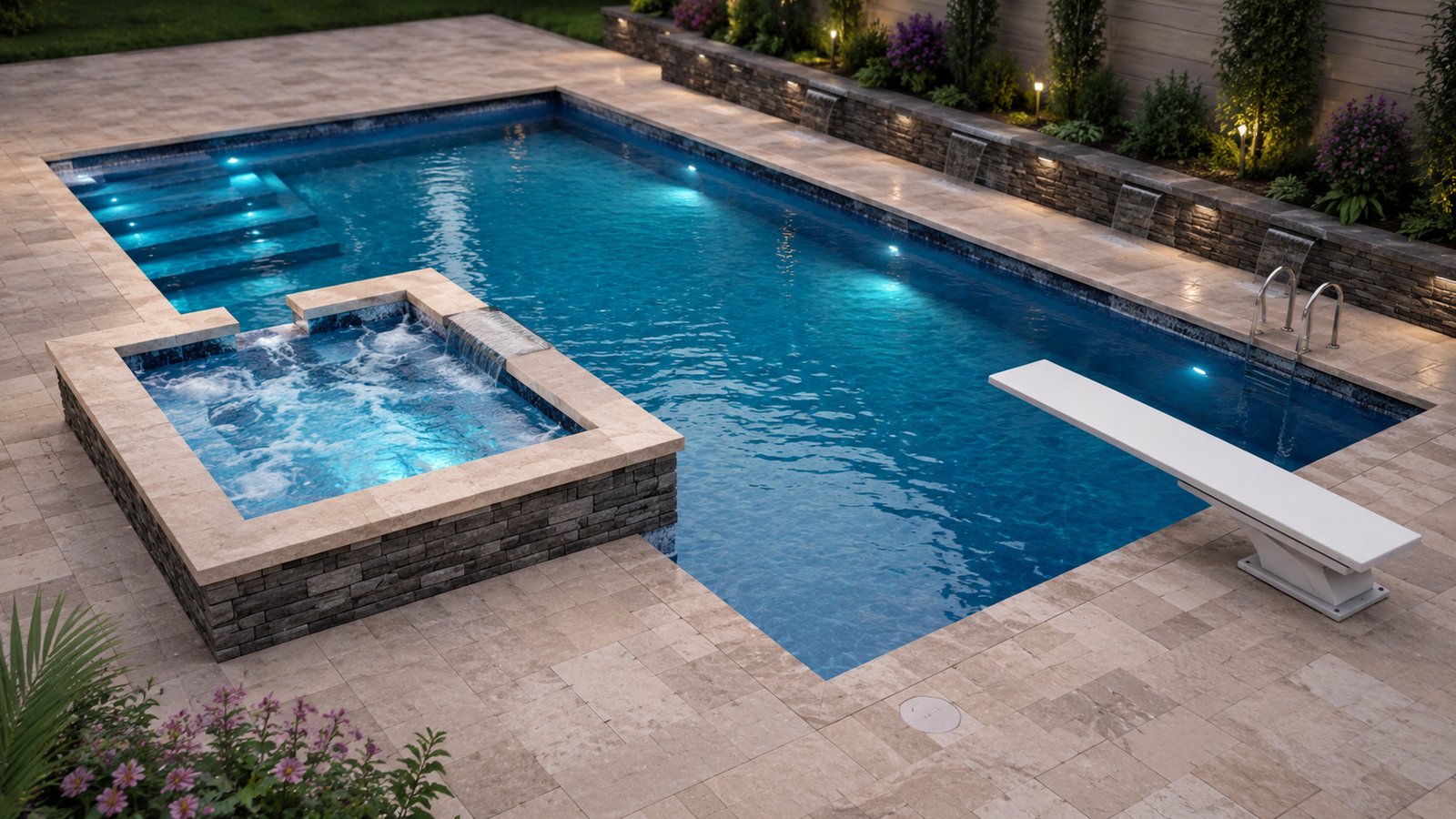
A swimming pool becomes far more valuable when its design supports different ways of enjoying the water. Some people want a peaceful place to unwind after a long day, while others want an energetic space for swimming, diving and family entertainment. Combining a custom jacuzzi with a diving board for inground pool can meet both expectations within one carefully planned outdoor environment.
These features, however, should not be treated as simple accessories. A jacuzzi involves heating, water circulation, jet positioning and comfortable seating, while a diving board requires appropriate pool geometry, structural support and strict attention to safety. The best results come from designing the entire pool as one coordinated system.
Why Custom Pool Features Are Becoming More Important
Standard swimming pools provide basic functionality, but customised features allow homeowners, resorts and hospitality properties to create spaces around actual user needs.
A custom jacuzzi can become a dedicated relaxation zone, while a diving board for inground pool creates an activity-focused area.
Together, they can provide:
- Relaxation and hydrotherapy
- Recreational diving
- Family entertainment
- Improved outdoor ambience
- More personalised pool layouts
- Distinct zones for different activities
- Greater flexibility in pool usage
The important principle is balance. Relaxation areas and active diving areas should complement rather than interfere with each other.
How a Custom Jacuzzi Is Designed Around the User
Unlike an off-the-shelf spa, a custom jacuzzi can be developed according to the property’s dimensions, architectural style and expected number of users.
The design process normally considers seating capacity, water depth, jet configuration, temperature requirements, access and surrounding materials.
For example, a family-oriented jacuzzi may require several comfortable seating positions, whereas a smaller private spa might prioritise deep seating and targeted hydrotherapy jets.
Seating Configuration Matters
Comfort starts with seating geometry. Different seat heights can accommodate users of varying heights while also creating different water immersion levels.
Design possibilities include:
- Bench-style seating
- Individual moulded seats
- Lounger-style seating
- Corner seating
- Multi-level seating
Good seat placement should also allow users to enter and leave the spa conveniently.
Hydrotherapy Jet Placement
Simply installing more jets does not necessarily create a better spa.
Jets should be positioned according to their intended function. Some may target the upper back and shoulders, while others can be positioned around the lower back, legs or feet.
Correct pump capacity and plumbing design are essential because the system must provide sufficient flow to operate the selected jets effectively.
Heating and Circulation in a Custom Jacuzzi
Temperature control is one of the major differences between a jacuzzi and a conventional swimming pool.
A custom jacuzzi generally operates at a warmer temperature, making appropriate heating equipment essential. Heat loss can also become significant when the spa is exposed to outdoor conditions.
Energy-conscious planning may include:
- Appropriate insulation
- Efficient heating equipment
- A properly fitted spa cover
- Programmable temperature controls
- Correctly sized circulation equipment
Filtration and sanitisation must also be designed for the spa’s water volume and usage patterns.
Understanding the Diving Board for Inground Pool
Installing a diving board for inground pool requires more technical assessment than many homeowners initially expect.
A diving board projects a swimmer forward into the water. Therefore, safe use depends not only on depth immediately below the board but also on sufficient underwater clearance throughout the diving trajectory.
The pool’s length, width, depth profile and floor transition must all be considered.
Why Pool Depth Alone Is Not Enough
A common misconception is that any deep swimming pool can accommodate a diving board.
In reality, professionals consider the complete diving envelope. This includes the volume of unobstructed water required for entering the pool and moving safely underwater.
Factors include:
- Deep-end water depth
- Distance from the diving board
- Pool width
- Floor slope
- Transition towards shallow water
- Board height
- Board projection
- Manufacturer specifications
Local building and swimming-pool regulations may impose additional requirements.
Choosing the Appropriate Diving Board
A diving board for inground pool should always be selected according to the pool design rather than appearance alone.
Different systems have different dimensions, weight ratings, mounting requirements and performance characteristics.
| Feature | Flexible Diving Board | Diving Platform |
| Movement | Provides controlled flex | Usually rigid |
| User experience | More dynamic | Simple entry point |
| Structural requirements | Specific mounting system | Platform-specific mounting |
| Pool compatibility | Requires approved diving envelope | Requires suitable deep-water area |
| Installation | Professional installation recommended | Professional assessment required |
Always follow the board manufacturer’s compatibility and installation requirements.
Designing a Pool with Both Features
A custom jacuzzi and diving board for inground pool can coexist successfully when the pool is divided into functional zones.
The diving area should remain unobstructed. The jacuzzi can then be positioned at another end or side of the pool where users can relax without entering the diving path.
A Practical Layout Approach
One possible configuration could include:
- Diving board at the deep end
- Open swimming zone through the centre
- Shallow recreational area at the opposite end
- Raised jacuzzi positioned beside the shallow section
- Decking around the entire pool
- Equipment room positioned for convenient maintenance
The exact arrangement should always reflect available space and engineering requirements.
Structural and Technical Considerations
Both features place different demands on the pool structure.
A built-in custom jacuzzi may require dedicated plumbing lines, jet pumps, heating equipment, drainage and structural reinforcement.
A diving board requires a mounting system capable of safely transferring loads into the supporting structure.
Plumbing Requirements
Jacuzzi plumbing may include separate systems for:
- Water circulation
- Hydrotherapy jets
- Air injection
- Filtration
- Heating
- Drainage
Correct pipe sizing helps maintain consistent water flow and reduces unnecessary pressure losses.
Electrical Planning
Pumps, heaters, controls and underwater lighting require professionally designed electrical connections suitable for wet environments.
Electrical installation should comply with applicable local codes and pool safety requirements.
Safety Should Influence Every Design Decision
Luxury features should never compromise practical safety.
Slip-resistant surfaces are particularly important around spa entrances and diving areas. Steps, handholds and pathways should also remain visible and unobstructed.
For a diving board for inground pool, users should understand that the diving area is specifically intended for forward diving and should remain clear whenever the board is being used.
For a custom jacuzzi, temperature management, safe entry and exit, appropriate drainage and secure electrical systems are equally important.
Materials That Support Long-Term Performance
Materials should be selected for appearance, durability and resistance to water and pool chemicals.
Suitable options may include:
- Porcelain pool tiles
- Glass mosaics
- Textured stone
- Specialist pool finishes
- Slip-resistant decking
- Corrosion-resistant fittings
A customised jacuzzi can use finishes matching the main pool to create a unified appearance.
Maintenance and Long-Term Ownership
Beautiful pool features remain enjoyable only when they are maintained properly.
Jacuzzi filters, pumps, jets, heaters and water chemistry require routine attention. The smaller volume and warmer water of a spa can mean water conditions change more quickly than in the main swimming pool.
The diving board for inground pool should also be inspected periodically.
Check for:
- Loose mounting hardware
- Surface deterioration
- Unexpected movement
- Corrosion
- Damage around the base
- Wear specified by the manufacturer
Damaged components should be assessed before further use.
Frequently Asked Questions
What makes a custom jacuzzi different from a standard hot tub?
A custom jacuzzi can be designed specifically for the property’s dimensions, seating requirements, finishes, jets and integration with the swimming pool.
Can a jacuzzi be constructed inside an existing swimming pool?
Sometimes. Structural conditions, available space and existing plumbing must first be professionally assessed.
Does a custom jacuzzi need a separate heater?
It often does because spa water generally operates at a different temperature from swimming-pool water.
Can every deep pool use a diving board?
No. A suitable diving board for inground pool requires an appropriate diving envelope, not simply a deep section.
How should I choose a diving board?
Selection should consider pool geometry, manufacturer specifications, mounting requirements and applicable safety standards.
Can the jacuzzi be located near the diving board?
It is generally better to separate relaxation areas from active diving zones so the diving path remains unobstructed.
Are spa jets customisable?
Yes. Their number, type and positioning can be customised according to seating arrangements and desired hydrotherapy effects.
Is a diving platform the same as a diving board?
No. A platform is generally rigid, whereas many traditional diving boards provide controlled flexibility.
What surface is suitable around a jacuzzi?
A durable, water-resistant and slip-resistant surface is preferable around frequently wet areas.
Can LED lighting be added to both areas?
Purpose-designed pool and spa lighting can be incorporated when installed according to relevant electrical requirements.
Which feature should be planned first?
Ideally, the custom jacuzzi and diving board for inground pool should both be considered during the initial pool-design process.
Do these features require professional maintenance?
Professional inspections can be valuable for heaters, pumps, electrical systems, structural components and diving-board mounting hardware.
Read more – https://gosarkarijobs.com/how-swimming-pool-manufacturers-in-india-are-redefining-the-modern-designer-pool/
https://newsgrow.blogspot.com/2026/08/swimming-pool-manufacturers-in-india.html
https://newsgrow.blogspot.com/2026/08/frp-swimming-pool-manufacturers-in.html
https://newsgrow.blogspot.com/2026/08/fiberglass-pool-manufacturers-near-me.html
https://blogstream.net/why-a-readymade-fiberglass-pool-is-becoming-a-smart-choice-for-modern-homes/
https://newsgrow.blogspot.com/2026/08/fiberglass-inground-pools-and-readymade.html
https://newsgrow.blogspot.com/2026/08/terrace-readymade-swimming-pool-and.html
https://newsgrow.blogspot.com/2026/08/hydrotherapy-swimming-pool-manufacturer.html
https://newsgrow.blogspot.com/2026/08/deep-information-about-swimming-pool.html
https://newsgrow.blogspot.com/2026/08/custom-jacuzzi-and-diving-board-for.html