
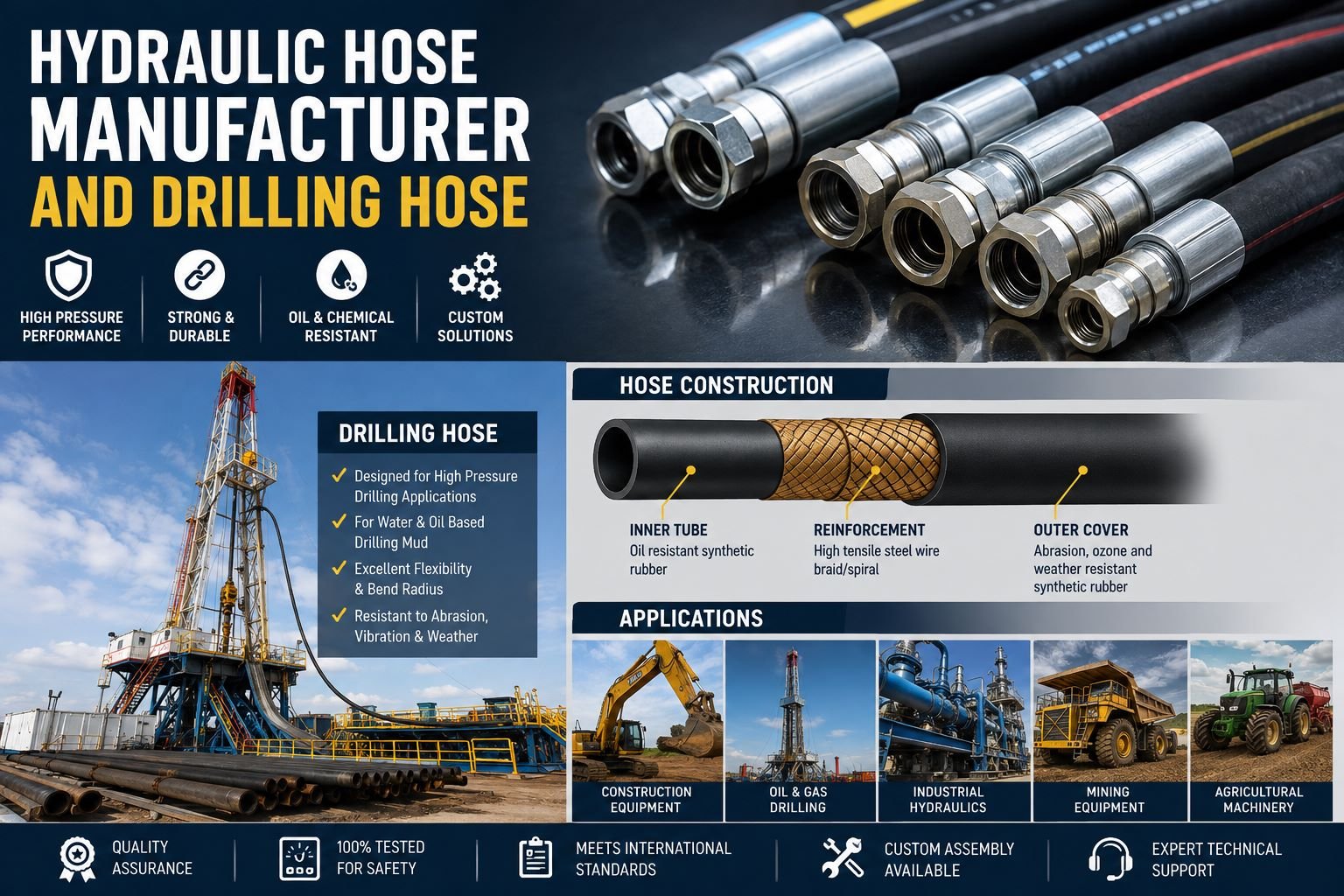
Industrial fluid-power systems operate under conditions where a small component can influence the reliability of an entire machine. Hydraulic hoses are a clear example. They carry pressurised fluids while accommodating movement, vibration and installation constraints that rigid pipelines cannot easily handle. This makes selecting a dependable Hydraulic Hose Manufacturer particularly important for construction, mining, manufacturing, marine and energy applications.
The requirements become even more specialised with a drilling hose. Drilling environments may involve high pressures, abrasive media, continuous movement and demanding outdoor conditions. Rather than treating a hose as a replaceable commodity, engineers and procurement teams should evaluate it as an engineered part of the fluid-transfer system.
The Engineering Role of a Hydraulic Hose Manufacturer
A professional Hydraulic Hose Manufacturer does more than produce flexible rubber tubing. Manufacturing requires careful coordination between materials, reinforcement technology, dimensions, pressure requirements and end connections.
A typical hydraulic hose consists of:
- A fluid-compatible inner tube
- One or more reinforcement layers
- Bonding layers between components
- An abrasion- and weather-resistant cover
- Compatible couplings and fittings
Each element performs a different function. The tube contains the fluid, reinforcement provides pressure strength, and the outer cover protects the structural layers from external damage.
The manufacturer must ensure these components operate together under the intended working conditions.
Why Hydraulic Hose Quality Matters
Hydraulic systems can experience pressure fluctuations, machine movement, heat and repeated operating cycles. Poorly selected hoses may deteriorate prematurely even when their nominal dimensions appear correct.
Quality becomes particularly important in applications involving:
- Excavators and loaders
- Mining equipment
- Agricultural machinery
- Industrial presses
- Material-handling equipment
- Offshore machinery
- Drilling equipment
- Heavy construction machines
A reliable Hydraulic Hose Manufacturer should therefore understand both hose construction and real-world operating conditions.
Understanding Drilling Hose Technology
A drilling hose is designed for demanding fluid-transfer duties associated with drilling operations. Depending on the specification, these hoses may carry drilling mud and other approved media between equipment where a flexible connection is required.
Their operating environment can be significantly more severe than that of conventional low-pressure industrial hoses.
What Makes a Drilling Hose Different?
A drilling application can combine several stresses simultaneously:
- High internal pressure
- Large fluid volumes
- Abrasive drilling media
- Equipment vibration
- Dynamic movement
- Outdoor exposure
- Temperature variation
- Mechanical abrasion
For this reason, drilling hose selection should consider the complete application rather than pressure rating alone.
Inside the Construction of a High-Pressure Hose
Understanding hose construction makes it easier to compare products from different manufacturers.
Inner Tube Performance
The innermost layer must remain compatible with the conveyed medium. Fluid incompatibility can cause swelling, hardening, softening or other deterioration.
When purchasing a drilling hose, buyers should clearly identify the drilling medium rather than simply asking for an oil-resistant hose.
Reinforcement Technology
Reinforcement provides the structural strength required to contain internal pressure.
Depending on the hose design, reinforcement may include:
- High-strength textile
- Steel-wire braid
- Multiple spiral-wire layers
High-pressure and heavy-duty applications generally require more sophisticated reinforcement structures.
Protective Outer Cover
The cover protects the hose against environmental and mechanical damage. Depending on service conditions, resistance to abrasion, weather, ozone, oil or other contaminants may be important.
Hydraulic Hose and Drilling Hose Comparison
| Selection Factor | Hydraulic Hose | Drilling Hose |
| Primary function | Hydraulic power transmission | Drilling-fluid transfer |
| Typical application | Mobile and industrial machinery | Drilling equipment |
| Main design concern | Pressure and flexibility | Pressure, flow, vibration and movement |
| Reinforcement | Textile, braided or spiral | Heavy-duty reinforced construction |
| Fluid | Hydraulic fluid | Specified drilling media |
| Installation | Machine hydraulic circuits | Dynamic drilling connections |
| Selection complexity | Application dependent | Highly application specific |
Neither product should be selected purely according to outside diameter or visual similarity.
Key Factors When Ordering a Drilling Hose
Providing complete technical information helps a Hydraulic Hose Manufacturer recommend an appropriate solution.
1. Working Pressure
The selected hose must have an appropriate working-pressure rating for the system. Engineers should also understand possible pressure surges and operating conditions.
2. Hose Diameter
Inside diameter influences fluid velocity and flow capacity. An incorrectly sized hose can affect system efficiency and performance.
3. Temperature
Consider both fluid temperature and surrounding environmental temperature.
4. Media Compatibility
The tube material must be suitable for the fluid being transported.
5. Bend Radius
Every hose has limitations regarding how tightly it can be bent. Installing a drilling hose below its specified minimum bend radius can place unnecessary stress on its structure.
6. End Connections
Fittings must match the equipment connection, pressure requirements and hose construction.
Why Hose Routing Is as Important as Hose Quality
Even a premium hose can perform poorly when installed incorrectly.
Good routing should minimise:
- Sharp bends
- Hose twisting
- Unnecessary tension
- Contact with sharp surfaces
- Excessive movement at fittings
- Exposure to damaging heat sources
A hose should have enough length to accommodate equipment movement without creating excessive slack.
Avoid Twisting During Installation
A hydraulic hose is generally designed to flex, not operate continuously in a twisted condition. Twisting can introduce additional stress into the reinforcement structure.
Installation practices therefore have a direct influence on service performance.
How Manufacturers Control Hose Quality
An established Hydraulic Hose Manufacturer should maintain quality-control procedures throughout production.
Important controls may include:
- Raw-material inspection
- Tube dimensional verification
- Reinforcement inspection
- Cover-quality checks
- Finished-hose dimensional inspection
- Pressure testing where specified
- Assembly inspection
- Product identification and traceability
For specialised drilling hose requirements, customers should also request documentation relevant to the specified standard or project requirements.
Common Mistakes When Purchasing Hydraulic Hoses
One of the biggest mistakes is buying exclusively on price.
Other common errors include:
- Selecting by hose diameter alone
- Ignoring temperature limits
- Using incompatible fluids
- Mixing unsuitable hose and fitting systems
- Ignoring minimum bend radius
- Assuming higher burst pressure automatically means better performance
- Failing to communicate dynamic movement
- Purchasing without checking relevant standards
A technically suitable hose can provide better overall value than a cheaper product that requires frequent replacement.
Signs That a Hose Needs Attention
Routine inspection can identify visible deterioration before it develops further.
Operators should look for:
- Cracked covers
- Severe abrasion
- Exposed reinforcement
- Leakage around fittings
- Bulging
- Flattened sections
- Kinking
- Loose connections
- Unusual deformation
A damaged drilling hose should be evaluated according to manufacturer recommendations and applicable maintenance procedures rather than repaired informally.
How to Evaluate a Hydraulic Hose Manufacturer
Before establishing a supply relationship, ask technical questions.
A capable Hydraulic Hose Manufacturer should be able to explain:
- Available pressure ranges
- Hose construction
- Fluid compatibility
- Temperature limitations
- Fitting options
- Testing procedures
- Product traceability
- Applicable standards
- Custom assembly capabilities
Technical transparency is often a better indicator of manufacturing capability than broad claims such as “best quality” or “maximum durability”.
Applications Across Heavy Industry
Hydraulic and drilling hoses support operations across numerous sectors.
Common applications include:
- Oil and gas equipment
- Mining machinery
- Construction equipment
- Drilling rigs
- Marine systems
- Industrial machinery
- Agricultural equipment
- Material handling
- Infrastructure projects
The exact hose design should always correspond to the operating environment.
Frequently Asked Questions
1. What does a Hydraulic Hose Manufacturer produce?
A Hydraulic Hose Manufacturer produces flexible reinforced hoses designed to transfer pressurised fluids in hydraulic and industrial systems.
2. What is the main purpose of a drilling hose?
A drilling hose provides a flexible connection for transferring specified fluids in demanding drilling operations.
3. How do I select the correct hydraulic hose?
Consider pressure, temperature, fluid compatibility, diameter, fittings, bend radius, routing and applicable standards.
4. Why does reinforcement matter?
Reinforcement enables the hose structure to resist internal pressure while maintaining required flexibility.
5. Can any hydraulic hose carry drilling mud?
No. Hose materials and construction must be specifically suitable for the intended drilling medium and operating conditions.
6. What causes hydraulic hose leakage?
Possible causes include damaged hose material, incorrect fittings, poor assembly, excessive pressure, abrasion and improper installation.
7. Why is bend radius important for drilling hose installation?
Excessive bending can stress the hose structure, restrict movement and contribute to premature deterioration.
8. Should I select a hose according to burst pressure?
No. Normal system operation must be based on the specified working-pressure rating, not the burst-pressure value.
9. Can hydraulic hoses be customised?
Yes. Depending on manufacturing capabilities, hose length, fittings, dimensions and construction can be configured for specific applications.
10. How should hydraulic hoses be inspected?
Check regularly for leakage, abrasion, cracks, deformation, exposed reinforcement and fitting damage.
Read more – https://newsgrow.blogspot.com/2026/08/hydraulic-hose-manufacturer-and.html