
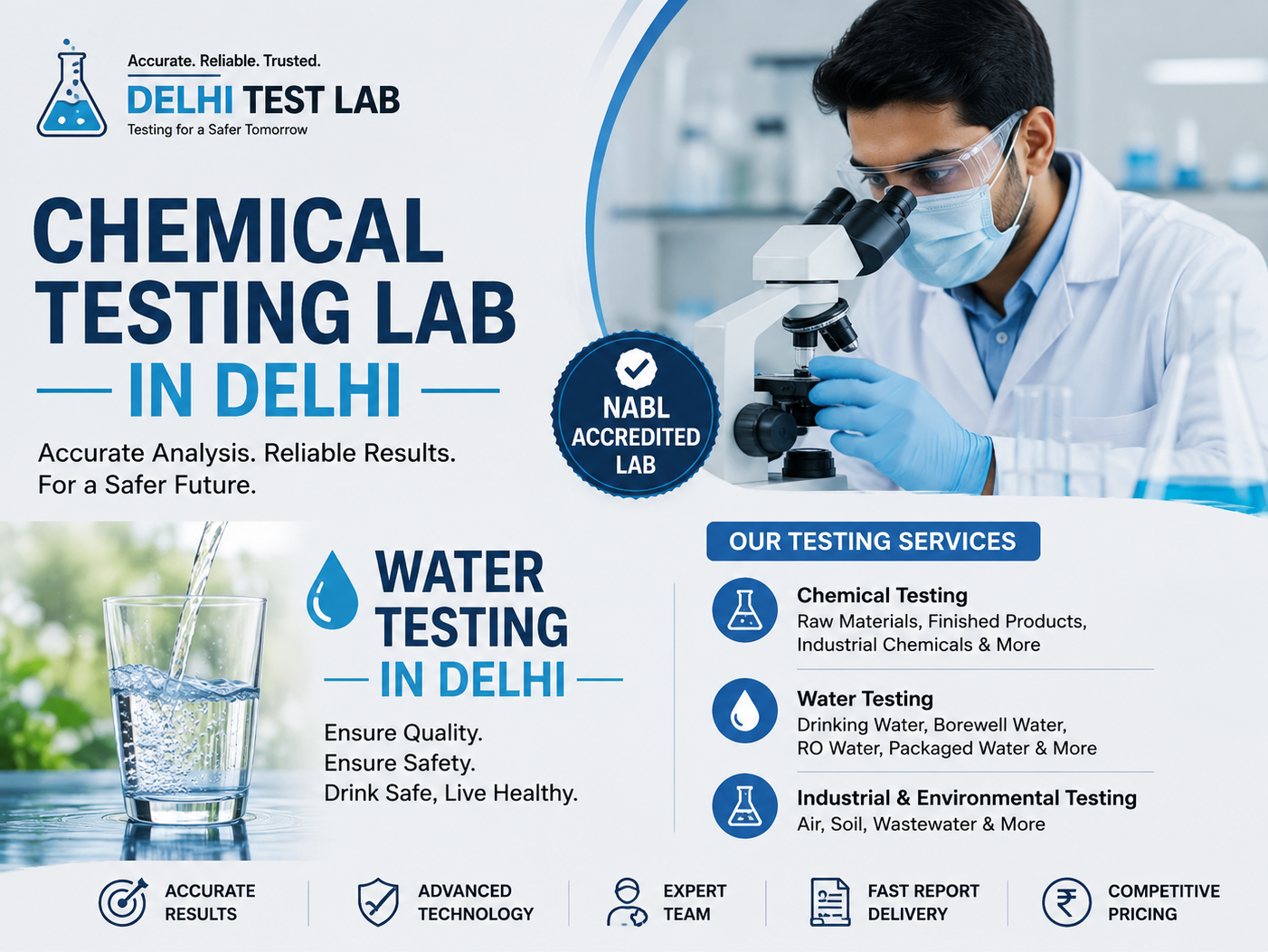
Laboratory testing is an essential part of quality assurance. From manufacturers checking raw materials to residential societies evaluating their water supply, accurate testing helps turn uncertainty into measurable information. A professional chemical testing lab in Delhi can examine the composition, purity, characteristics and possible contaminants of a wide range of materials.
Similarly, water testing in Delhi is important for drinking water, groundwater, industrial water, treated water and wastewater. Water that looks perfectly clear may still contain dissolved minerals, excessive salts, metals or microorganisms. Laboratory analysis helps identify these factors and supports better decisions about treatment, usage and quality control.
Why Chemical Testing Has Become Important in Delhi
Delhi and the wider NCR region support manufacturing, construction, healthcare, food processing, hospitality, pharmaceuticals and numerous other industries. Each sector deals with materials whose chemical properties can directly influence product quality or operational performance.
A chemical testing lab in Delhi can help determine whether a material meets specified technical requirements.
Testing is commonly required for:
- Industrial chemicals and raw materials
- Water and wastewater
- Construction materials
- Metals and alloys
- Food-related materials
- Paints and coatings
- Cosmetics
- Petroleum products
- Packaging materials
- Soil and environmental samples
Rather than relying only on supplier specifications or visual inspection, laboratory analysis provides measurable data about the submitted sample.
What Happens Inside a Chemical Testing Laboratory?
Chemical testing is not simply about placing a sample into an instrument and generating a report. Reliable analysis involves several controlled stages.
Sample Identification and Preparation
The laboratory first identifies the sample and determines the appropriate preparation method. Depending on the material, preparation may involve dilution, digestion, filtration, extraction, grinding or drying.
Selection of Test Parameters
The required parameters are selected according to the product, purpose of testing, customer requirements and applicable test methods.
Analytical Testing
Laboratory professionals use suitable analytical techniques and equipment to determine the required characteristics.
Evaluation and Reporting
After analysis and appropriate quality checks, results are documented in a laboratory test report.
This systematic approach is one reason businesses prefer an established chemical testing lab in Delhi for quality-control and compliance-related requirements.
Water Testing in Delhi: More Than Checking TDS
One common misunderstanding is that checking TDS alone determines whether water is suitable for use.
TDS measures the concentration of dissolved substances collectively, but it does not identify every individual contaminant or microbiological concern. Therefore, comprehensive water testing in Delhi may require several physical, chemical and microbiological parameters.
The exact test profile should always depend on the source and intended use of the water.
Major Parameters Used to Evaluate Water Quality
A laboratory may analyse different combinations of parameters.
| Parameter | What It Helps Evaluate |
| pH | Acidity or alkalinity |
| Turbidity | Suspended particles and water clarity |
| TDS | Overall dissolved solids |
| Total Hardness | Calcium and magnesium-related hardness |
| Chloride | Chloride concentration |
| Fluoride | Fluoride level |
| Nitrate | Nitrate concentration |
| Iron | Presence of iron |
| Alkalinity | Acid-neutralising capacity |
| Microbiological Tests | Indicators of microbial contamination |
Additional parameters may be required depending on whether the sample comes from municipal supply, groundwater, a treatment plant or an industrial process.
Different Types of Water Require Different Testing
Choosing the correct test package is more important than simply asking for a “complete water test.”
Drinking Water
Testing may focus on physical, chemical and microbiological characteristics relevant to drinking-water quality.
Borewell and Groundwater
Groundwater analysis may require particular attention to hardness, TDS, fluoride, nitrate, iron and other location-dependent parameters.
Industrial Process Water
Industries may need to evaluate characteristics that can influence manufacturing processes, equipment performance or final product quality.
Boiler and Cooling Water
Parameters associated with scaling, deposits and corrosion become particularly important.
Wastewater and Effluent
Wastewater analysis can include parameters relevant to treatment performance, discharge requirements and environmental monitoring.
Therefore, when requesting water testing in Delhi, always tell the laboratory where the sample comes from and why you need it tested.
Chemical Testing vs Water Testing
| Chemical Testing | Water Testing |
| Covers many materials and products | Specifically evaluates water samples |
| Can determine composition and purity | Evaluates water-quality parameters |
| Used across multiple industries | Used by homes, industries and institutions |
| Methods vary significantly by material | Methods depend on source and intended water use |
| Supports product and material quality control | Supports water quality and treatment decisions |
Both forms of testing depend heavily on correct sampling, suitable methods and technically competent analysis.
Why Sampling Can Change Your Test Results
Even an advanced laboratory cannot completely compensate for an unrepresentative or contaminated sample.
For accurate water testing in Delhi, proper sampling procedures are particularly important.
Consider these basic practices:
- Obtain the correct sampling bottle from the laboratory where necessary.
- Collect water from a representative location.
- Avoid touching the internal surface of the bottle or cap.
- Label the sample correctly.
- Follow preservation and transportation instructions.
- Submit time-sensitive samples promptly.
- Follow specific laboratory guidance for microbiological testing.
Industrial and regulatory sampling may require additional documented procedures.
How to Select a Reliable Chemical Testing Lab in Delhi
Price should be only one factor when comparing laboratories.
Technical Competence
Confirm that the laboratory has experience with your particular material and required parameters.
Appropriate Testing Methods
Ask which standard or analytical method will be used, particularly when results are needed for contractual, regulatory or customer requirements.
Laboratory Accreditation
Where accreditation is necessary, check the laboratory’s current accreditation status and scope. A laboratory being accredited does not automatically mean every possible test it offers falls within its accredited scope.
Reporting Quality
A useful test report should clearly communicate the sample identification, parameters, units, results and relevant test methods or references where applicable.
Who Can Benefit From Laboratory Testing?
Demand for chemical testing lab in Delhi services is not limited to large manufacturers.
Testing can benefit:
- Manufacturing companies
- Construction businesses
- Hotels and restaurants
- Schools and colleges
- Hospitals and healthcare facilities
- Housing societies
- Offices and commercial buildings
- Food-processing businesses
- Environmental consultants
- Facility management companies
- Individual households
For organisations, periodic testing can also become part of an ongoing quality-management programme.
Frequently Asked Questions
1. What is chemical laboratory testing?
Chemical laboratory testing determines selected chemical characteristics, composition, concentration, purity or contaminants within a submitted sample.
2. Where can drinking water be tested in Delhi?
Drinking water can be submitted to a competent laboratory providing water testing in Delhi. Choose a laboratory capable of performing the parameters relevant to your testing objective.
3. Is TDS enough to determine drinking water quality?
No. TDS provides useful information about dissolved solids but does not provide a complete assessment of chemical and microbiological quality.
4. Can a laboratory test borewell water?
Yes. Borewell and groundwater samples can be analysed for physical, chemical and, where required, microbiological parameters.
5. Can chemical laboratories test industrial products?
Yes. Depending on their capabilities, laboratories can analyse raw materials, chemicals, metals, coatings, construction materials and numerous industrial products.
6. What is the cost of water testing in Delhi?
Testing cost depends on the number of parameters, analytical methods, sample type and required reporting scope. A laboratory should provide a quotation based on your actual requirements.
7. How much sample should I submit?
Required sample quantity varies considerably between tests. Contact the laboratory before collecting or sending the sample.
8. Can wastewater also be tested?
Yes. Water testing in Delhi can cover wastewater, treated wastewater, STP samples, ETP samples and industrial effluents where the laboratory has the required capability.
9. Why are microbiological tests important?
They can help identify indicator organisms associated with microbiological water quality that cannot be detected simply by looking at the water.
10. How do I choose the right chemical testing lab?
Compare technical capability, testing methods, accreditation scope where relevant, sample handling, turnaround time and reporting quality.
https://newsgrow.blogspot.com/2026/08/chemical-testing-lab-in-delhi-and-water.html