
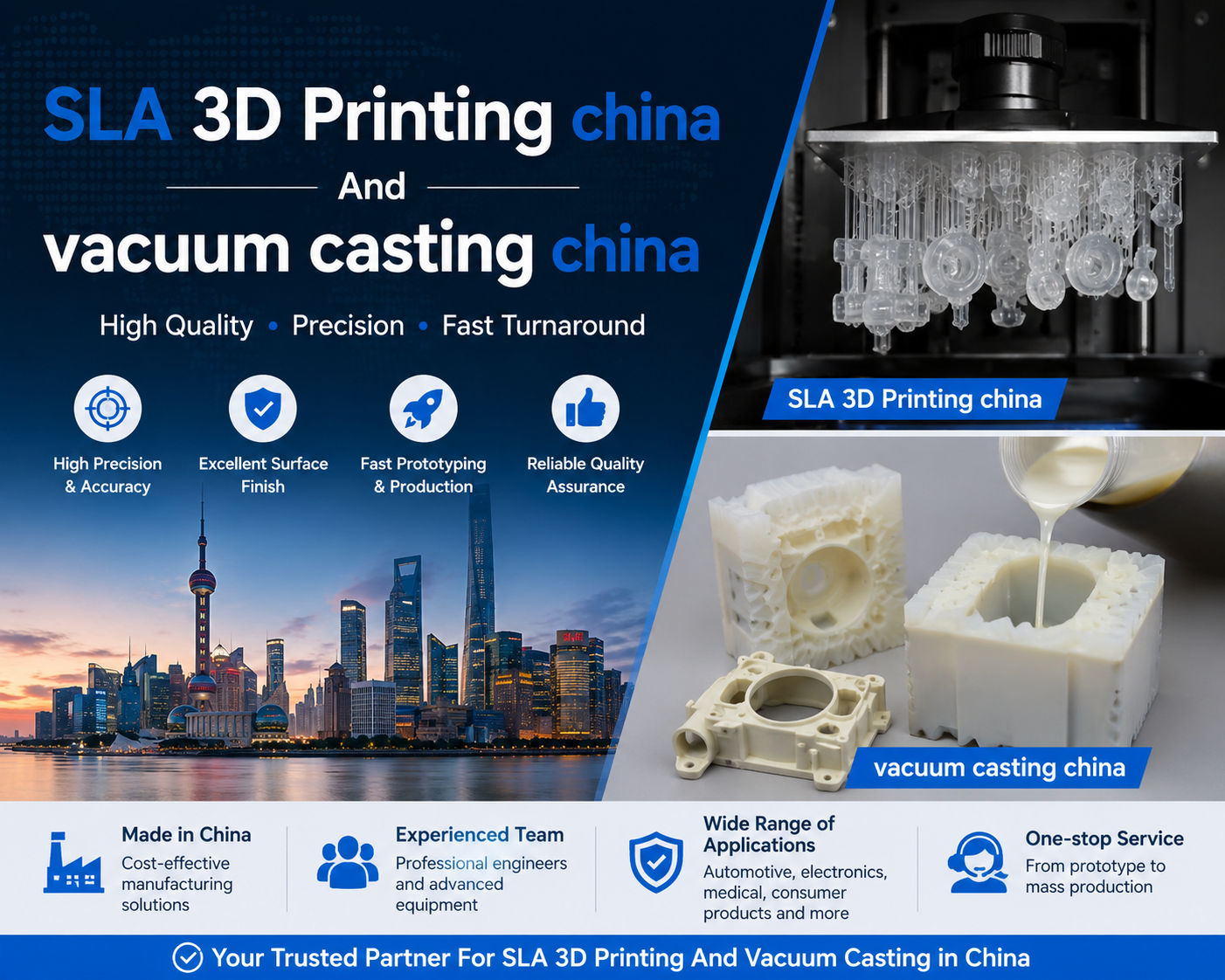
Turning a digital product concept into a physical component is one of the most important stages of modern manufacturing. Engineers need to examine dimensions, test assemblies, assess appearance and identify design problems before committing significant resources to production tooling. This is where SLA 3D Printing China and vacuum casting China provide practical manufacturing options.
Both technologies are widely associated with rapid prototyping and low-volume production, but their roles are different. SLA transforms CAD data directly into detailed resin components, while vacuum casting uses a master pattern and silicone mould to reproduce multiple plastic-like parts.
For companies developing electronics, automotive components, medical devices, industrial products or consumer goods, understanding these processes can help reduce unnecessary development cycles and select the right manufacturing route.
Understanding SLA 3D Printing China
SLA 3D Printing China uses stereolithography, a form of additive manufacturing based on photopolymer resin. Instead of cutting material away from a solid block, SLA creates a component progressively from a liquid resin.
A controlled light source selectively cures the resin according to information obtained from the three-dimensional CAD model. Each cured layer becomes part of the final geometry until the entire component has been created.
After printing, the component typically requires cleaning, support removal and post-curing.
SLA is especially attractive when a project requires:
- Fine surface details
- Complex geometries
- Smooth cosmetic surfaces
- Rapid design verification
- Small quantities
- Presentation models
- Master patterns
- Transparent or translucent prototypes
Because conventional hard tooling is not necessary, designers can modify their CAD files and manufacture revised prototypes relatively quickly.
Why SLA Has Become Important in Rapid Prototyping
Speed alone does not make a prototype useful. A successful prototype must provide meaningful information about the product.
With SLA 3D Printing China, engineers can physically evaluate designs that previously existed only on a computer screen.
Visual Design Verification
Physical models help designers evaluate proportions, curves, openings, surface transitions and overall appearance.
Assembly Checking
Multiple SLA components can be manufactured to determine whether individual parts fit together correctly before moving towards production.
Design Communication
Physical prototypes make it easier for engineering teams, customers and decision-makers to understand a proposed product.
Complex Geometry Development
Internal passages, thin features and intricate external geometries can often be produced without the restrictions associated with conventional machining tools.
Where SLA 3D Printing Is Commonly Used
The versatility of SLA 3D Printing China makes it suitable for different stages of product development.
Typical examples include:
- Electronic device enclosures
- Automotive interior prototypes
- Household appliance components
- Medical equipment housings
- Product demonstration models
- Industrial equipment prototypes
- Transparent covers
- Packaging development models
- Architectural components
- Vacuum-casting master patterns
The correct SLA resin should be selected according to the intended application because different formulations provide different levels of toughness, flexibility, temperature resistance and transparency.
Understanding Vacuum Casting China
While SLA is highly effective for producing individual prototypes, companies sometimes need several identical components for evaluation, exhibitions, customer samples or pilot testing.
This is where vacuum casting China becomes valuable.
Vacuum casting typically uses a high-quality master pattern to manufacture a flexible silicone mould. Liquid casting material is subsequently introduced into the mould under controlled conditions to reproduce the master geometry.
Polyurethane materials are commonly used because different formulations can imitate certain characteristics of familiar production plastics.
The technology is particularly suitable when businesses need low-volume parts but are not yet ready to invest in expensive production tooling.
Step-by-Step Vacuum Casting Process
A typical vacuum casting China project can be divided into several important stages.
Step 1: Manufacture the Master
The process begins with an accurate master pattern. SLA 3D printing or CNC machining can be used depending on the required geometry and finish.
The quality of this master is extremely important because its surface characteristics influence the resulting mould.
Step 2: Prepare the Silicone Mould
The master is positioned inside a moulding frame. Liquid silicone surrounds the model and is allowed to cure.
Once cured, the mould is carefully opened and the master is removed.
Step 3: Prepare the Casting Material
A suitable casting resin is selected according to required hardness, flexibility, appearance, colour and performance characteristics.
Step 4: Cast Under Vacuum
The material is introduced into the mould while vacuum processing helps control unwanted air bubbles and supports detailed cavity filling.
Step 5: Cure and Demould
After curing, the component is carefully removed from the silicone mould.
Step 6: Finish and Inspect
Excess material is trimmed and the component can undergo additional finishing, painting, polishing, printing or assembly.
SLA 3D Printing China vs Vacuum Casting China
The best technology depends on the development objective rather than simply choosing whichever process appears cheaper.
| Consideration | SLA 3D Printing China | Vacuum Casting China |
| Manufacturing method | Additive manufacturing | Silicone mould replication |
| Tooling requirement | No conventional tooling | Silicone mould required |
| Ideal quantity | One-offs and very small batches | Low-volume repeated parts |
| Design changes | Fast and straightforward | May require a new master/mould |
| Material type | Photopolymer resin | Commonly polyurethane |
| Surface finish | Smooth and detailed | Closely follows master finish |
| Initial setup | Lower | Higher |
| Repeated components | Printed individually | Cast from the same mould |
| Typical application | Prototype development | Pre-production batches |
| Master model required | No | Yes |
Neither process completely replaces the other. In many projects, they form part of the same product-development strategy.
Combining SLA 3D Printing and Vacuum Casting
One of the most useful approaches is to combine SLA 3D Printing China and vacuum casting China within a single manufacturing workflow.
A company might first create an SLA prototype to check the appearance and dimensions of a new product.
Engineers review the prototype and modify the CAD model if necessary.
A final SLA component is then manufactured and professionally finished to serve as the vacuum-casting master.
The workflow becomes:
CAD Model → SLA Prototype → Evaluation → Design Revision → Final Master → Silicone Mould → Vacuum Casting → Low-Volume Parts
This approach provides an important advantage: expensive production tooling can be postponed until the design has been more thoroughly evaluated.
Material Selection for SLA Prototypes
Material selection should never be based solely on appearance.
Common SLA resin categories include:
- Standard resin for general prototypes
- Tough resin for stronger functional models
- Flexible resin for softer components
- Clear resin for transparent applications
- Heat-resistant resin for elevated-temperature testing
- High-detail resin for intricate models
Before ordering SLA 3D Printing China, buyers should communicate the intended use of the component to the manufacturer.
For example, a prototype intended only for an exhibition may prioritise surface quality, while an assembly-testing component may require better mechanical properties.
Material Options for Vacuum Casting
One advantage of vacuum casting China is the availability of casting materials with different physical and cosmetic characteristics.
Depending on supplier capabilities, options may include:
- ABS-like polyurethane
- PP-like materials
- Rigid casting resin
- Flexible polyurethane
- Rubber-like materials
- Clear resin
- Coloured materials
- Heat-resistant formulations
However, terms such as “ABS-like” should be understood correctly. They indicate an attempt to approximate selected characteristics rather than guarantee that the material is chemically or mechanically identical to injection-moulded ABS.
What Determines SLA 3D Printing Cost?
Several factors influence the quotation for SLA 3D Printing China.
Part Size
Larger components generally require more material and machine capacity.
Geometry
Complex features and extensive support structures can increase manufacturing and finishing requirements.
Resin Selection
Special-purpose resins can cost more than standard materials.
Surface Finish
A basic prototype and a professionally painted presentation model involve very different levels of post-processing.
Quantity
Multiple identical parts increase total printing and finishing requirements because each SLA component is manufactured separately.
What Determines Vacuum Casting Cost?
The cost structure of vacuum casting China differs because a mould must first be manufactured.
Important factors include:
- Master-pattern production
- Component dimensions
- Silicone mould complexity
- Casting resin
- Required quantity
- Number of mould cavities
- Surface requirements
- Colour matching
- Inserts and embedded components
- Painting or printing
- Inspection requirements
For this reason, buyers should compare total project cost rather than only the price per component.
How to Select a Reliable China Prototyping Partner
A reliable manufacturing partner should be able to discuss more than delivery time and price.
Before selecting a supplier, consider the following:
- Ask about available SLA equipment and materials.
- Review previous prototype examples.
- Confirm vacuum-casting capabilities.
- Provide technical drawings alongside CAD files.
- Clearly identify critical tolerances.
- Define cosmetic surface requirements.
- Request material information.
- Discuss inspection methods.
- Confirm expected lead time.
- Clarify packaging and international shipping arrangements.
Good technical communication can prevent misunderstandings that become expensive later in the development cycle.
Quality Control Should Begin Before Manufacturing
Quality inspection should not be treated as something that happens only after production.
Before manufacturing begins, both the buyer and supplier should agree on important specifications such as dimensions, tolerances, surface finish, colour, material, assembly interfaces and functional requirements.
For SLA 3D Printing China, orientation and post-curing can influence dimensional results.
For vacuum casting China, mould condition, casting material, geometry and curing behaviour can affect part consistency.
Critical dimensions should therefore be clearly marked on engineering drawings.
Frequently Asked Questions
What is SLA 3D printing?
SLA is a resin-based additive manufacturing process that creates three-dimensional components by selectively curing photopolymer resin layer by layer.
Is SLA suitable for rapid prototyping?
Yes. It is particularly useful for detailed prototypes, appearance models, design verification and master-pattern production.
What is vacuum casting used for?
Vacuum casting is primarily used to manufacture small quantities of plastic-like components using silicone moulds.
Does vacuum casting require a master model?
Yes. A high-quality master is required to create the silicone mould.
Can SLA create the master for vacuum casting?
Yes. SLA is frequently selected because it can produce detailed models with high-quality surfaces.
Is vacuum casting suitable for mass production?
Generally, no. It is better suited to low-volume manufacturing and pre-production requirements. Large-scale manufacturing usually requires a different production strategy.
Can SLA produce transparent prototypes?
Yes. Clear SLA resins are available, although additional finishing may be required when high optical clarity is important.
Can vacuum-cast parts be coloured?
Yes. Colour can often be incorporated into the casting material or added through painting and finishing.
Is SLA better than CNC machining?
Neither is universally better. SLA is excellent for complex resin prototypes, while CNC machining may be preferable when components must be produced directly from engineering plastics or metals.
How should I choose between SLA and vacuum casting?
Choose SLA for fast individual prototypes and frequent design revisions. Consider vacuum casting when you require multiple similar plastic-like components after the design has stabilised.
Read more – https://shopnets.com/china-cnc-custom-machining-how-to-choose-the-right-manufacturing-partner/
https://newsgrow.blogspot.com/2026/08/china-cnc-custom-machining-practical.html
https://newsgrow.blogspot.com/2026/08/china-cnc-machining-suppliers-and.html
https://newsgrow.blogspot.com/2026/08/sla-3d-printing-china-and-vacuum.html