
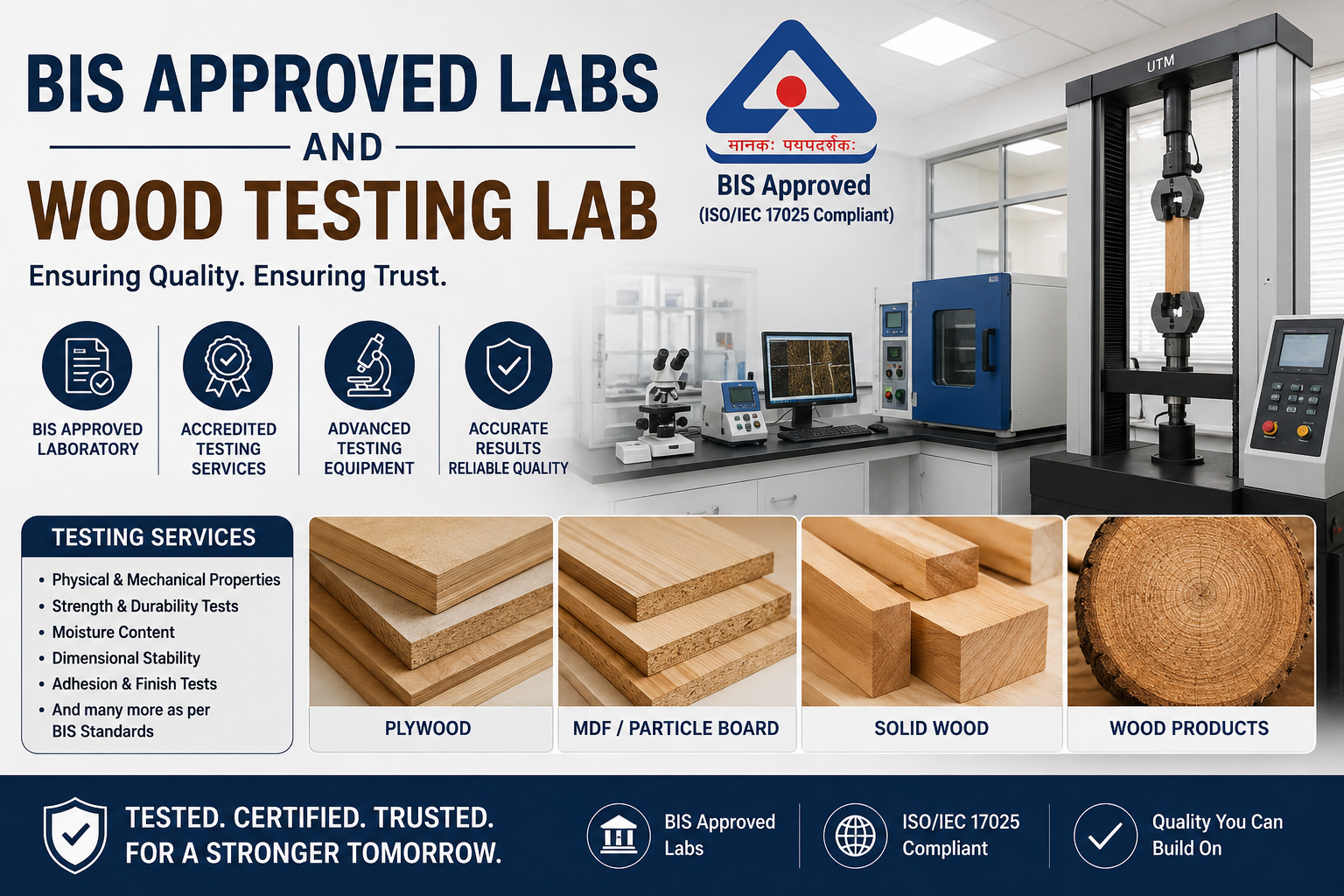
Wood may look strong from the outside, but its actual performance depends on several hidden characteristics. Moisture, density, bonding quality, grain structure, manufacturing defects and mechanical strength can significantly affect how timber or a wood-based product performs over time.
This is where BIS approved Labs and a professional Wood Testing lab become important. Scientific testing provides measurable information about a product’s quality and helps manufacturers, suppliers, contractors and buyers determine whether the material meets the required specifications.
For businesses dealing with plywood, timber, boards, doors, furniture and other wood products, laboratory testing should be considered an essential part of quality assurance rather than simply a final compliance formality.
Understanding the Role of BIS Approved Labs
BIS approved Labs is a commonly searched term for laboratories associated with testing products according to requirements of the Bureau of Indian Standards (BIS).
In practice, businesses should carefully verify the exact recognition status and testing scope of a laboratory. A laboratory may have facilities for testing a particular material but may not necessarily have recognition for every Indian Standard or product category.
Testing through an appropriate laboratory can help manufacturers:
- Assess product conformity
- Verify important performance characteristics
- Maintain consistent production quality
- Detect defective materials
- Generate documented test results
- Support applicable certification processes
- Meet purchaser or tender specifications
The applicable Indian Standard should normally be identified before samples are submitted for testing.
What Does a Wood Testing Lab Actually Do?
A Wood Testing lab scientifically evaluates the characteristics and performance of timber and manufactured wood products.
Unlike basic visual inspection, laboratory testing can reveal properties that cannot reliably be judged by looking at the material.
Products commonly evaluated may include:
- Natural timber
- Commercial plywood
- Structural plywood
- Block boards
- Particle boards
- Fibre boards
- Flush doors
- Wooden panels
- Furniture components
- Packaging wood
- Engineered wood products
The required testing programme depends on the type of product and its intended application.
Why Laboratory Testing of Wood Is Necessary
Wood differs from many industrial materials because it naturally varies. Two pieces of apparently similar timber can behave differently because of moisture level, species, grain direction, density or internal defects.
Manufacturing introduces additional variables when wood is converted into plywood, boards or engineered products.
Laboratory testing therefore provides objective evidence about material performance.
The major reasons for testing include:
- Confirming whether specified quality requirements are achieved.
- Comparing raw materials from different sources.
- Monitoring production consistency.
- Identifying weaknesses before products reach customers.
- Evaluating product suitability for a particular application.
- Supporting quality documentation.
- Reducing rejection and failure risks.
For manufacturers, testing can also provide valuable information for improving production processes.
Important Parameters Checked During Wood Testing
A professional Wood Testing lab may conduct different tests depending upon the applicable standard and product.
Moisture Content Testing
Moisture is one of the most important characteristics of wood.
Changes in moisture can cause wood to expand, shrink, warp or change dimensions. Testing moisture content helps manufacturers determine whether the material has been adequately conditioned for its intended application.
Density Testing
Density provides useful information about the physical characteristics of wood.
It is determined by considering the relationship between the mass and volume of a specimen under specified conditions. Density information may also help when comparing materials or monitoring product consistency.
Mechanical Strength Testing
Wood used in furniture, construction or load-bearing applications may experience considerable forces.
Mechanical evaluation can include parameters such as:
- Bending strength
- Compression strength
- Tensile characteristics
- Shear strength
- Modulus of elasticity
- Modulus of rupture
- Impact resistance
- Fastener holding performance
Testing requirements depend on the product specification.
Water Resistance and Dimensional Stability
Wood-based boards and plywood may be exposed to humidity or moisture during use.
Testing can evaluate characteristics such as:
- Water absorption
- Thickness swelling
- Dimensional changes
- Moisture-related behaviour
- Bond performance where applicable
These results can be especially useful for products intended for environments where moisture exposure is expected.
Wood Testing for Plywood and Engineered Boards
Plywood is manufactured by bonding multiple layers of wood veneer. Consequently, its quality depends not only on the wood itself but also on manufacturing consistency and bonding performance.
A Wood Testing lab may assess relevant plywood characteristics according to the applicable specification.
Similarly, particle boards, fibre boards and other engineered wood products may require tests covering dimensions, density, strength, swelling and other specified properties.
Manufacturers should avoid assuming that one testing procedure applies to every type of board.
Difference Between BIS Related Testing and Routine Wood Testing
| Testing Aspect | BIS approved Labs | General Wood Testing lab |
| Primary focus | Testing associated with specified standards and conformity requirements | Product quality and performance evaluation |
| Testing method | Relevant Indian Standard requirements | Specified national/international/customer method |
| Laboratory status | Recognition must be verified | May be accredited or independent |
| Product coverage | Limited to applicable scope | Depends on available facilities |
| Typical users | Manufacturers seeking compliance support | Manufacturers, buyers, contractors and R&D teams |
| Documentation | Formal test reporting | Test report based on requested parameters |
The most suitable laboratory is therefore determined by the purpose of testing rather than simply its name.
How to Choose a Reliable Testing Laboratory
Before selecting BIS approved Labs or a Wood Testing lab, businesses should perform basic verification.
Check the following:
- Laboratory recognition or accreditation status
- Current scope of testing
- Applicable IS standard
- Product category covered
- Available testing equipment
- Required sample dimensions
- Number of samples needed
- Sample conditioning procedure
- Expected reporting format
- Estimated testing timeline
Never Depend Only on a Laboratory’s Marketing Claims
Always confirm whether the laboratory’s scope actually includes the product and standard you require.
This small verification step can prevent unnecessary testing expenses, repeated sample submission and reports that may not fulfil the intended compliance requirement.
Step-by-Step Wood Testing Process
The typical process can be understood in seven stages:
- Identify the exact wood or wood-based product.
- Determine the intended application.
- Identify the relevant specification or Indian Standard.
- Select a laboratory with appropriate testing capabilities.
- Prepare and submit representative specimens.
- Complete the required physical or mechanical tests.
- Review the laboratory report against applicable requirements.
Where certification is involved, manufacturers should also follow the specific requirements of the relevant conformity assessment process.
How Testing Supports Better Manufacturing
Laboratory testing is valuable beyond certification.
Consider a plywood manufacturer experiencing inconsistent product performance. Instead of changing raw materials randomly, the manufacturer can compare test results from different production batches.
If variations appear in moisture, density, bonding or mechanical performance, production teams have objective information to investigate.
Testing therefore becomes part of process improvement.
It can help businesses establish:
- Raw material acceptance criteria
- Batch-wise quality monitoring
- Supplier evaluation systems
- Production benchmarks
- Finished-product inspection programmes
- Corrective action procedures
This approach turns a Wood Testing lab into a quality-control resource rather than merely a testing service provider.
FAQs About BIS Approved Labs and Wood Testing Lab
1. What are BIS approved Labs?
The phrase commonly describes laboratories used for BIS-related product testing. Businesses should verify the laboratory’s current recognition status and applicable testing scope before submitting samples.
2. What is a Wood Testing lab?
A Wood Testing lab is a facility that evaluates physical, mechanical and other specified characteristics of timber and wood-based products.
3. Why is wood testing required?
Testing provides objective information about characteristics such as moisture, density, dimensional behaviour and mechanical performance.
4. Can plywood be laboratory tested?
Yes. Plywood can be evaluated for relevant physical, dimensional, bonding and mechanical characteristics according to the applicable specification.
5. Are all testing laboratories recognised by BIS?
No. General testing capability does not automatically mean that a laboratory is recognised by BIS for a particular product or Indian Standard.
6. How do I select the correct laboratory?
Identify your product and applicable standard first, then verify whether the laboratory has the required test parameters within its current scope.
7. What is moisture content testing?
It determines the amount of moisture present in wood under specified test conditions and helps evaluate material condition and consistency.
8. What mechanical properties can be tested?
Depending on the product, tests may evaluate bending, compression, tensile, shear, impact and related performance characteristics.
9. How much sample is needed for testing?
Sample requirements vary according to the product, standard and number of parameters being evaluated. Confirm this with the laboratory before dispatch.
10. Does a laboratory test report mean a product is BIS certified?
No. Laboratory testing and BIS certification are not the same thing. Testing may form part of a conformity assessment process, but certification involves its own applicable requirements.
https://newsgrow.blogspot.com/2026/08/chemical-testing-lab-in-delhi-and-water.html
https://newsgrow.blogspot.com/2026/08/bis-approved-labs-and-wood-testing-lab.html