
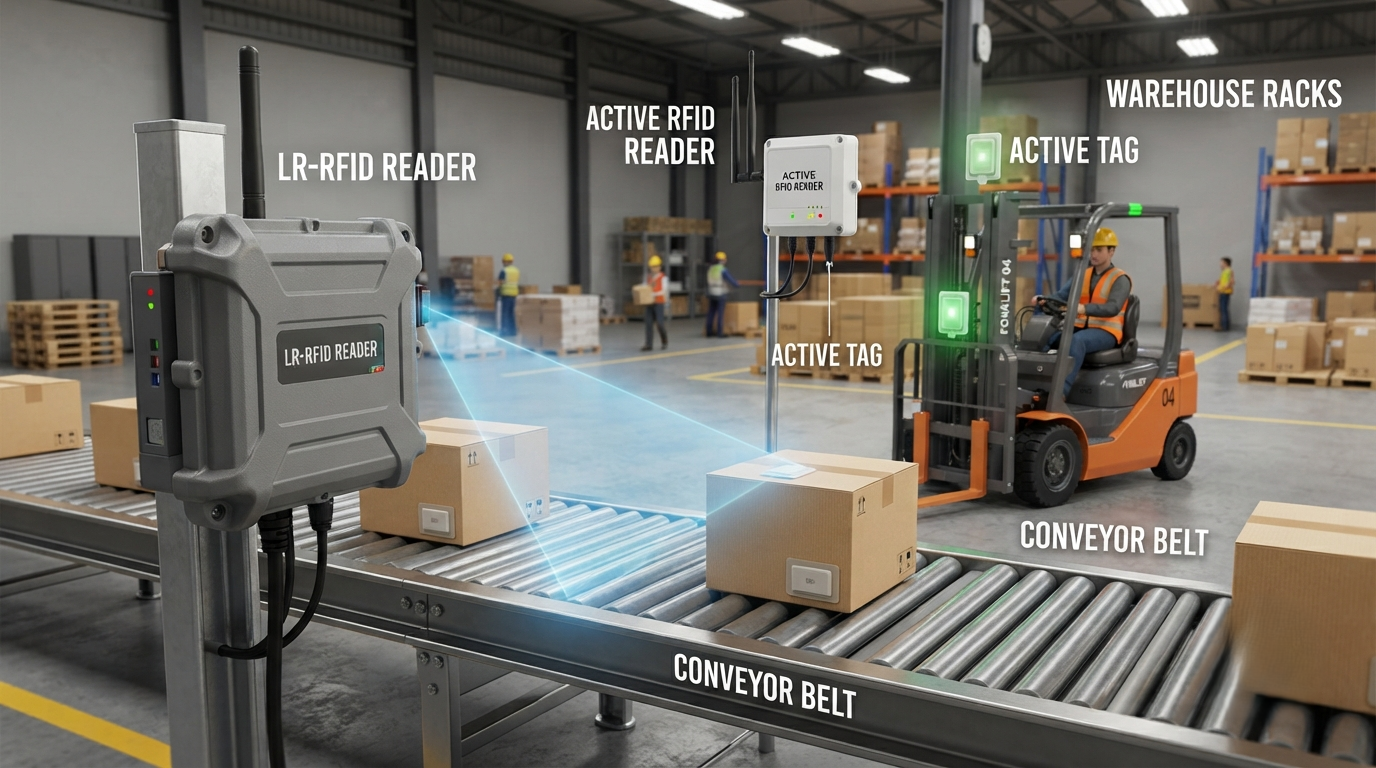
Radio Frequency Identification (RFID) has transformed how organisations identify assets, monitor vehicles, control access, and collect operational data. Instead of relying entirely on manual checks, barcodes, or close-range scanning, RFID allows information to be captured wirelessly and automatically.
Two technologies frequently considered for applications requiring greater reading distance are the Long Range RFID Reader and Active RFID Reader. Although both support automated identification, they work differently and suit different operational environments. Understanding these differences helps businesses select an RFID infrastructure that provides reliable performance without unnecessary complexity.
Understanding Long Range RFID Reader Technology
A Long Range RFID Reader is designed to communicate with compatible RFID tags from greater distances than conventional short-range readers. Depending on the RFID frequency, antenna configuration, tag design, installation environment, and regulatory limits, these systems can identify tags without requiring them to be positioned immediately beside the reader.
Long-range RFID technology is commonly associated with applications such as:
- Vehicle identification and parking management
- Warehouse automation
- Logistics and supply-chain tracking
- Industrial asset identification
- Gate access management
- Inventory movement monitoring
- Manufacturing operations
One important advantage is contactless operation. Vehicles, equipment, pallets, or other tagged objects may be recognised as they approach or pass through a designated RFID reading zone.
How a Long Range RFID Reader Works
A typical reader uses an antenna to transmit radio-frequency signals. Compatible RFID tags within the reading field respond with stored identification information, which the reader captures and transfers to connected software.
The system generally involves four key components: RFID tags, antennas, the RFID reader, and management software.
For passive RFID applications, the tag normally does not require an internal battery. Instead, it receives energy from the reader’s electromagnetic field. This approach can make passive tags practical for large-scale deployments where thousands of objects need individual identification.
Actual read range should never be evaluated using distance specifications alone. Tag orientation, mounting material, interference, antenna placement, transmission power, environmental conditions, and reader configuration can significantly influence real-world performance.
What Is an Active RFID Reader?
An Active RFID Reader communicates with active RFID tags that contain their own internal power source, typically a battery. Because these tags can transmit signals using their own power, active RFID systems can support applications requiring greater communication distances and frequent identification of moving or high-value assets.
They are often considered for:
- Real-time asset location
- Large industrial facilities
- Construction equipment monitoring
- Hospital equipment management
- Container and yard tracking
- Fleet operations
- High-value inventory monitoring
An Active RFID Reader becomes especially valuable when organisations need to identify assets across larger areas rather than only at specific checkpoints.
How Active RFID Systems Operate
Active RFID tags can periodically transmit their identification information or communicate according to the design of the particular system. Readers positioned throughout a facility detect these transmissions and send the collected data to asset-management, security, or tracking software.
A typical workflow includes:
- An active tag is attached to an asset.
- The powered tag transmits its unique identification data.
- A nearby Active RFID Reader detects the transmission.
- Reader data is forwarded to management software.
- The software associates the tag ID with the relevant asset.
- Users can review location or movement information according to system capabilities.
Why Powered Tags Matter
The battery inside an active RFID tag allows it to generate a stronger communication signal than a passive tag that depends entirely on reader-generated energy.
Battery Life Requires Planning
The benefit of powered tags also creates an additional maintenance consideration. Batteries have finite operating lives, so replacement cycles and tag maintenance should be incorporated into the RFID deployment strategy.
Long Range RFID Reader vs Active RFID Reader
The technologies can overlap in their applications, but they should not automatically be treated as interchangeable.
| Feature | Long Range RFID Reader | Active RFID Reader |
| Typical tag type | Often passive RFID | Active, battery-powered RFID |
| Tag battery | Usually not required | Required |
| Infrastructure purpose | Long-distance checkpoint identification | Wider-area asset identification |
| Tag maintenance | Generally low | Battery maintenance required |
| Tag cost | Usually lower | Generally higher |
| Common application | Gates, vehicles, warehouses | Asset location, yards, large facilities |
The correct choice depends on what needs to be identified, the required reading distance, asset movement, environmental conditions, integration requirements, and total system cost.
Business Benefits of Long-Range RFID Technology
RFID should solve an operational problem rather than simply replace an existing identification technology.
A well-planned Long Range RFID Reader installation can reduce the need for employees to manually scan individual items. At vehicle gates, for example, automated identification can make access processes more efficient.
Other potential benefits include improved data capture, reduced manual intervention, faster asset identification, better inventory visibility, and integration with existing business software.
Active RFID offers additional value when organisations need broader asset visibility. Instead of knowing only that equipment passed through a particular doorway, an active RFID infrastructure may help determine its presence within designated operational areas.
Choosing the Right RFID Solution
Selecting RFID hardware should begin with application requirements rather than advertised maximum range.
Organisations should evaluate:
- Required identification distance
- Number and type of tagged assets
- Passive versus active tag requirements
- Asset movement speed
- Indoor or outdoor installation
- Metal and liquid interference
- Number of simultaneous tags
- Network connectivity
- Software integration
- Security requirements
- Maintenance expectations
- Expansion requirements
A site survey and controlled pilot installation can reveal practical issues before full deployment.
Importance of RFID Reader Placement
Even advanced RFID equipment can perform poorly when antennas and readers are incorrectly positioned. RFID performance is influenced by physical surroundings, including walls, metal structures, machinery, vehicles, liquids, and other radio-frequency systems.
For a Long Range RFID Reader, antenna direction should correspond with the intended identification zone. Excessive coverage may cause unintended tags to be captured, while insufficient coverage can create missed reads.
An Active RFID Reader deployment similarly requires careful planning to achieve the required coverage across warehouses, yards, hospitals, factories, or other facilities.
RFID Integration with Business Systems
RFID becomes considerably more useful when reader data connects with operational software.
Integration may include warehouse management systems, enterprise resource planning platforms, access-control systems, asset-management applications, fleet-management software, or customised dashboards.
Instead of simply displaying a tag number, integrated software can translate RFID events into useful information such as asset identity, authorised vehicle status, inventory movement, entry time, or equipment location.
Frequently Asked Questions
1. What is a Long Range RFID Reader?
A Long Range RFID Reader is an RFID device designed to identify compatible tags from greater distances than conventional close-range RFID systems.
2. What is an Active RFID Reader?
An Active RFID Reader receives or exchanges information with battery-powered active RFID tags used for tracking and identification applications.
3. Are long-range and active RFID the same?
No. Long range describes reading capability, while active RFID specifically refers to systems using powered tags.
4. Do long-range RFID tags require batteries?
Not always. Many long-range applications use passive UHF RFID tags that operate without internal batteries.
5. Where are long-range RFID readers commonly used?
They are frequently deployed for vehicle access, logistics, warehouses, industrial automation, inventory movement, and gate management.
6. Where is active RFID commonly used?
Active RFID is useful for tracking valuable or mobile assets across large facilities, yards, hospitals, factories, and logistics operations.
7. What affects RFID reading distance?
Antenna design, frequency, tag orientation, mounting surface, transmission power, environmental interference, reader configuration, and local regulations can all influence performance.
8. Can RFID identify multiple tags?
Many RFID systems support simultaneous identification of multiple tags, although practical performance depends on system design and operating conditions.
9. Can RFID readers integrate with existing software?
Yes. Depending on the reader and software platform, RFID data can often be integrated through APIs, middleware, network interfaces, or customised applications.
10. Which RFID reader should a business choose?
The decision should be based on required range, asset type, environment, tag volume, tracking objectives, maintenance requirements, software compatibility, and budget.