
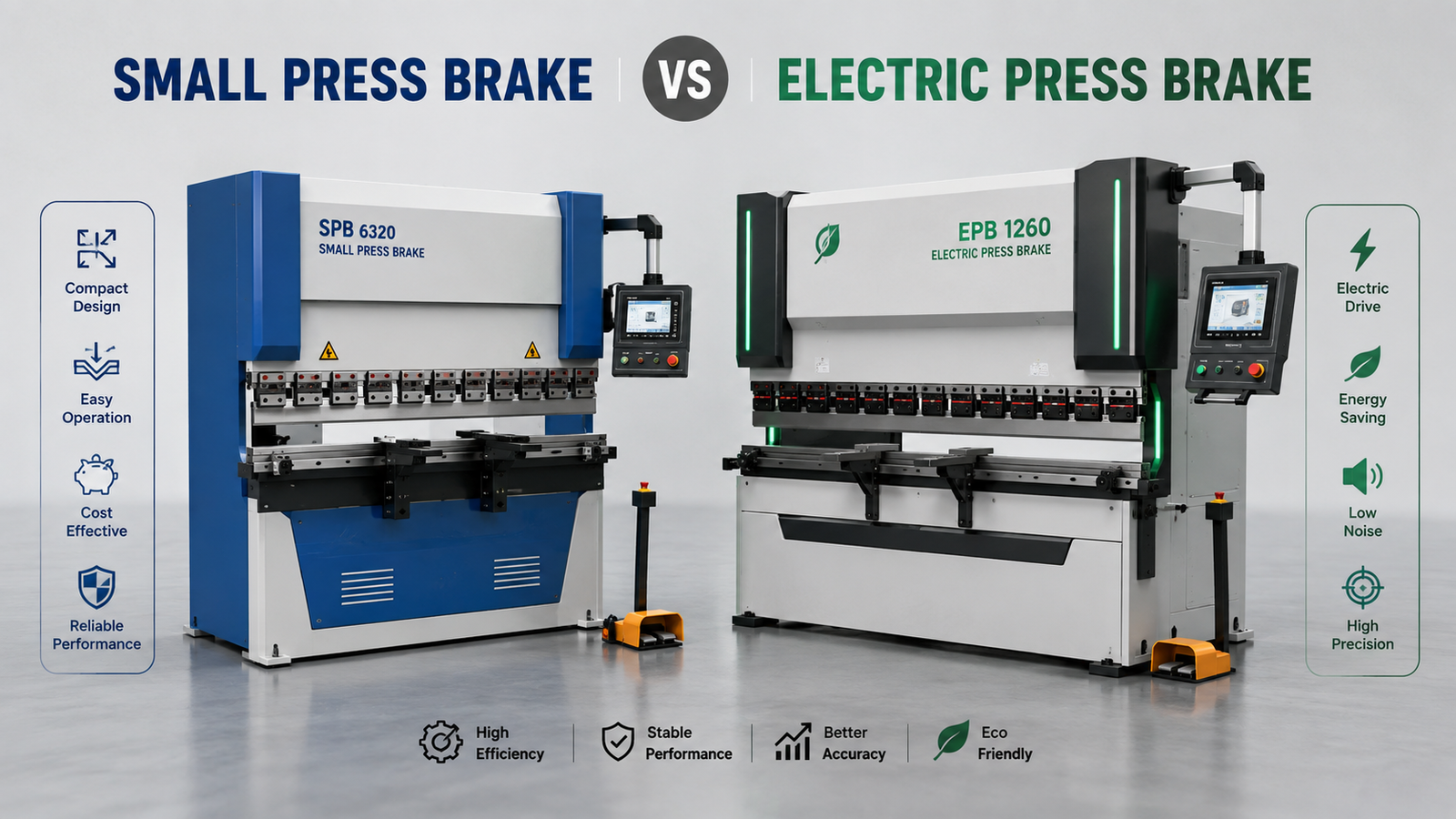
A small press brake is ideal where space, budget, and compact-part production matter. An electric press brake focuses on precision, energy efficiency, repeatability, and responsive control. Understanding them helps fabricators choose equipment that matches goals.
Understanding the Small Press Brake
A small press brake is a compact bending machine designed for short or relatively lightweight sheet metal components. It is commonly used for electrical boxes, brackets, panels, enclosures, kitchen equipment, cabinets, signage parts, and precision fabricated components.
Because of its reduced footprint, a small press brake suits workshops where floor space is limited. Compact machines may include CNC controls, programmable back gauges, safety systems, precision tooling, and digital bend settings.
Key Advantages of a Small Press Brake
The main benefit is flexibility. Manufacturers producing varied small components can change jobs quickly without dedicating a large machine to light work.
Important advantages include:
- Compact footprint
- Lower investment than many larger machines
- Suitable capacity for small components
- Fast setup for short production runs
- Easier operator access
- Lower power demand in many applications
- Compatibility with standard or specialised tooling
What Is an Electric Press Brake?
An electric press brake uses servo-electric drive technology instead of relying completely on a conventional hydraulic system. Depending on the design, electric motors transfer force through belts, screws, pulleys, or other mechanical systems to move the ram.
The purpose is precise, responsive bending with efficient energy consumption. Electric systems can deliver repeatable ram positioning and controlled movement, making them attractive for manufacturers producing tolerance-sensitive components.
Why Manufacturers Choose Electric Press Brakes
Electric press brakes are popular in precision sheet metal operations because their drive systems can offer several practical benefits.
Key advantages include:
- High positioning accuracy
- Excellent bending repeatability
- Reduced idle energy consumption
- Lower dependence on hydraulic oil
- Fast ram movement
- Cleaner operation
- Reduced hydraulic maintenance
- Responsive CNC control
Small Press Brake vs Electric Press Brake
The terms are not direct opposites. A press brake can be both small and electric. However, buyers often compare compact conventional machines with servo-electric models when planning new fabrication capacity.
| Factor | Small Press Brake | Electric Press Brake |
| Main strength | Compact, flexible production | Precision and efficiency |
| Typical use | Small parts and short runs | Precision repetitive bending |
| Floor space | Usually low | Compact to moderate |
| Energy efficiency | Depends on drive system | Generally excellent |
| Maintenance | Depends on machine type | Less hydraulic maintenance |
| Accuracy | Good with quality CNC | Typically very high |
| Best buyer | Flexible job shop | Precision-focused manufacturer |
Applications in Modern Fabrication
Both machine types serve many industries. Common applications include electrical enclosures, control cabinets, HVAC components, automotive brackets, machinery covers, stainless steel kitchen products, laboratory equipment, furniture hardware, lift components, electronics housings, and custom assemblies.
Precision Production
For parts requiring consistent dimensions across repeated batches, CNC-controlled bending improves repeatability. Accurate back gauges position the sheet while stored programs reduce manual measurement.
Short-Run Manufacturing
Compact equipment is valuable for prototypes, repair components, customised orders, and small batches where frequent setup changes are needed.
How to Choose the Right Press Brake
Consider:
- Maximum sheet length
- Material type
- Maximum thickness
- Required bending force
- Flange dimensions
- Required angular accuracy
- Daily production volume
- Tooling compatibility
- CNC controller capability
- Back-gauge configuration
- Safety requirements
- Service availability
Tooling and Bend Quality
Even an advanced press brake cannot compensate for incorrect tooling. Punch radius, die opening, material thickness, grain direction, tensile strength, and bend method affect the final result.
Operators should match tooling to the material and required bend angle. Correct tooling protects the workpiece, reduces marking, and prevents unnecessary machine loading.
Safety and Operator Training
Operators should receive training in tooling installation, machine limits, safe hand positioning, material handling, program verification, and emergency procedures. Safety devices should never be bypassed to increase speed.
Frequently Asked Questions
1. What is a small press brake used for?
It bends compact sheet metal parts such as brackets, boxes, covers, panels, and enclosures.
2. Is a small press brake suitable for production?
Yes. With correct capacity and CNC controls, it can handle prototypes, short runs, and repeat production.
3. What makes an electric press brake different?
It uses an electrically driven ram system rather than depending mainly on conventional hydraulic power.
4. Is an electric press brake energy efficient?
Yes. Power demand is closely linked to machine movement, which can reduce unnecessary energy use.
5. Can electric press brakes achieve high accuracy?
Yes. Servo-electric control can provide excellent positioning and repeatability when correctly configured.
6. Can a small press brake be electric?
Yes. Compact servo-electric press brakes combine a small footprint with electric-drive technology.
7. Which machine is better for small workshops?
A compact model is often practical, but tonnage, bend length, accuracy, volume, and budget should decide the choice.
8. What materials can press brakes bend?
Common materials include mild steel, stainless steel, aluminium, brass, and other formable sheet metals within machine capacity.
9. Does CNC control improve productivity?
Yes. CNC systems store programs, control back-gauge positions, manage bend sequences, and reduce setup time.
10. What should buyers check before purchasing?
Check tonnage, bending length, tooling, accuracy, controller functions, safety features, warranty, training, and technical support.