
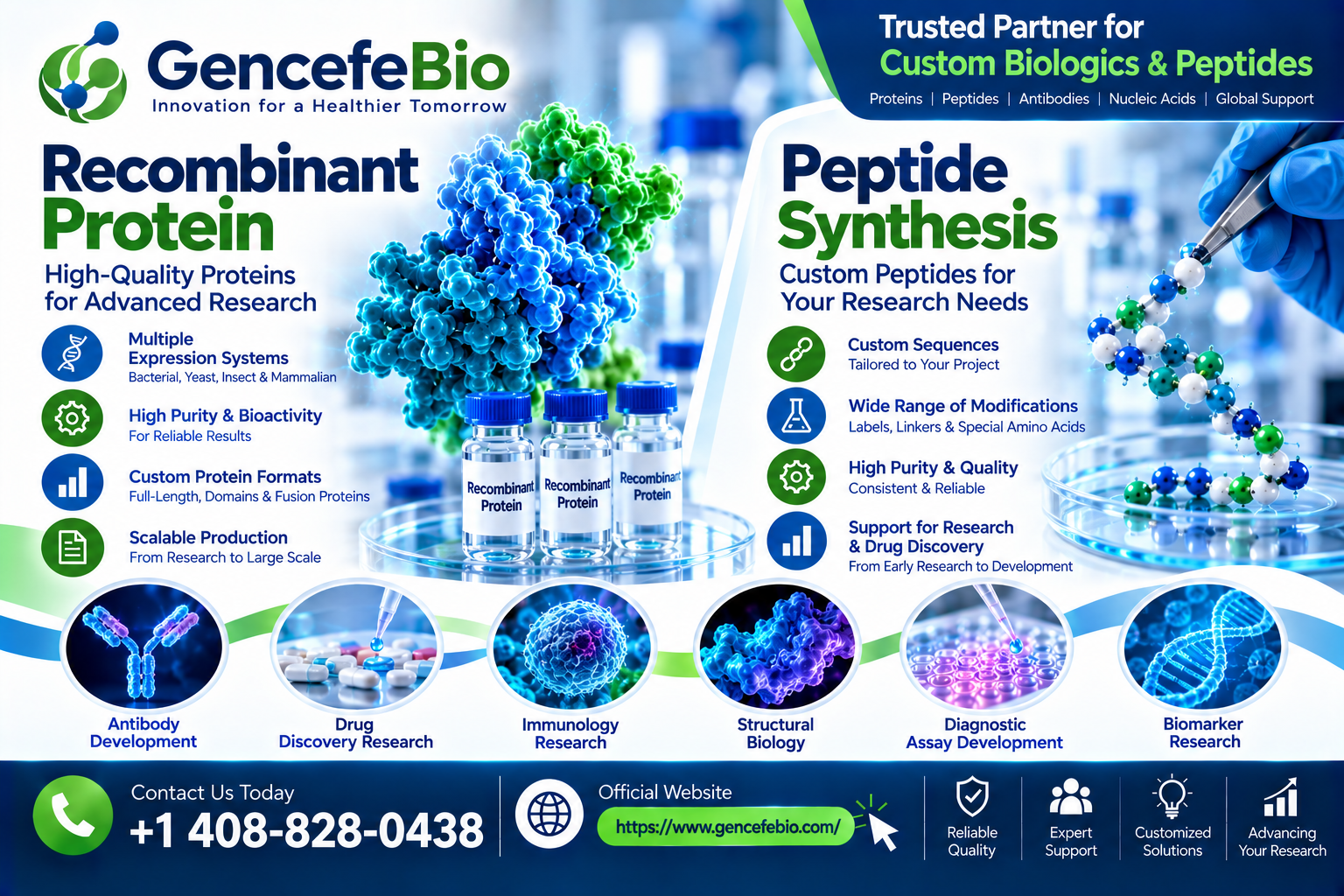
As biotechnology, pharmaceutical research, and molecular biology continue advancing, scientists are exploring innovative technologies to better understand biological processes and develop new research applications. Recombinant protein technology is an important tool for producing specific proteins through engineered biological expression systems, while peptide synthesis enables researchers to create customized amino acid sequences for specialized scientific investigations.
From drug discovery and immunology to molecular diagnostics research and protein engineering, these technologies support modern laboratory workflows.
Research organizations are increasingly emphasizing molecular purity, protein functionality, sequence accuracy, and analytical validation when choosing biotechnology products and research services.
Growing Importance of Recombinant Protein Technology
Proteins are essential biological molecules responsible for numerous cellular functions, including biochemical reactions, signaling, structural support, and molecular recognition.
A recombinant protein is produced by introducing a gene encoding a desired protein into a suitable expression system.
Researchers use recombinant DNA technology to produce proteins for scientific analysis and experimental applications.
Common research applications include:
- Drug discovery and pharmaceutical research.
- Immunology and antibody studies.
- Molecular biology investigations.
- Enzyme characterization.
- Protein interaction studies.
- Biomarker and diagnostic assay research.
- Structural biology experiments.
Selecting suitable protein production technologies can support more consistent experimental research.
What Is a Recombinant Protein?
A recombinant protein is a protein manufactured using recombinant DNA technology, typically by expressing a specified gene in a suitable biological system.
The process allows researchers to produce proteins with defined sequences for scientific experiments.
Different expression systems may be selected according to protein complexity, structural requirements, and intended research applications.
Common Protein Expression Systems
Bacterial Expression: Frequently uses suitable bacterial hosts for producing proteins that can be expressed and folded appropriately.
Yeast Expression: Offers an alternative production platform for selected recombinant proteins.
Mammalian Cell Expression: Often considered when proteins require particular folding or post-translational modifications.
Cell-Free Protein Expression: Uses biological components outside living cells to produce proteins under controlled experimental conditions.
The appropriate expression platform depends on the molecular characteristics of the target protein.
Understanding Peptide Synthesis in Biotechnology
Peptide synthesis is the chemical production of peptide molecules through the controlled assembly of amino acids.
Peptides are generally shorter amino acid chains than many naturally occurring proteins, although the distinction is not based on one universally applicable length.
Scientists frequently use synthetic peptides to study biological interactions, investigate protein regions, and develop experimental assays.
Major Applications of Peptide Synthesis
- Antigen and epitope research.
- Biochemical assay development.
- Protein interaction studies.
- Drug discovery research.
- Molecular labeling experiments.
- Enzyme-substrate investigations.
- Immunological studies.
Depending on technical feasibility, peptides may be produced with specific sequences, chemical modifications, and purity requirements.
How Recombinant Protein Production Works
Recombinant protein manufacturing involves several important stages.
Step 1: Gene Design and Preparation
Researchers identify the genetic sequence encoding the target protein and prepare a suitable expression construct.
Step 2: Expression System Selection
An appropriate host system is selected according to the desired protein’s properties and production requirements.
Step 3: Protein Expression
The selected biological system produces the target protein using the introduced genetic information.
Step 4: Protein Recovery
The expressed protein is recovered from cells or the relevant production system.
Step 5: Purification
Suitable purification procedures are used to separate the target protein from unwanted materials.
Step 6: Quality Characterization
Analytical testing helps assess protein identity, purity, concentration, structural properties, and relevant biological activity.
Production conditions may require optimization for complex proteins.
How Peptide Synthesis Works
One widely used peptide production technique is solid-phase peptide synthesis, commonly known as SPPS.
In this approach, amino acids are added sequentially to a growing peptide chain attached to a solid support.
Following chain assembly, the peptide is separated from the support, processed, and purified.
Researchers may request modifications such as acetylation, biotinylation, phosphorylation, or fluorescent labeling.
Analytical methods such as high-performance liquid chromatography and mass spectrometry help assess peptide purity and molecular identity.
Recombinant Protein vs Peptide Synthesis: Key Differences
Although both technologies involve amino acid-based molecules, their production methods and typical research applications differ.
| Feature | Recombinant Protein | Peptide Synthesis |
| Production method | Biological expression system | Primarily chemical synthesis |
| Main product | Expressed protein | Chemically assembled peptide |
| Typical applications | Enzyme studies, protein interactions, immunology | Epitope research, assays, molecular studies |
| Important quality factors | Folding, purity, identity, activity | Sequence identity, purity, modifications |
| Customization options | Sequence engineering, expression formats | Amino acid sequence, labels, modifications |
Both technologies can complement each other during protein and molecular research.
Benefits of Recombinant Protein Research
Recombinant protein technology enables scientists to study selected proteins without relying exclusively on extraction from their natural biological sources.
Important advantages include:
Defined Molecular Targets: Researchers can investigate proteins produced from selected genetic sequences.
Experimental Flexibility: Different expression systems may support specific research requirements.
Functional Investigation: Suitable proteins can be used to study molecular interactions and biochemical activity.
Research Applications: Recombinant materials support protein engineering, immunology, and drug discovery investigations.
However, protein performance depends on correct folding, appropriate modifications, purity, and intended experimental conditions.
Importance of Quality Control in Peptide and Protein Production
Reliable molecular research requires appropriately characterized materials.
Protein quality assessment may involve electrophoresis, chromatography, mass spectrometry, and functional assays.
For peptide synthesis, testing commonly focuses on molecular identity, purity, and requested chemical modifications.
Additional considerations may include aggregation, stability, residual impurities, and storage conditions.
Researchers should review available certificates of analysis and technical specifications before using products in sensitive experiments.
Choosing a Reliable Biotechnology Research Supplier
Research organizations should consider the following factors when selecting a molecular materials provider:
- Technical expertise in protein and peptide production.
- Available expression and synthesis platforms.
- Purification and analytical testing capabilities.
- Supported molecular modifications.
- Product documentation and traceability.
- Production quantities and feasibility.
- Storage, packaging, and delivery requirements.
Clear communication about experimental objectives helps establish suitable material specifications.
Frequently Asked Questions (FAQs)
1. What is a recombinant protein?
A recombinant protein is produced using recombinant DNA technology, generally by expressing a selected gene in a suitable biological system.
2. What is peptide synthesis?
Peptide synthesis is the controlled chemical assembly of amino acids to create peptides with specified sequences.
3. What is the difference between proteins and peptides?
Both contain amino acids, but peptides are generally shorter chains, while proteins often have more complex structures and biological functions.
4. Where are recombinant proteins commonly used?
They are used in molecular biology, immunology, drug discovery, enzyme studies, and suitable assay development.
5. What is solid-phase peptide synthesis?
It is a chemical method that assembles peptides by adding amino acids sequentially to a chain attached to a solid support.
6. Can synthetic peptides include chemical modifications?
Yes. Depending on feasibility, peptides may include biotinylation, phosphorylation, fluorescent labels, and other modifications.
7. Why is protein purification important?
Purification helps separate the target protein from impurities that could interfere with experimental results.
8. How is peptide purity evaluated?
High-performance liquid chromatography is commonly used for purity assessment, often alongside mass spectrometry for identity confirmation.
9. What factors influence recombinant protein production costs?
Costs depend on protein complexity, expression system, purification requirements, production quantity, and analytical testing.
10. What should researchers verify before ordering molecular research products?
Researchers should review molecular identity, purity, biological activity where relevant, analytical documentation, storage requirements, and application compatibility.
Media Contact
Industry: Biotechnology, Protein Research, Molecular Biology & Life Sciences
Service Enquiries: Recombinant Protein Production, Peptide Synthesis & Customized Research Materials
Contact Number: +1 408-828-0438
Email: gene@gencefebio.com
Official Website: https://www.gencefebio.com/