
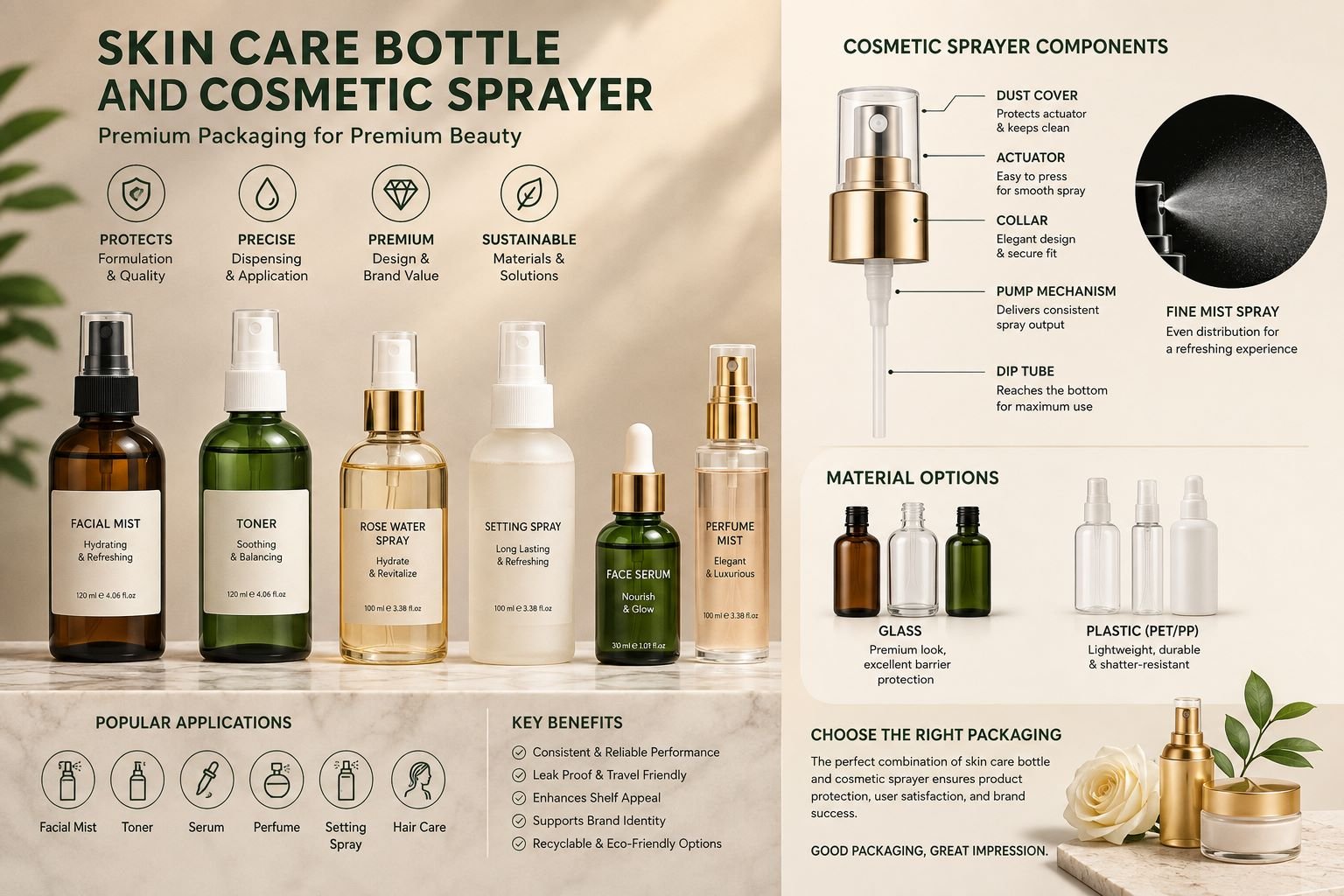
Packaging is one of the first things customers notice about a cosmetic or personal care product. Beyond appearance, good packaging protects the formulation, improves dispensing, reduces unnecessary product waste, and creates a convenient user experience. This is why choosing the right skin care bottle and disc cap is an important decision for cosmetic brands, manufacturers, private-label businesses, and packaging suppliers.
From facial cleansers and moisturising lotions to serums, shampoos, body oils, and toners, different formulations require different packaging solutions. A properly selected bottle and closure combination can enhance product safety while supporting the visual identity of a brand.
What Is a Skin Care Bottle?
A skin care bottle is a packaging container specifically designed for cosmetic, beauty, personal care, or dermatological formulations. Depending on the product, these bottles may hold liquids, lotions, gels, oils, creams, cleansers, or other formulations.
Manufacturers produce cosmetic bottles in numerous shapes, capacities, colours, materials, and neck sizes.
Common applications include:
- Facial cleanser
- Body lotion
- Moisturiser
- Toner
- Hair serum
- Shampoo and conditioner
- Facial oil
- Hand wash
- Sunscreen lotion
- Body care products
The best bottle should balance functionality, compatibility, appearance, transportation requirements, and cost.
Why Skin Care Bottle Selection Matters
Choosing attractive packaging is important, but cosmetic packaging needs to do considerably more than look good.
Product Protection
A suitable skin care bottle protects the formulation from contamination, leakage, moisture, and unnecessary exposure to environmental conditions.
Certain ingredients can also be sensitive to oxygen, sunlight, or temperature. Selecting appropriate packaging material can therefore help maintain formulation stability during the intended product lifecycle.
Convenient Dispensing
Consumers expect cosmetic products to be easy to use. Bottles paired with pumps, sprays, flip-top closures, or a disc cap allow users to dispense controlled quantities.
Brand Presentation
Premium packaging can influence how consumers perceive a cosmetic brand.
Bottle colour, finish, shape, label design, printing, and closure style can create an identity ranging from minimalist and clinical to luxury, organic, youthful, or professional.
Popular Materials for Skin Care Bottles
Different packaging materials provide different advantages.
| Material | Key Characteristics | Common Applications |
| PET | Lightweight, transparent and attractive | Toners, oils and cleansers |
| HDPE | Strong and chemical resistant | Shampoo and body lotion |
| PP | Durable and versatile | Cosmetic and personal care packaging |
| Glass | Premium appearance and strong barrier | Facial oils and premium serums |
| PCR Plastic | Contains recycled material | Sustainability-focused product ranges |
Material selection should always consider formulation compatibility rather than appearance alone.
What Is a Disc Cap?
A disc cap, also called a disc-top closure, is a dispensing closure commonly used on bottles containing cosmetics and personal care products.
The closure normally contains a press-down section. When one side of the top is pressed, the opposite section lifts and reveals the dispensing opening. After use, the consumer presses the raised section down again to close it.
This straightforward mechanism makes disc-top closures particularly convenient for products that consumers frequently dispense using one hand.
Advantages of Using a Disc Cap
A well-designed disc cap offers several practical benefits.
Easy One-Hand Operation
Consumers can normally open and close the closure by applying pressure with one finger. This makes it convenient for bathroom, salon, travel, and everyday applications.
Controlled Product Flow
The dispensing opening helps control the amount of lotion, shampoo, gel, or other formulation released from the package.
Reduced Product Waste
Controlled dispensing allows customers to use an appropriate amount instead of accidentally pouring excessive product.
Clean Appearance
Disc-top closures have a smooth and compact design that complements both modern and traditional cosmetic packaging.
Suitable for Multiple Products
Disc closures are widely suitable for:
- Shampoo
- Conditioner
- Body lotion
- Face wash
- Hand sanitiser
- Shower gel
- Hair oil
- Massage oil
- Moisturiser
- Other personal care liquids
Skin Care Bottle with Disc Cap: Why the Combination Works
Pairing a skin care bottle with a disc cap creates a packaging format that combines appearance, convenience, and dispensing efficiency.
For example, a lightweight plastic bottle with a disc-top closure can provide straightforward dispensing for shampoo or lotion without requiring a separate pump mechanism.
This format can be particularly useful when packaging products with low-to-medium viscosity.
The suitability ultimately depends on factors such as formulation thickness, bottle flexibility, closure orifice diameter, neck finish, and intended consumer application.
Disc Cap vs Other Cosmetic Closures
Understanding closure differences makes packaging selection easier.
| Closure Type | Convenience | Dispensing Control | Typical Products |
| Disc Cap | Excellent | High | Lotion, shampoo, cleanser |
| Flip-Top Cap | Excellent | High | Shampoo, gel, body wash |
| Pump | Excellent | Very high | Lotion, serum, hand wash |
| Screw Cap | Moderate | Low | Oils and refill products |
| Spray Pump | Excellent | Fine mist | Toners and body sprays |
| Dropper | Good | Precision dispensing | Facial serum and oil |
A disc cap is often selected where convenient dispensing is required without the added complexity of a pump.
How to Choose the Right Skin Care Bottle
Packaging buyers should evaluate several factors before placing a commercial order.
1. Understand the Formulation
Determine whether the product is thin, thick, oil-based, water-based, acidic, alcohol-containing, or chemically sensitive.
Packaging compatibility testing should be performed before mass production.
2. Select Bottle Capacity
Common cosmetic bottle capacities may range from small travel containers to larger family-size bottles.
The ideal capacity depends on product consumption rate, positioning, retail price, and intended application.
3. Check Bottle Neck Compatibility
The bottle and closure must have compatible neck finishes.
A visually suitable disc cap will still fail if its dimensions or threading do not match the bottle.
4. Consider Dispensing Performance
Evaluate:
- Orifice size
- Bottle squeezeability
- Product viscosity
- Closure seal
- Leakage resistance
- Dispensing speed
5. Match Packaging With Brand Identity
Custom colours, printing, labels, surface finishes, and decorative techniques can transform a standard skin care bottle into distinctive branded packaging.
Customisation Options for Cosmetic Packaging
Packaging manufacturers can offer various customisation possibilities depending on material and order quantity.
Common options include:
- Custom bottle colours
- Matching disc-cap colours
- Screen printing
- Hot foil stamping
- Pressure-sensitive labels
- Frosted effects
- Matte or glossy finishes
- Custom logos
- Embossing
- Decorative sleeves
Brands should maintain consistency between their bottles, closures, labels, cartons, and broader visual identity.
Quality Checks Before Bulk Production
Before approving large quantities of bottles and closures, businesses should request samples and conduct practical testing.
Important checks include:
- Bottle and closure fit
- Leakage testing
- Dispensing performance
- Drop resistance
- Formulation compatibility
- Decoration durability
- Transportation performance
- Closure opening and closing consistency
A sample that looks attractive is not enough. Packaging should be tested with the actual formulation whenever possible.
Sustainable Considerations for Skin Care Packaging
Environmental considerations increasingly influence cosmetic packaging development.
Brands can consider lightweight bottles, recyclable materials, recycled-content plastics, simplified packaging structures, and refill-oriented systems where technically suitable.
However, sustainable packaging decisions should remain practical. A package that fails to protect the formulation or leaks during transportation may create more waste rather than less.
The objective should therefore be to balance material reduction, product protection, consumer convenience, recyclability, and manufacturing feasibility.
Frequently Asked Questions
1. What is a skin care bottle used for?
A skin care bottle is used for packaging products such as facial cleansers, moisturisers, lotions, toners, oils, shampoos, conditioners, and other cosmetic formulations.
2. What is a disc cap?
A disc cap is a press-to-open dispensing closure. Pressing one side raises the dispensing section, allowing the product to flow through an opening.
3. Which products are suitable for disc caps?
Disc caps are commonly used for lotions, shampoos, conditioners, cleansers, body wash, oils, and similar personal care formulations.
4. Are disc caps suitable for thick creams?
They can work with some thicker formulations, but suitability depends on viscosity, bottle flexibility, and dispensing-orifice size. Testing is recommended.
5. Can skin care bottles be customised?
Yes. Depending on the manufacturer, bottles can be customised with colours, logos, labels, printing, surface finishes, and decorative effects.
6. Which material is best for cosmetic bottles?
There is no universal best material. PET, HDPE, PP, glass, and recycled-content plastics all have different advantages. Selection should depend on the formulation and application.
7. Can a disc cap prevent leakage?
A properly manufactured and correctly matched closure can provide effective sealing, but leak resistance should always be tested with the final bottle and product.
8. Are disc caps reusable?
Many disc-top closures can be opened and closed repeatedly throughout the normal lifecycle of the packaged product.
9. How do I select the correct closure size?
Check the bottle’s neck dimensions and finish specification, then select a closure designed to match that exact specification.
10. Should cosmetic packaging be tested before ordering?
Yes. Sample testing is strongly recommended before bulk production, especially for formulation compatibility, leakage, dispensing, decoration, and transportation performance.