
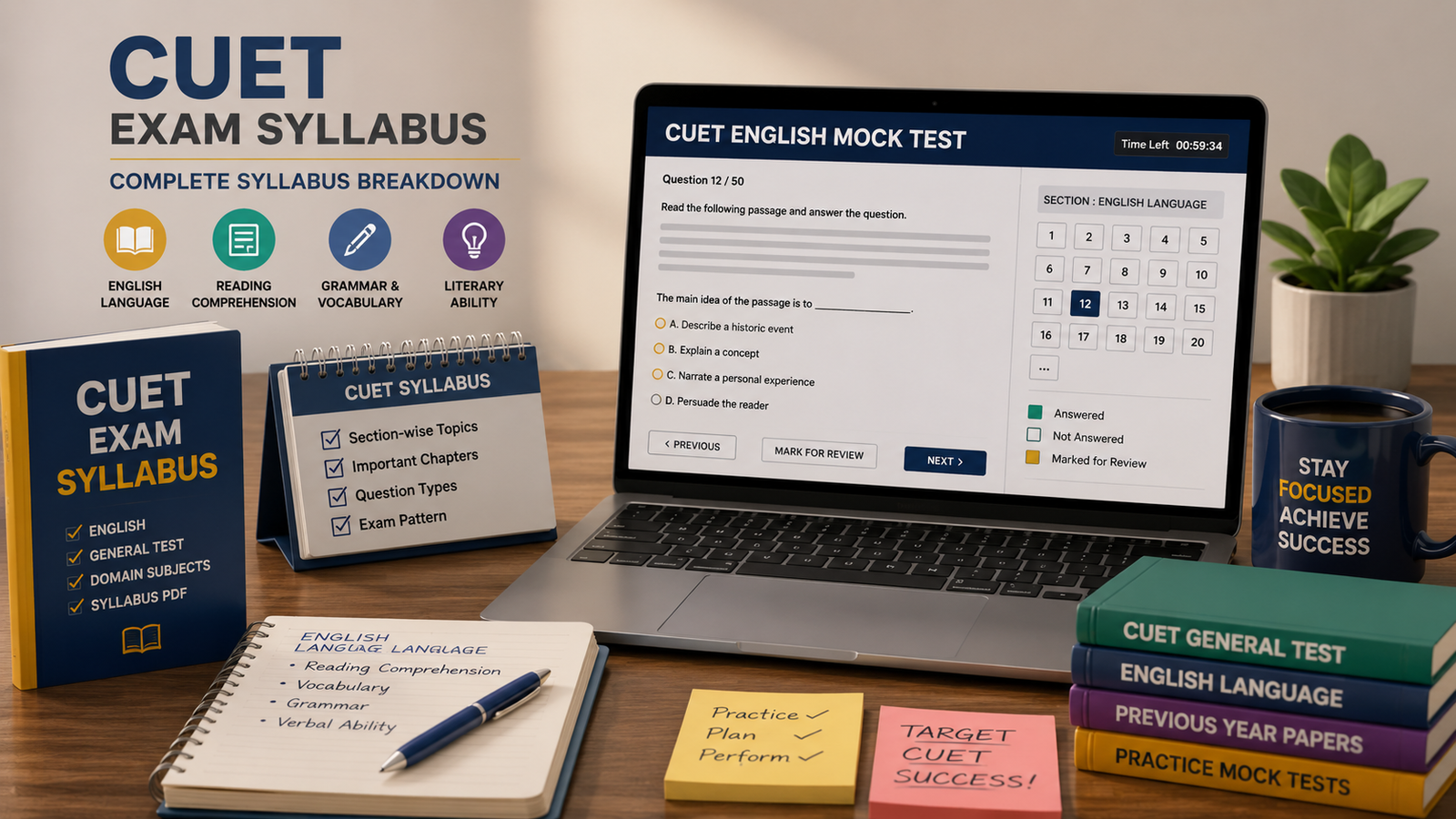
Students need to understand the CUET exam syllabus, identify high-priority topics, practise questions regularly, and evaluate their performance through a reliable CUET English mock test.
The CUET examination is used by participating universities for admission to various undergraduate programmes. English is listed as a language subject under code 101 in the official CUET UG syllabus.
A syllabus-based preparation strategy combined with regular mock tests can help students improve accuracy, reading speed, vocabulary and overall confidence.
Understanding the CUET Exam Syllabus
The CUET exam syllabus varies according to the subjects selected by a candidate. Students may need to prepare language subjects, domain-specific subjects and the General Aptitude Test depending on the eligibility requirements of their preferred university and programme.
The official CUET UG syllabus includes English and other languages along with subjects such as Mathematics, Physics, Chemistry, Biology, Economics, Business Studies, History, Political Science, Psychology and several others.
Therefore, candidates should always check the subject combination required by their chosen universities before beginning preparation.
Major Categories in the CUET Syllabus
Broadly, CUET preparation may involve:
- Language subjects
- Domain-specific subjects
- General aptitude
- Logical and analytical reasoning
- Quantitative ability
- General knowledge and current affairs
The exact subjects required depend on the course and institution selected by the student.
Why Students Should Study According to the Official Syllabus
Preparing without checking the syllabus often results in unnecessary study. The official syllabus gives students a clear preparation boundary.
It helps candidates:
- Identify important concepts.
- Organise subjects systematically.
- Avoid irrelevant chapters.
- Create realistic revision schedules.
- Select appropriate mock tests and practice material.
What Does the CUET English Section Test?
English preparation primarily focuses on a student’s ability to understand and use the language effectively.
Previous official language syllabus documents have included areas such as reading comprehension, verbal ability, sentence rearrangement, choosing appropriate words, synonyms, antonyms and vocabulary.
Reading comprehension may include factual, narrative and literary passages.
Students should therefore concentrate on understanding context rather than depending entirely on memorised grammar rules.
Important Areas for English Preparation
A strong English preparation plan should generally cover:
- Reading comprehension
- Vocabulary
- Synonyms and antonyms
- Word usage
- Verbal ability
- Sentence arrangement
- Context-based questions
- Grammar fundamentals
Regular reading of newspapers, editorials, essays and quality articles can also improve comprehension naturally.
Why a CUET English Mock Test Is Important
A CUET English mock test recreates examination-style conditions and gives students an opportunity to evaluate their preparation before the actual test.
Studying concepts alone cannot reveal whether a candidate can answer questions accurately under time pressure.
Mock tests help bridge that gap.
Benefits of Taking Mock Tests Regularly
Students taking a CUET English mock test can identify:
- Weak vocabulary areas
- Slow reading speed
- Comprehension difficulties
- Repeated grammatical errors
- Poor time allocation
- Guessing habits
- Topics requiring revision
Most importantly, students become familiar with solving questions continuously within a limited period.
CUET English Study vs Mock-Test Practice
| Preparation Method | Main Purpose | Best Time to Use |
| Syllabus Study | Build concepts | Beginning of preparation |
| Topic Practice | Strengthen individual areas | Daily preparation |
| Vocabulary Revision | Improve word knowledge | Throughout preparation |
| CUET English Mock Test | Measure overall performance | After basic preparation |
| Error Analysis | Identify weaknesses | After every mock test |
| Full Revision | Strengthen retention | Before examination |
Students should not choose between studying and taking mock tests. Both are essential parts of an effective CUET strategy.
How to Use CUET English Mock Tests Effectively
Simply completing dozens of mock tests without analysing mistakes may provide limited improvement.
Students should follow a structured process.
Step 1: Complete the Basic Syllabus
First understand the important topics included in your current CUET exam syllabus.
Step 2: Practise Topic-Wise Questions
Solve separate exercises for vocabulary, comprehension, verbal ability and sentence arrangement.
Step 3: Attempt a Full Mock Test
Take the test in an environment similar to the actual examination.
Avoid unnecessary breaks, mobile phones and external assistance.
Step 4: Analyse Every Mistake
Create an error notebook containing:
- Incorrect questions
- Correct answers
- Reason for the mistake
- Important vocabulary
- Concepts requiring revision
Turn Mistakes Into Revision Material
Reviewing previous mistakes can sometimes provide greater improvement than continuously solving new questions.
Students should revisit their error notebook every few days.
A Practical CUET Preparation Schedule
Students can divide their daily preparation into manageable sessions.
For example:
- 30 minutes: reading comprehension
- 20 minutes: vocabulary
- 20 minutes: verbal ability
- 30 minutes: domain subject revision
- 20 minutes: aptitude practice
- 30–45 minutes: mock test or previous questions
- 15 minutes: mistake analysis
The timetable can be modified according to individual strengths and subject combinations.
Common CUET Preparation Mistakes
Many candidates work hard but lose marks because their preparation lacks structure.
Avoid:
- Ignoring the official syllabus
- Memorising vocabulary without context
- Taking mock tests without reviewing errors
- Spending too much time on one question
- Starting full mock tests without basic preparation
- Ignoring weaker subjects
- Depending entirely on shortcuts
Accuracy and consistency should remain the priority.
Frequently Asked Questions
1. What is a CUET English mock test?
It is a practice examination containing English questions designed to help students experience examination-style problem solving and evaluate preparation.
2. Why should I check the CUET exam syllabus first?
The syllabus tells you exactly which subject areas should guide your preparation and prevents unnecessary studying.
3. What should I study for CUET English?
Students should focus on reading comprehension, vocabulary, verbal ability, sentence arrangement, word selection, synonyms and antonyms.
4. How often should I attempt an English mock test?
Beginners may start weekly and gradually increase the frequency as the examination approaches.
5. Are mock tests enough for CUET English?
No. Mock tests should complement syllabus study, vocabulary development, reading practice and revision.
6. How can I improve reading comprehension?
Read regularly, identify main ideas, understand context and practise answering passage-based questions within a time limit.
7. How can I improve my English vocabulary?
Learn words in context, maintain a vocabulary notebook and revise synonyms, antonyms and frequently confused words.
8. Should I analyse my mock-test mistakes?
Yes. Error analysis is one of the most valuable parts of mock-test preparation.
9. Does the CUET syllabus differ by course?
Yes. Subject requirements can vary according to the university and undergraduate programme.
10. Where should students verify the latest CUET syllabus?
Students should check the official NTA CUET website because examination requirements and syllabus information may be updated.