
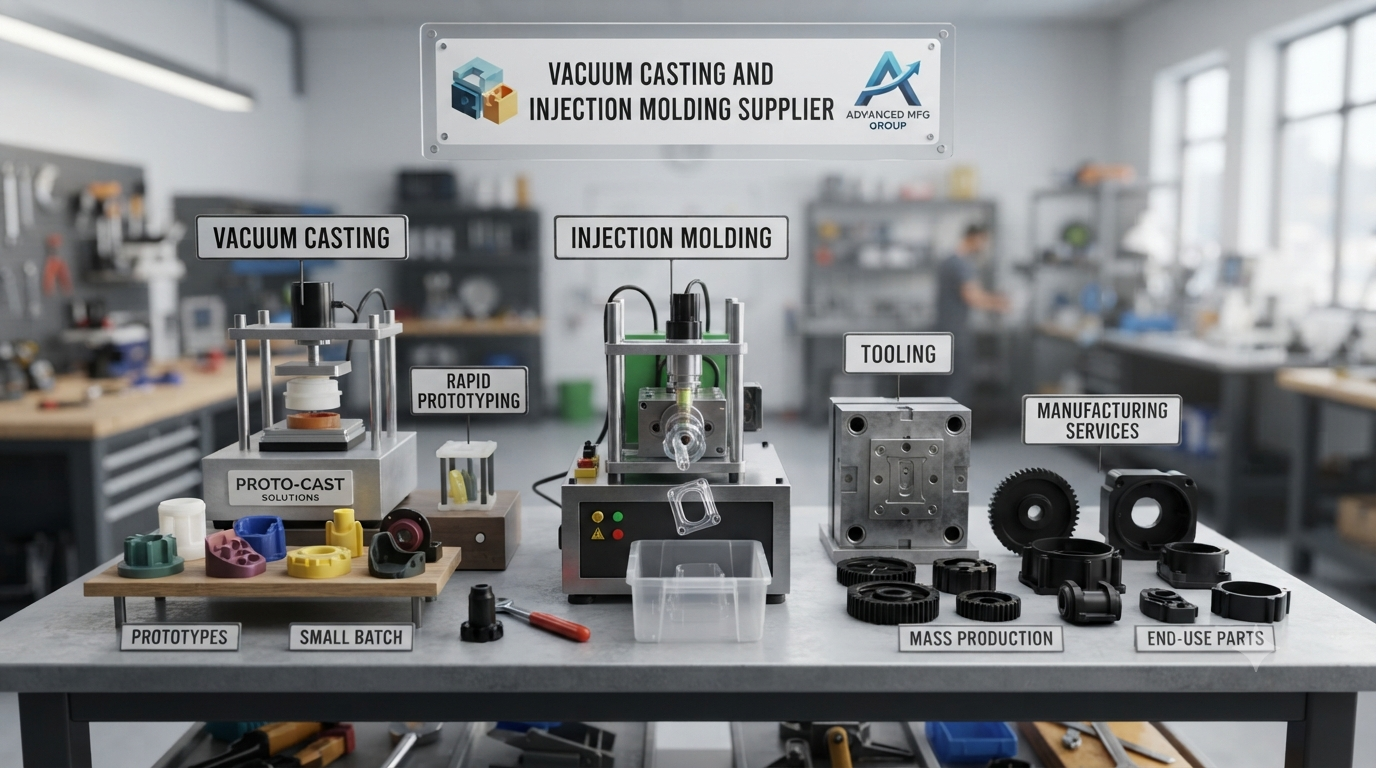
Turning a product concept into a reliable physical part requires more than a good design. Manufacturers must choose the right production method, material, tooling strategy, and manufacturing partner. Two widely used processes for product development and production are vacuum casting and injection molding.
Although both methods manufacture plastic components, they serve different requirements. Vacuum casting is particularly useful for prototypes, functional testing, presentation models, and low-volume manufacturing. Injection molding becomes more economical when businesses need hundreds, thousands, or millions of consistent parts.
Working with an experienced injection molding supplier can help businesses select the correct process, control manufacturing costs, maintain dimensional accuracy, and move smoothly from prototyping to full-scale production.
Understanding Vacuum Casting
Vacuum casting is a manufacturing process commonly used to create small quantities of high-quality plastic or elastomer parts. Instead of expensive metal tooling, the process normally uses silicone molds created from a master model.
A master component is typically produced using CNC machining, 3D printing, or another rapid prototyping technique. Silicone is poured around the master model and allowed to cure. Once the silicone mold is ready, polyurethane or similar casting materials are introduced under vacuum.
The vacuum environment helps remove trapped air and reduces bubbles, resulting in parts with smooth surfaces and fine details.
Vacuum casting is commonly selected for:
- Functional product prototypes
- Design validation components
- Pre-production samples
- Marketing and exhibition models
- Small batches of plastic products
- Flexible rubber-like components
- Customer evaluation samples
- Engineering testing
Because silicone tooling can be manufactured relatively quickly, the process helps product developers evaluate designs before investing heavily in permanent production tooling.
Why Vacuum Casting Is Valuable for Product Development
One of the strongest advantages of vacuum casting is flexibility. Product designers frequently need several realistic samples before approving a design for production.
Changes during this stage are common. Dimensions may require adjustment, surfaces may need refinement, or materials might have to be changed.
Creating expensive steel injection molds too early can make these revisions costly. Silicone molds used in vacuum casting require a much smaller tooling investment.
The process also offers several practical benefits:
- Fast production of prototype batches
- Excellent reproduction of surface details
- Lower tooling investment for limited quantities
- Availability of rigid and flexible materials
- Different colours, textures, and finishes
- Suitable parts for assembly and functional testing
For startups and engineering teams, these advantages can significantly improve the product validation process.
How Injection Molding Works
Injection molding is one of the most established methods for manufacturing plastic products at scale.
Plastic granules are heated until they become molten. The material is then injected under pressure into a precisely manufactured mold. After cooling and solidification, the mold opens and the finished component is ejected.
A professional injection molding supplier carefully controls temperature, injection pressure, cooling time, material flow, and tooling conditions to achieve repeatable results.
Injection molding can manufacture everything from small electronic components to large automotive and industrial parts.
Frequently used thermoplastics include:
- ABS
- Polypropylene
- Polycarbonate
- Nylon
- POM
- TPE
- TPU
- Acrylic
- Polyethylene
Material selection depends on factors such as strength, flexibility, heat resistance, chemical resistance, appearance, product environment, and budget.
Vacuum Casting vs Injection Molding
The most suitable manufacturing process usually depends on production quantity, project stage, tooling budget, material specifications, and product requirements.
| Factor | Vacuum Casting | Injection Molding |
| Tooling | Silicone mold | Aluminium or steel mold |
| Production volume | Low volume | Medium to very high volume |
| Initial investment | Lower | Higher |
| Tool preparation | Relatively fast | More complex |
| Part consistency | Very good | Excellent |
| Material choice | Casting resins | Wide range of thermoplastics |
| Design validation | Excellent | Possible but often expensive |
| Large-scale production | Less economical | Highly economical |
Many successful projects actually use both technologies.
A company may begin with vacuum casting for design validation and then transfer the approved product to an injection molding supplier for commercial manufacturing.
When Should You Choose Vacuum Casting?
Vacuum casting makes the most sense when production quantities are relatively small and realistic prototype quality is required.
For example, a manufacturer preparing a new medical housing may require 20 samples for assembly evaluation, customer demonstrations, colour approval, and engineering tests.
Building a production injection mold specifically for those samples may not be financially practical.
Vacuum casting allows the company to manufacture realistic components while retaining the ability to modify the design.
It is also useful when multiple product versions need to be compared before final approval.
When Should You Choose Injection Molding?
Injection molding becomes increasingly attractive as manufacturing volumes grow.
Although tooling requires a larger upfront investment, the cost per component can decrease considerably during larger production runs.
Companies should consider injection molding when they need:
- Consistent repeat production
- Large manufacturing quantities
- Engineering-grade thermoplastics
- Tight dimensional requirements
- Automated manufacturing
- Competitive unit costs
- Long-term product supply
An experienced injection molding supplier can also optimise mold construction, gate locations, draft angles, wall thickness, cooling channels, and material flow before production begins.
Importance of Design for Manufacturing
A visually attractive 3D model is not automatically ready for manufacturing.
Design for Manufacturing, often called DFM, evaluates whether the component can be produced efficiently and consistently.
Important considerations include wall thickness, draft angles, undercuts, ribs, bosses, holes, parting lines, shrinkage, tolerances, and surface finishes.
For injection molding, inconsistent wall thickness may create sink marks, warping, or uneven cooling. Poor draft angles can make molded components difficult to remove from the tool.
Conducting DFM analysis before tooling helps prevent expensive modifications later.
A capable injection molding supplier should therefore provide engineering feedback rather than simply manufacture the submitted design.
Choosing a Reliable Injection Molding Supplier
Supplier selection can directly influence product quality, lead time, and manufacturing costs.
Before choosing an injection molding supplier, evaluate both technical capability and communication quality.
Look for a supplier that can provide:
- DFM analysis
- Prototype manufacturing
- Mold design and production
- Material recommendations
- Dimensional inspection
- Surface finishing
- Assembly services
- Quality documentation
- Production scalability
Communication is equally important. Engineering changes, tolerances, material grades, cosmetic expectations, and testing requirements should be documented clearly before manufacturing begins.
Moving From Prototype to Production
An efficient product development strategy can combine vacuum casting with injection molding.
A typical workflow may include:
- Complete the CAD design.
- Manufacture a master prototype.
- Produce vacuum-cast samples.
- Test fit, appearance, and functionality.
- Modify the design where required.
- Conduct DFM analysis.
- Manufacture injection molding tooling.
- Produce initial molded samples.
- Inspect and approve the components.
- Begin commercial production.
This staged approach reduces the risk of discovering major design problems after production tooling has already been manufactured.
Quality Control in Plastic Manufacturing
Reliable plastic production requires measurable quality standards.
Depending on the component, inspection may involve dimensional measurements, visual checks, material verification, fit testing, functional testing, and comparison with approved samples.
For critical components, businesses should establish acceptable tolerances and inspection requirements before placing production orders.
The selected injection molding supplier should also maintain traceable manufacturing parameters whenever repeatability is important.
Quality control should not begin after production. It should be considered from prototype development through final manufacturing.
Frequently Asked Questions
1. What is vacuum casting used for?
Vacuum casting is mainly used for realistic prototypes, engineering samples, presentation models, functional components, and low-volume plastic production.
2. How is vacuum casting different from injection molding?
Vacuum casting generally uses silicone molds and casting resins, while injection molding uses durable metal tooling and melted thermoplastics.
3. Is vacuum casting suitable for mass production?
Generally, no. It is better suited to relatively small production quantities because silicone molds have a limited working life.
4. Is injection molding expensive?
The tooling investment can be significant, but injection molding can provide very economical per-part costs when production quantities become larger.
5. Can vacuum-cast products look like injection-molded products?
Yes. Well-produced vacuum-cast components can achieve impressive surface quality, colour, texture, and detail suitable for demonstrations and testing.
6. What information does an injection molding supplier need?
Usually, the supplier needs 3D CAD files, material requirements, production quantities, tolerances, surface specifications, colours, and application information.
7. Which materials are commonly injection molded?
ABS, polypropylene, nylon, polycarbonate, POM, polyethylene, TPE, and many other engineering thermoplastics can be injection molded.
8. Should prototypes be produced before injection tooling?
For many new products, prototypes are highly recommended because they help identify design, assembly, ergonomic, and functional problems before expensive tooling begins.
9. What is DFM in injection molding?
DFM means Design for Manufacturing. It examines whether a product has been designed in a way that supports reliable, efficient, and economical manufacturing.
10. How do I select the right manufacturing process?
Consider required quantity, material, tolerances, expected product life, tooling budget, development stage, surface finish, and future production requirements.