
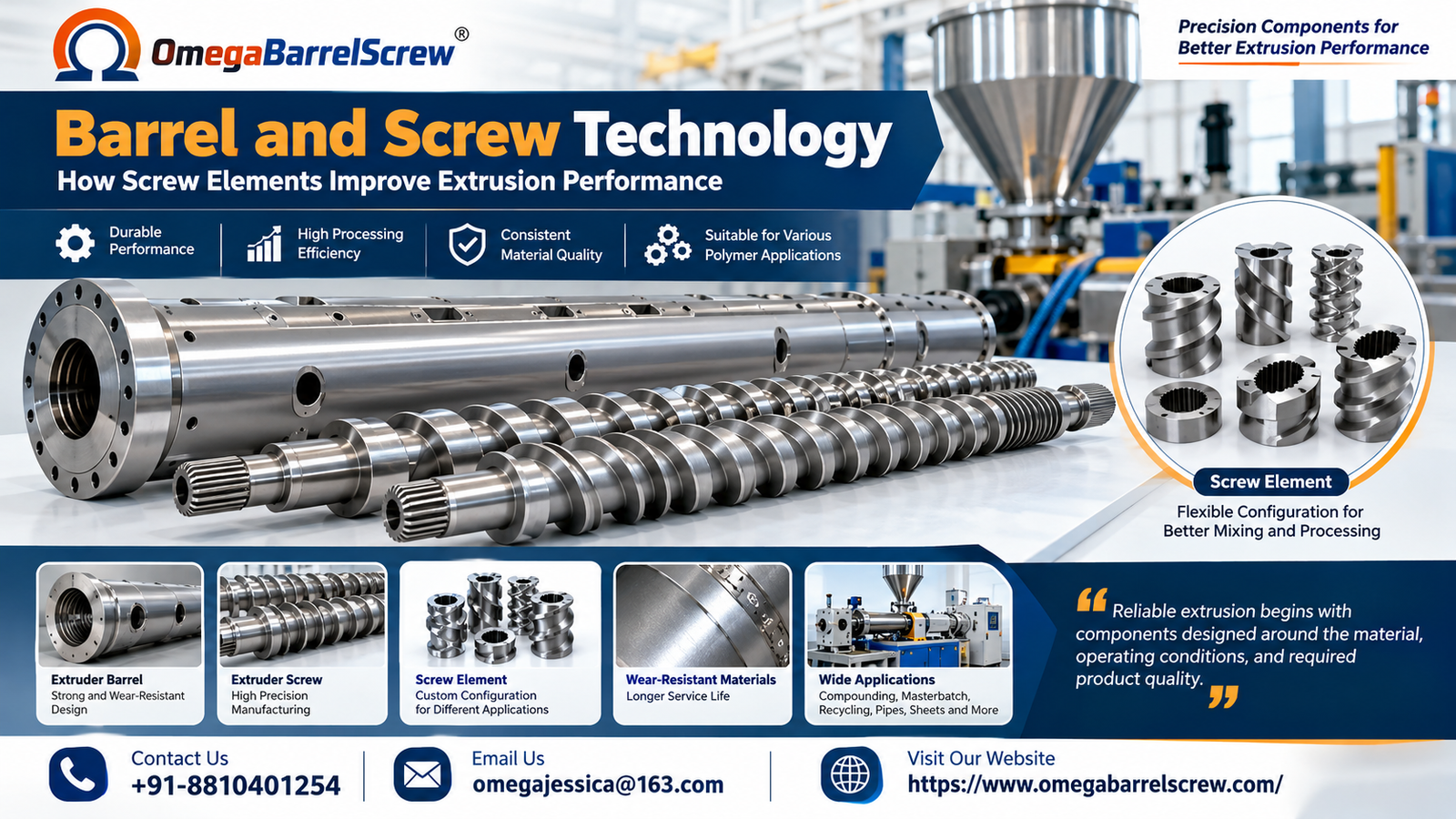
While manufacturers frequently focus on output capacity and finished-product specifications, the condition of internal processing components deserves equal attention.
The barrel and screw assembly plays a central role in transporting, melting, mixing, and processing polymer materials. Its design influences how materials behave as they move through the extrusion system.
Meanwhile, the screw element is especially important in modular twin-screw extrusion equipment, where individual components can be arranged to support specific processing functions.
For polymer compounders, plastic recycling businesses, and extrusion equipment manufacturers, understanding component wear and screw configuration can support more consistent production and effective maintenance planning.
Why Internal Component Wear Matters in Extrusion Manufacturing
Extrusion machinery operates under demanding mechanical and thermal conditions.
During processing, polymer materials move through the barrel while rotating screws generate conveying action, shear, and pressure.
Over extended operation, contact with abrasive fillers, processing additives, or other demanding materials can contribute to component wear.
Excessive wear may change internal clearances and influence material flow.
These changes can affect melting behaviour, mixing performance, pressure stability, and finished-product consistency.
Understanding wear patterns helps maintenance teams identify potential problems before they result in significant equipment damage.
Understanding the Barrel and Screw Assembly
The barrel and screw assembly is one of the primary mechanical systems in an extruder.
The barrel provides the processing chamber, while the rotating screw or screws convey material through different processing sections.
Depending on the machine, the assembly may support feeding, melting, mixing, pressure generation, and material discharge.
Screw geometry influences the movement and transformation of polymer materials.
Barrel construction must accommodate operating temperatures, mechanical forces, and the chemical characteristics of processed materials.
The correct component design depends on the intended polymer, machine configuration, and operating requirements.
What Is a Screw Element?
A screw element is an individual component used in the modular screw configurations of certain extrusion machines, particularly twin-screw extruders.
These elements can perform different processing functions depending on their geometry and arrangement.
Common categories include conveying elements, kneading elements, and specialised mixing components.
Conveying elements help move material along the processing path.
Kneading elements can contribute to polymer melting and mixing.
Other configurations may influence material residence, pressure development, or the distribution of additives.
Not every element is appropriate for every polymer.
Manufacturers should select configurations according to material characteristics and processing objectives.
How Screw Element Arrangement Influences Mixing
Polymer compounding often requires effective distribution of additives, fillers, pigments, or reinforcing materials.
The arrangement of screw components can influence how materials experience mechanical mixing.
Some element configurations promote distributive mixing, helping spread ingredients throughout a material.
Others generate conditions that support dispersive mixing, which can help break down suitable agglomerates.
However, greater mixing intensity is not always beneficial.
Excessive shear may increase material temperature or contribute to degradation in sensitive formulations.
Appropriate configuration can therefore support product consistency while helping control unnecessary processing stress.
Recognising Warning Signs of Component Wear
Internal wear may develop gradually, making it difficult to identify without suitable monitoring.
Potential indicators include:
- Unstable Output: Unexpected variations in material discharge.
- Pressure Changes: Differences from established operating conditions.
- Inconsistent Mixing: Variation in additive distribution or compound appearance.
- Temperature Concerns: Unusual thermal behaviour requiring investigation.
- Increased Maintenance Needs: Repeated adjustments to maintain acceptable production.
- Dimensional Wear: Changes identified through appropriate component inspection.
These symptoms do not always indicate screw or barrel damage.
Feedstock variation, control settings, heating equipment, and other mechanical problems may produce similar effects.
A systematic investigation is necessary before replacing components.
Material Selection and Wear Resistance
Different polymers and additives create different operating conditions.
Materials containing abrasive fillers may increase wear on certain processing components.
Other formulations may introduce chemical compatibility concerns.
Manufacturers can select screw and barrel materials, surface treatments, or wear-resistant configurations according to the intended application.
However, no material offers unlimited resistance to every operating environment.
Component durability depends on construction, processing conditions, material characteristics, and maintenance.
Supplier documentation should identify relevant material specifications and application limitations.
Why Replacement Components Require Precision
Replacing a worn component involves more than matching its general appearance.
Dimensions, geometry, material grade, and mechanical compatibility must correspond to the equipment’s requirements.
For modular systems, individual elements must also be compatible with the relevant shaft configuration and approved assembly design.
Incorrect replacement parts can affect processing performance or create additional mechanical risks.
Manufacturers should verify technical drawings, applicable tolerances, and component specifications before ordering.
Appropriate installation procedures are equally important.
Screw Element and Barrel Assembly: Different Maintenance Priorities
| Evaluation Factor | Barrel and Screw Assembly | Screw Element |
| Primary Function | Overall material processing | Specific conveying or mixing function |
| Inspection Focus | Internal wear, dimensions, and mechanical condition | Element geometry and surface condition |
| Design Consideration | Machine compatibility and processing requirements | Position and function within screw configuration |
| Replacement Planning | Overall assembly condition | Individual modular component condition |
| Performance Impact | Melting, conveying, pressure, and processing stability | Local mixing, conveying, and shear behaviour |
Evaluating these components together can help engineers understand how individual changes affect the complete processing system.
How Preventive Maintenance Supports Production Reliability
Preventive maintenance helps manufacturers identify gradual equipment deterioration.
A suitable program may include monitoring processing conditions, reviewing production records, and inspecting components according to equipment recommendations.
Maintenance teams should compare relevant operating information against established production conditions.
Significant changes may justify a more detailed investigation.
However, maintenance procedures must follow appropriate machinery isolation and safety requirements.
Component inspection and replacement should be performed by qualified personnel using approved procedures.
A documented maintenance approach can support better production planning and reduce avoidable interruptions.
Selecting a Reliable Extrusion Component Supplier
Machinery manufacturers and plastic processors should evaluate suppliers according to their technical capabilities.
Important purchasing considerations include:
- Dimensional Accuracy: Verify component specifications and manufacturing tolerances.
- Material Quality: Review suitable steel grades and surface treatments.
- Design Compatibility: Confirm application-specific screw geometry.
- Manufacturing Consistency: Evaluate relevant quality-control practices.
- Technical Documentation: Request drawings, specifications, and inspection information.
- Application Support: Confirm understanding of polymer processing requirements.
The objective is to source components that match the equipment and intended production process.
Frequently Asked Questions (FAQs)
1. What is a barrel and screw assembly used for?
It conveys and processes polymer materials inside extrusion equipment, supporting functions such as melting, mixing, and pressure generation.
2. What is a screw element in extrusion machinery?
A screw element is a modular processing component used in certain extrusion systems to perform conveying, kneading, or mixing functions.
3. How does screw wear affect extrusion quality?
Excessive wear can alter processing clearances, material flow, mixing behaviour, and pressure stability, potentially affecting product consistency.
4. Can individual screw elements be replaced?
In suitable modular extrusion systems, individual elements may be replaceable when compatible components and approved procedures are available.
5. How should manufacturers choose screw and barrel components?
They should evaluate polymer characteristics, equipment specifications, component materials, dimensional requirements, processing conditions, and supplier documentation.
Media Contact
Department: Extrusion Components and Industrial Machinery Enquiries
Contact: +86-15021464410
Email: omegajessica@163.com
Alternative Email: 965425705@qq.com
Official Website: https://www.omegabarrelscrew.com/
Read More:-