
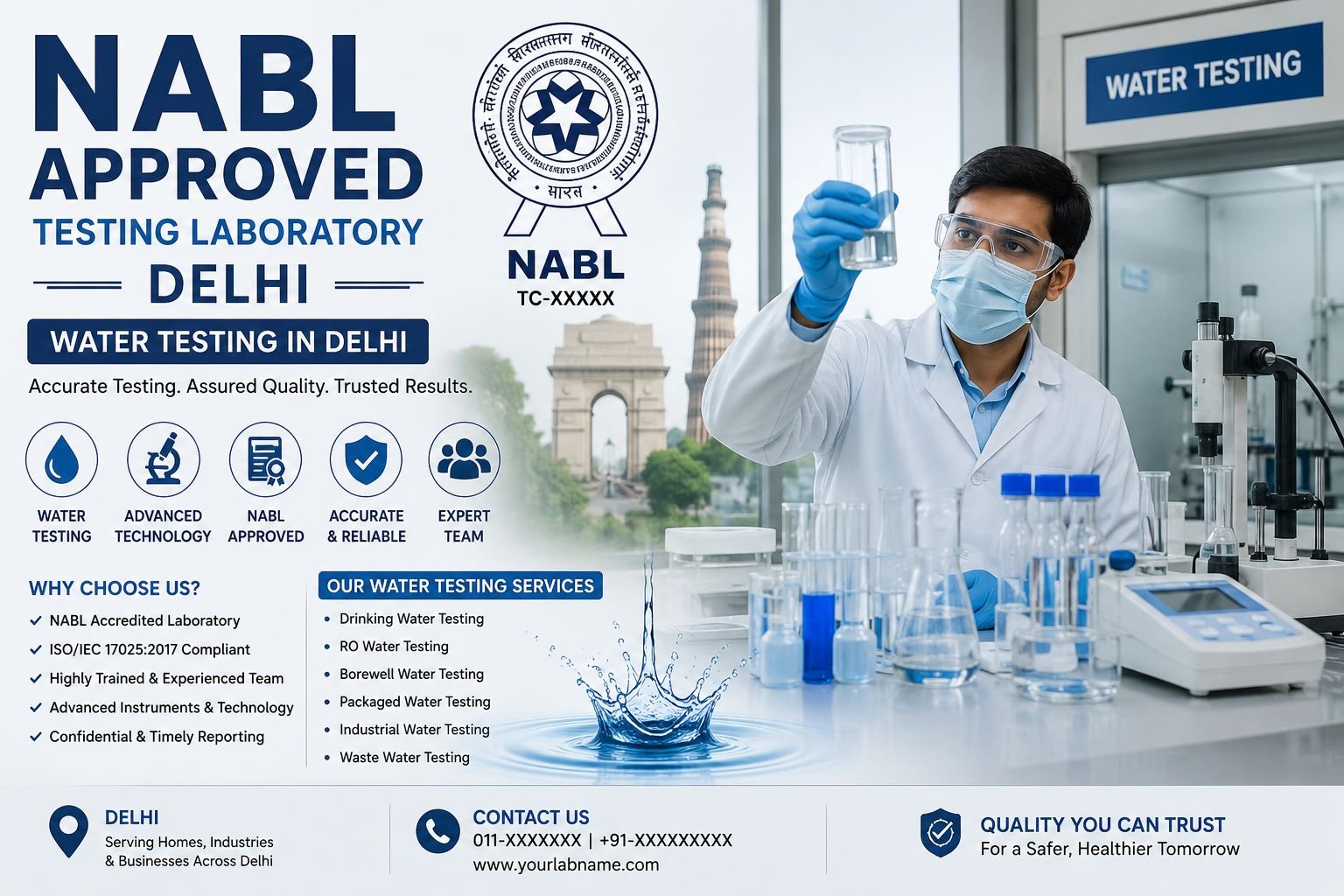
Quality testing plays an important role in protecting public health, maintaining regulatory compliance, and confirming that products, materials, and water meet required standards. Businesses, industries, institutions, builders, hospitals, manufacturers, and households often need reliable laboratory reports before making important decisions.
Choosing a NABL approved testing laboratory Delhi can provide greater confidence because accredited laboratories operate according to recognised quality and technical requirements. Similarly, professional water testing in Delhi helps identify physical, chemical, and microbiological characteristics that may affect the suitability of water for drinking, industrial processes, construction, food production, or other applications.
Understanding how laboratory testing works, what parameters should be tested, and how to select an appropriate facility can help organisations obtain dependable and meaningful results.
What Is a NABL Approved Testing Laboratory?
NABL refers to the National Accreditation Board for Testing and Calibration Laboratories. Laboratory accreditation is designed to demonstrate technical competence for specific testing or calibration activities within an approved scope.
A NABL approved testing laboratory Delhi generally follows defined laboratory management systems, validated testing procedures, appropriate equipment practices, quality-control processes, and documented methods for handling samples.
Accreditation should not simply be viewed as a logo displayed on a laboratory website. Customers should check whether the specific test they require falls within the laboratory’s current accredited scope.
Important elements of a competent testing laboratory commonly include:
- Qualified and trained technical professionals
- Appropriate sampling and testing procedures
- Properly maintained laboratory equipment
- Documented quality-control systems
- Sample identification and traceability
- Standard operating procedures
- Controlled testing environments where required
- Accurate reporting and record management
These measures help improve consistency and confidence in laboratory results.
Why Businesses Choose NABL Approved Laboratories in Delhi
Laboratory reports are frequently required for quality assurance, regulatory submissions, vendor approvals, research, construction projects, manufacturing processes, environmental assessments, and product development.
Selecting a NABL approved testing laboratory Delhi can be particularly useful when results may be reviewed by customers, consultants, government departments, auditors, certification bodies, or other stakeholders.
Businesses may require laboratory services for testing:
- Construction materials
- Drinking and process water
- Soil and environmental samples
- Food-related samples
- Chemicals and raw materials
- Metals and engineering products
- Wood and building products
- Industrial materials
The actual testing capability varies between laboratories. Therefore, clients should verify the laboratory’s accredited scope before submitting samples.
Importance of Water Testing in Delhi
Water quality can vary considerably depending on its source, storage conditions, plumbing systems, treatment processes, environmental conditions, and surrounding infrastructure.
Professional water testing in Delhi helps determine whether water meets relevant quality requirements for its intended purpose.
Water may be sourced from:
- Municipal supplies
- Borewells
- Tankers
- Groundwater
- Packaged-water systems
- Industrial treatment plants
- Rainwater harvesting systems
- Residential storage tanks
Visual appearance alone cannot reliably determine water quality. Clear water can still contain dissolved substances or microorganisms that are not visible to the human eye.
This makes laboratory analysis an important part of responsible water management.
Important Parameters Checked During Water Testing
The testing parameters required depend on the source and intended use of the water. Drinking water normally requires a different testing profile from industrial, wastewater, construction, or process water.
Common parameters investigated during water testing in Delhi may include:
| Testing Category | Common Parameters |
| Physical | Colour, odour, taste, turbidity and total dissolved solids |
| Chemical | pH, hardness, alkalinity, chloride and sulphate |
| Mineral-related | Calcium, magnesium and other relevant constituents |
| Microbiological | Total coliform and other specified microbial indicators |
| Industrial | Conductivity, dissolved solids and application-specific parameters |
| Specialised | Metals or additional contaminants based on testing requirements |
The exact testing package should always be selected according to the purpose of the analysis rather than automatically choosing the largest list of parameters.
Drinking Water Testing for Homes and Commercial Properties
Drinking water quality deserves particular attention because contaminated or unsuitable water can create health and operational concerns.
Residential societies, schools, hotels, hospitals, offices, restaurants and commercial establishments may use water testing in Delhi periodically to evaluate their drinking-water systems.
Testing can be useful when:
- Water develops unusual colour or odour.
- A new borewell becomes operational.
- Tanker water is regularly used.
- Water-storage tanks have been cleaned or replaced.
- Plumbing systems have undergone major changes.
- A treatment or filtration system has been installed.
- Routine quality verification is required.
Testing the source and treated water separately can sometimes help identify whether a treatment system is functioning as expected.
Industrial Water Testing and Quality Control
Industrial facilities may require water with carefully controlled properties. Even comparatively small changes in mineral content, hardness, conductivity, pH or dissolved solids can affect equipment or manufacturing processes.
Industrial water testing in Delhi may therefore support:
- Boiler-water management
- Cooling-tower operations
- Manufacturing processes
- Food-processing facilities
- Pharmaceutical operations
- Water-treatment plants
- Construction activities
- Commercial facilities
A suitable laboratory can recommend testing parameters based on the particular industrial application.
Regular monitoring can also help businesses identify changing water conditions before they create larger operational problems.
How Water Samples Should Be Collected
Correct sample collection is essential because even advanced laboratory equipment cannot compensate for a contaminated or incorrectly collected sample.
The laboratory should ideally provide instructions regarding sampling containers, sample quantity, preservation methods and transportation requirements.
Basic precautions may include:
- Using clean or laboratory-provided containers
- Avoiding contact with the inner surface of containers
- Correctly labelling every sample
- Recording the source and collection time
- Following specialised procedures for microbiological testing
- Delivering samples within recommended holding periods
For critical or regulatory testing, professional sample collection by authorised laboratory personnel may be preferable.
NABL Laboratory vs Ordinary Testing Facility
The main difference relates to demonstrated technical competence and formal accreditation for specified testing activities.
| Factor | NABL Accredited Laboratory | General Testing Facility |
| Formal accreditation | Available for approved scope | May not be available |
| Quality system | Structured accreditation requirements | Depends on laboratory |
| Technical assessment | Conducted as part of accreditation | May vary |
| Traceability | Generally documented | Depends on procedures |
| Report acceptance | Often preferred for formal purposes | Depends on requirement |
| Scope verification | Can be checked | May not apply |
An accredited laboratory should still be evaluated carefully because accreditation applies to defined tests rather than automatically covering every service offered by the laboratory.
How to Select the Right Testing Laboratory
Choosing a laboratory solely on the lowest quotation may not provide the best value. Testing accuracy, scope, methodology and report usability are more important.
Before choosing a NABL approved testing laboratory Delhi, consider asking:
- Is the required test included in the accredited scope?
- Which testing method will be followed?
- How should the sample be collected?
- What quantity of sample is required?
- What is the expected reporting process?
- Will the report clearly identify the testing method?
- Does the laboratory have experience with similar samples?
Clear communication before sample submission can prevent unnecessary retesting.
Benefits of Professional Water Testing
Reliable water testing in Delhi can provide several practical advantages.
It helps organisations:
- Understand important water-quality characteristics.
- Detect potential quality problems.
- Evaluate treatment-system performance.
- Maintain records for quality management.
- Select appropriate filtration or treatment solutions.
- Support compliance and internal audits.
- Reduce assumptions about water suitability.
- Make informed maintenance decisions.
Most importantly, laboratory testing replaces guesswork with measurable information.
Frequently Asked Questions About NABL and Water Testing
1. What does NABL accreditation indicate?
It indicates that a laboratory has been assessed for technical competence within a defined accredited testing or calibration scope.
2. Is every test performed by a NABL laboratory automatically accredited?
No. Customers should confirm whether their particular test and method are covered within the laboratory’s current accredited scope.
3. Why is water testing important in Delhi?
Water characteristics can vary according to source, distribution systems, groundwater conditions, storage and treatment methods.
4. Can borewell water be tested?
Yes. Borewell or groundwater samples can be analysed for relevant physical, chemical and microbiological parameters.
5. Can tanker water be tested?
Yes. Tanker-water testing can help assess its characteristics and suitability for a particular intended use.
6. How often should drinking water be tested?
The appropriate frequency depends on the source, usage, risk profile, regulatory requirements and changes observed in water quality.
7. Is clear-looking water always safe?
No. Many dissolved substances and microorganisms cannot be identified through appearance alone.
8. Can laboratories test industrial water?
Yes. Laboratories can analyse industrial, process, boiler, cooling and other water types according to relevant requirements.
9. Does sample collection affect test results?
Yes. Improper containers, contamination, preservation problems or delayed transportation can influence results.
10. How do I know which water parameters need testing?
Tell the laboratory the water source and intended use. Technical personnel can then recommend an appropriate testing profile.