
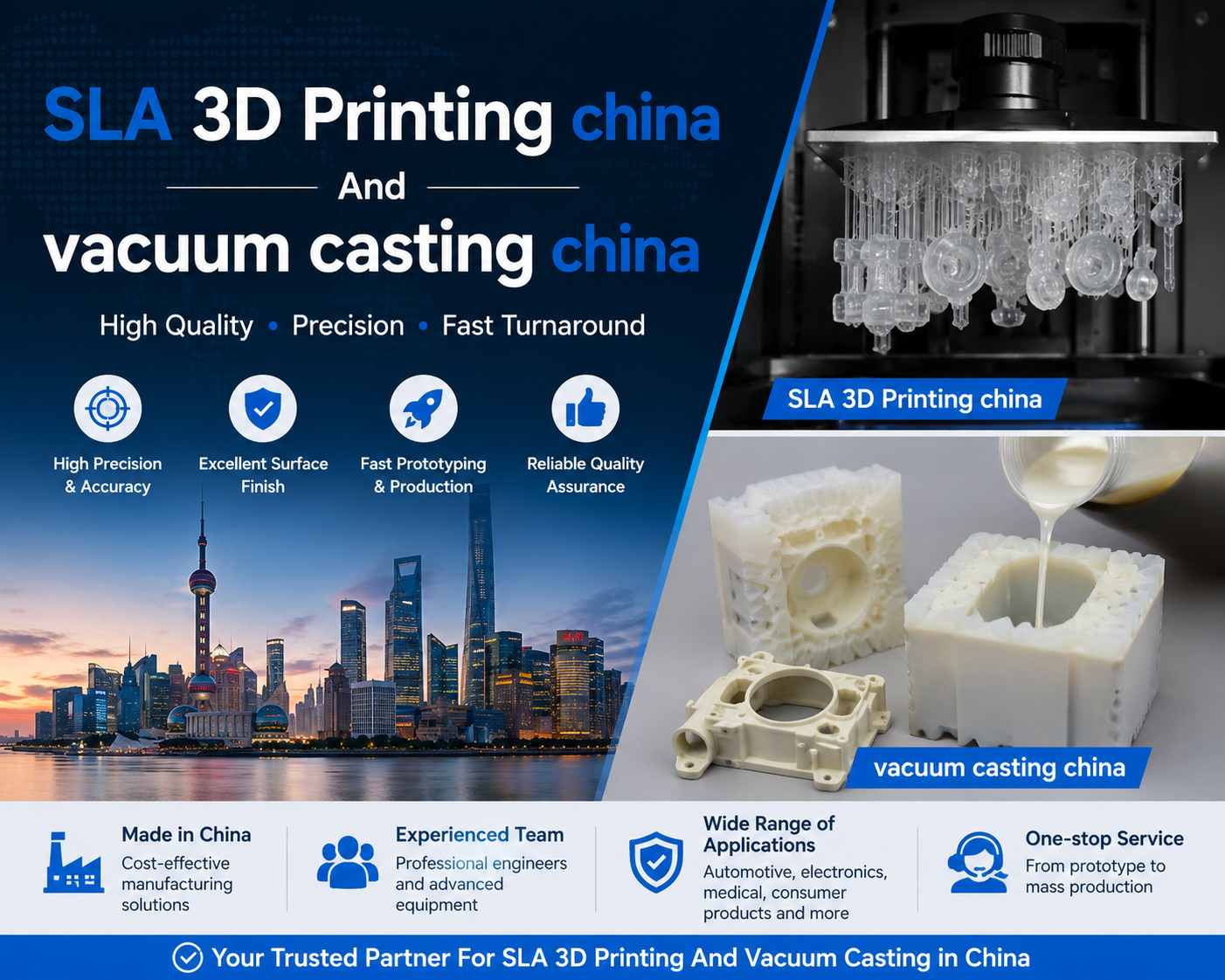
Turning a product concept into a physical prototype quickly is essential for companies developing consumer products, electronics, automotive components, medical devices, industrial equipment, and other engineered products. Two manufacturing technologies frequently used during this stage are SLA 3D Printing China services and vacuum casting China solutions.
Although both processes are widely used for rapid prototyping, they solve different manufacturing problems. SLA is particularly effective for producing highly detailed prototypes directly from digital CAD files, while vacuum casting is often selected when businesses need several realistic plastic-like parts that closely resemble injection-moulded products.
Understanding how these processes work, where they perform best, and when they can be combined can help product developers reduce development time, control prototype costs, and identify design problems before committing to expensive production tooling.
What Is SLA 3D Printing China?
Stereolithography, commonly called SLA, is an additive manufacturing technology that creates three-dimensional components using liquid photopolymer resin.
During production, a laser selectively cures the resin according to data from a digital CAD model. The platform gradually moves while additional layers are cured until the complete component is formed.
Manufacturers providing SLA 3D Printing China services commonly support projects that require:
- High dimensional accuracy
- Smooth surfaces
- Complex geometries
- Small detailed features
- Transparent or translucent prototypes
- Visual presentation models
- Engineering design verification
Unlike conventional machining, SLA does not require cutting the component from a solid material block. This gives designers greater freedom when developing complicated internal structures, thin walls, curved surfaces, and customised components.
Why SLA Is Popular for Rapid Prototyping
One major advantage of SLA technology is speed. Once a properly prepared 3D CAD model is available, prototype manufacturing can begin without dedicated moulds.
This makes SLA valuable during early product development when designs may change repeatedly.
Another advantage is excellent surface quality. Compared with many filament-based 3D printing technologies, SLA can create comparatively smooth surfaces with fine details.
Typical applications include concept models, electronics enclosures, cosmetic housings, medical product prototypes, automotive components, master patterns and functional design samples.
Different photopolymer materials may also simulate properties such as toughness, flexibility, transparency or heat resistance. However, engineers should remember that prototype resins do not always reproduce the long-term characteristics of production thermoplastics.
Understanding Vacuum Casting China
Vacuum casting is another rapid manufacturing process, but its workflow is significantly different.
Instead of printing every component individually, manufacturers normally begin by creating a master pattern. SLA printing is frequently used to manufacture this master because of its accuracy and surface finish.
A silicone mould is then formed around the master model. Once cured, the mould is separated and the original master is removed.
Polyurethane resin is mixed and poured into the silicone mould under vacuum conditions. The vacuum helps minimise trapped air and improves reproduction of fine details.
After curing, the finished component is removed and the mould can normally be reused for additional parts.
This makes vacuum casting China particularly useful for small production quantities where conventional injection moulding tooling would be unnecessarily expensive.
Benefits of Vacuum Casting China
Vacuum casting provides manufacturers with an effective bridge between individual prototypes and mass production.
One important benefit is realistic material simulation. Polyurethane casting materials can imitate many characteristics associated with production plastics such as ABS, polypropylene or rubber-like materials.
Other advantages include:
- Good surface finish
- Accurate reproduction of master patterns
- Multiple identical components from one mould
- Different colours and material properties
- Rubber-like and rigid material options
- Lower tooling investment than injection moulding
- Suitable production volumes for testing or market evaluation
Vacuum-cast prototypes can therefore be useful for exhibitions, customer demonstrations, packaging trials, engineering evaluation and limited pilot production.
SLA 3D Printing China vs Vacuum Casting China
Choosing between the technologies depends heavily on prototype quantity, application and required material characteristics.
| Factor | SLA 3D Printing | Vacuum Casting |
| Tooling | Generally unnecessary | Silicone mould required |
| Best quantity | One or several parts | Small batches |
| Surface detail | Excellent | Excellent |
| Design changes | Very convenient | New master or mould may be needed |
| Material options | Photopolymer resins | Polyurethane materials |
| Complex geometry | Excellent | Depends on mould design |
| Per-part economics | Better for very small quantities | Better as quantity increases |
There is therefore no universal winner. The correct manufacturing method depends on the specific stage of product development.
Combining SLA Printing and Vacuum Casting
Interestingly, SLA and vacuum casting are often complementary rather than competing technologies.
A manufacturer may first produce a highly accurate SLA master model. Engineers inspect and finish the master before using it to create a silicone mould.
Multiple polyurethane copies can then be produced through vacuum casting.
A typical workflow may involve:
- Preparing the 3D CAD model.
- Reviewing wall thickness and manufacturability.
- Printing the master using SLA.
- Sanding or polishing the prototype.
- Creating the silicone mould.
- Selecting suitable polyurethane resin.
- Vacuum casting the required components.
- Trimming and finishing each part.
- Inspecting dimensions and appearance.
This combined approach gives product designers the geometric flexibility of additive manufacturing together with economical small-batch replication.
Important Design Considerations
Successful prototypes depend on more than choosing a manufacturing process.
Engineers should carefully review wall thickness, tolerances, assembly gaps, surface requirements and intended mechanical loads.
Extremely thin walls may deform, while oversized solid sections may affect curing or increase material use.
For vacuum casting, mould orientation and undercuts should also be considered. Highly complicated geometry may require split moulds or specialised mould-making strategies.
Providing accurate STEP, STL or other supported CAD files is equally important. Clear drawings should identify critical dimensions, tolerances, surface finishes and cosmetic expectations.
How to Choose a China Prototyping Supplier
Selecting the right manufacturing partner can significantly influence prototype quality.
Before ordering SLA 3D Printing China or vacuum casting China, evaluate several areas:
- Available equipment and manufacturing capacity
- Resin and polyurethane material choices
- Dimensional inspection capabilities
- Surface finishing options
- Experience with similar products
- Engineering communication
- Intellectual property protection
- Quality control procedures
- Packaging and international shipping
- Ability to provide machining or moulding later
Price is important, but prototype quality and engineering support can prevent expensive design mistakes later in the project.
Applications Across Different Industries
SLA printing and vacuum casting support many industries because prototypes can be manufactured without expensive permanent production tooling.
Automotive developers may use them for dashboard components, lighting housings and interior assemblies.
Consumer electronics companies can evaluate enclosure dimensions, button positions and assembly interfaces.
Medical product developers may create equipment housings, ergonomic models and presentation prototypes.
Industrial manufacturers can produce control housings, covers, brackets and demonstration components.
Start-ups also benefit because small prototype quantities allow new concepts to be tested before significant capital is invested in mass-production tools.
FAQ About SLA 3D Printing China and Vacuum Casting China
1. What is SLA 3D printing mainly used for?
It is commonly used for accurate prototypes, detailed models, visual samples and master patterns.
2. Does SLA require a mould?
No. Parts are manufactured directly from digital 3D model data.
3. What is vacuum casting mainly used for?
It is primarily used to manufacture small batches of polyurethane prototype components.
4. Can SLA parts be used as vacuum casting masters?
Yes. SLA is frequently selected because it provides excellent detail and surface quality.
5. Is vacuum casting cheaper than injection moulding?
For low quantities, it can be considerably more economical because silicone moulds cost less than production injection moulds.
6. Can vacuum-cast parts have different colours?
Yes. Pigments can often be added to casting materials to achieve specified colours.
7. Are transparent prototypes possible?
Yes. Both SLA and vacuum casting can support transparent or translucent material options depending on requirements.
8. Which process is better for one prototype?
SLA printing is usually more practical when only one or a few components are required.
9. Which technology is suitable for small batches?
Vacuum casting is often more economical when multiple identical prototype components are needed.
10. Can both technologies support product development?
Yes. They are frequently combined, with SLA producing the master and vacuum casting creating multiple copies.