
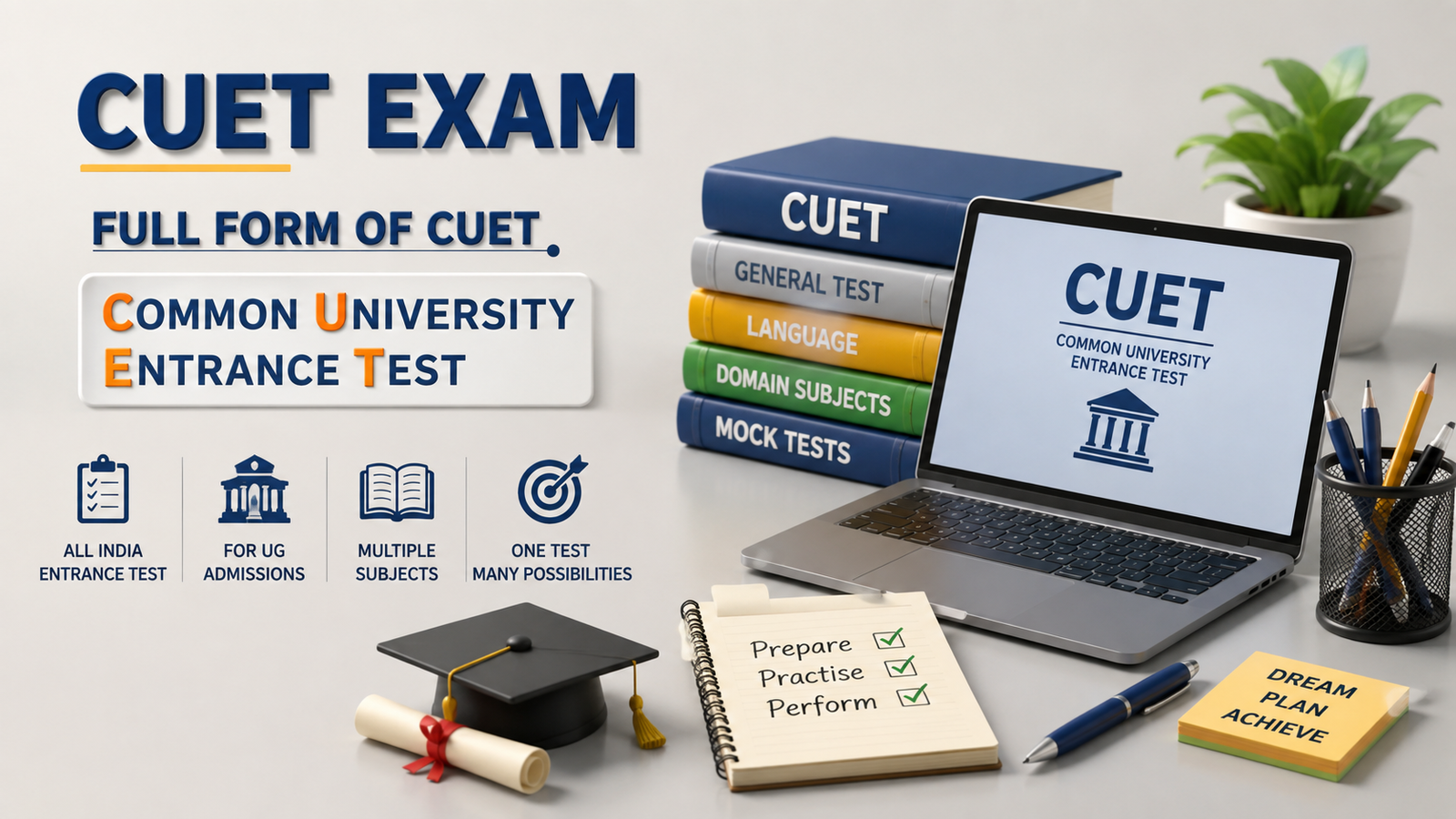
The CUET exam has become an important entrance route for students seeking admission to undergraduate programmes at participating universities across India. Instead of relying only on Class 12 board marks, CUET provides students with a common platform where their knowledge and subject understanding can be assessed through an entrance examination.
For students beginning their admission journey, understanding the full form of CUET, its purpose, eligibility, subjects, examination structure, and preparation process is essential. Proper information can help candidates avoid confusion while creating a practical study strategy.
What Is the Full Form of CUET?
The full form of CUET is Common University Entrance Test. It is an entrance examination designed to provide a common assessment platform for admission to programmes offered by participating universities and institutions.
CUET is primarily associated with admission opportunities in Central Universities and various other participating institutions. Depending on the programme and university, students need to select appropriate subjects while completing their application.
The introduction of the CUET exam helps create a more standardised admission process because students from different educational boards can compete through a common entrance assessment.
Why Is the CUET Exam Important for Students?
Before a common entrance system, admission requirements could differ significantly between universities. Some institutions depended heavily on board examination percentages, while others conducted separate entrance tests.
The CUET exam offers several advantages:
- A common examination platform for participating universities
- Wider university choices through one entrance process
- Reduced dependence on extremely high board cut-offs in relevant admissions
- A standardised assessment opportunity
- Flexibility to choose subjects according to programme requirements
- Opportunities to apply for multiple participating universities
However, qualifying or appearing for CUET does not automatically guarantee admission. Students must also satisfy the eligibility and subject requirements specified by their chosen university and programme.
CUET Exam Eligibility Explained
Eligibility is one area where candidates should be particularly careful. There can be differences between the eligibility requirements for appearing in the examination and the admission requirements of individual universities.
For undergraduate admission, candidates generally need to have completed or be appearing in the qualifying Class 12 examination, subject to applicable rules.
Universities may specify requirements related to:
- Required Class 12 subjects
- Minimum qualifying marks
- CUET subject combinations
- Programme-specific eligibility
- Category-related requirements
- Additional admission conditions
Therefore, candidates should check the current official information bulletin and the admission criteria of every university they intend to select.
Understanding the CUET Exam Structure
The examination is designed to assess students according to the subjects or components relevant to their selected programmes. Depending on current CUET rules and programme requirements, candidates may need to choose language papers, domain subjects or other applicable test components.
Domain subjects are especially important because universities may require candidates to appear in particular CUET subjects for specific courses.
For example, a student interested in a science, commerce or humanities programme should not simply select subjects based on personal preference. The selected combination should match the admission requirements of the target university.
This makes programme research an important part of CUET preparation.
CUET Exam and Board Exams: What Is the Difference?
| Factor | CUET Exam | Board Examination |
| Main purpose | University admission assessment | School-level academic qualification |
| Competition | Candidates seeking higher education admission | Students completing their board curriculum |
| Coverage | Based on selected test requirements | Based on prescribed board subjects |
| Admission role | Used by participating institutions | May remain part of eligibility criteria |
| Preparation approach | Entrance-oriented practice | Detailed school examination preparation |
Students should not treat board examinations and CUET as completely unrelated. Strong subject fundamentals developed during Class 12 can also support entrance preparation.
How to Choose Subjects for the CUET Exam
Subject selection should begin with the course rather than the examination itself.
First, shortlist the programmes you want to pursue. Next, identify universities offering those programmes. Then examine the subject requirements specified by those universities before completing your CUET application.
A practical process is:
- Decide your preferred undergraduate course.
- Shortlist suitable participating universities.
- Check programme-specific eligibility.
- Identify the required CUET subjects.
- Compare requirements across universities.
- Select subjects that keep suitable admission options available.
Incorrect subject selection can affect admission eligibility even when a candidate achieves a good score. Therefore, always verify requirements through current official university and CUET information.
How to Prepare Effectively for the CUET Exam
Successful preparation begins with understanding what you actually need to study. Avoid collecting too many books, videos and notes before analysing the syllabus and examination requirements.
Start by reviewing the current syllabus for your selected subjects. Divide topics into strong, average and weak areas. Spend additional time strengthening concepts where your accuracy is low.
A useful preparation routine includes:
- Studying concepts consistently
- Revising important chapters regularly
- Practising relevant objective questions
- Taking timed mock tests
- Analysing incorrect answers
- Improving speed without sacrificing accuracy
- Revisiting weak topics
- Maintaining short revision notes
Mock-test analysis is particularly valuable. A test should tell you whether mistakes happened because of weak concepts, poor time management, misunderstanding of questions or avoidable errors.
Common CUET Preparation Mistakes to Avoid
One common mistake is beginning preparation without checking university requirements. Another is focusing entirely on completing the syllabus while ignoring practice and revision.
Candidates should avoid:
- Selecting subjects without checking course eligibility
- Depending completely on memorisation
- Ignoring weaker chapters
- Taking mock tests without analysing mistakes
- Using too many study resources
- Leaving revision until the final weeks
- Assuming every university follows identical admission rules
A focused strategy using limited but reliable resources is generally more manageable than constantly changing study material.
How to Improve Your CUET Score
Improvement usually comes from increasing both knowledge and accuracy.
Maintain a notebook containing frequently forgotten concepts, formulas, definitions and recurring mistakes. Revise it regularly rather than repeatedly reading complete chapters.
During practice tests, identify questions that consume excessive time. Learn when to attempt a question immediately and when to return to it later, according to the applicable examination rules.
Most importantly, prepare consistently. Several months of disciplined study are generally more productive than highly intensive preparation immediately before the examination.
Frequently Asked Questions About CUET
1. What is the full form of CUET?
The full form of CUET is Common University Entrance Test.
2. What is the CUET exam used for?
It is used as an entrance assessment for admission to programmes offered by participating universities and institutions.
3. Is CUET only for Central Universities?
CUET is associated with Central Universities, but other participating universities and institutions may also use CUET scores for admission.
4. Does appearing in CUET guarantee university admission?
No. Candidates must meet the programme’s eligibility requirements and complete the applicable university admission process.
5. Can Class 12 students apply for CUET?
Students appearing in or completing their qualifying Class 12 examination may be eligible, subject to the current examination and university rules.
6. Are Class 12 marks irrelevant after CUET?
Not necessarily. Universities may still prescribe qualifying examination requirements. Candidates should check programme-specific eligibility.
7. How should I select CUET subjects?
Choose subjects according to the requirements of the courses and universities you want to apply to.
8. Is the CUET exam difficult?
Difficulty varies according to subjects, preparation level and competition. Strong concepts, regular practice and time management can make preparation more effective.
9. Are mock tests useful for CUET preparation?
Yes. Mock tests help candidates practise time management, identify weak areas and improve accuracy.
10. Can I apply to multiple universities using CUET?
CUET can provide admission opportunities across multiple participating institutions, provided you meet their respective requirements and follow their admission procedures.