
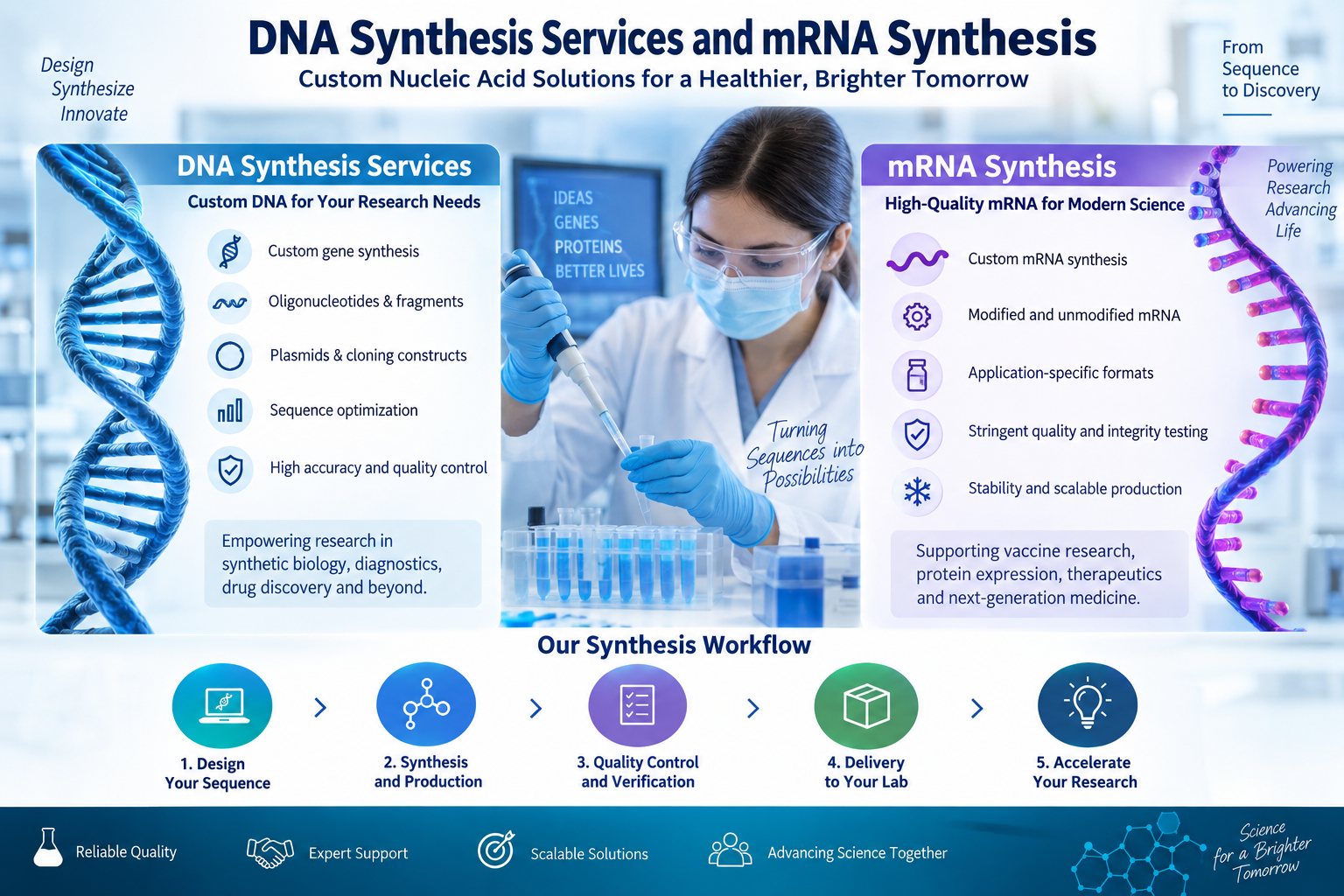
Two technologies at the center of this progress are DNA synthesis services and mRNA synthesis. They enable researchers to obtain customized genetic material without relying entirely on naturally occurring DNA or labor-intensive traditional preparation methods.
DNA synthesis focuses on producing designed DNA sequences for specific research applications, while mRNA synthesis provides messenger RNA molecules that can support studies involving gene expression, protein production, vaccines, and emerging therapeutics. Although closely related, these technologies serve different purposes and require distinct quality considerations.
Understanding how these services work, what they offer, and how to select an appropriate solution can help biotechnology teams improve research efficiency and achieve more reproducible results.
Understanding DNA Synthesis Services
DNA synthesis services provide researchers with custom-made DNA based on a specified sequence or design. Instead of isolating a required sequence from biological material, scientists can submit sequence requirements to a specialized provider and receive synthesized genetic constructs prepared according to the requested specifications.
Depending on the research objective, services may include synthetic genes, DNA fragments, plasmid constructs, oligonucleotides, sequence optimization, cloning support, and verification.
The major advantage is customization. Researchers can design sequences specifically for their experimental goals, including engineered genes and other specialized constructs.
Professional providers generally emphasize sequence accuracy, quality control, documentation, and scalable manufacturing. These factors become particularly important when synthetic DNA is intended for demanding research or downstream development.
Why Synthetic DNA Is Important in Biotechnology
Synthetic DNA has changed the way many molecular biology projects are planned. Researchers no longer need to depend exclusively on naturally available genetic templates.
Common research applications include:
- Synthetic biology and genetic engineering
- Recombinant protein research
- Molecular diagnostics development
- Gene-function studies
- Antibody and biologics research
- Agricultural biotechnology
- Academic molecular biology
- Drug discovery and preclinical research
Using DNA synthesis services can also simplify complex project workflows. A carefully designed sequence can be ordered according to research requirements and supplied in a format suitable for the intended downstream workflow.
This approach can reduce repetitive preparation work while allowing scientists to concentrate on experimental design and data interpretation.
What Is mRNA Synthesis?
mRNA synthesis refers to the production of messenger RNA designed to carry genetic instructions that cellular machinery can translate into a specific protein.
Interest in synthetic mRNA has expanded significantly because mRNA provides a flexible platform for biomedical research. Rather than permanently altering genomic DNA, mRNA can provide temporary instructions for protein expression, making it valuable for many research and development programs.
Potential areas of application include:
- Vaccine research
- Protein-expression studies
- Immunology
- Gene regulation research
- Cell-based studies
- Therapeutic discovery
- Regenerative medicine research
- Personalized medicine development
The final characteristics required from an mRNA product depend heavily on its intended application. Consequently, researchers should evaluate quality specifications and analytical documentation when choosing an mRNA synthesis provider.
DNA Synthesis Services vs. mRNA Synthesis
Although DNA and mRNA are both nucleic acids, their roles are different.
| Factor | DNA Synthesis Services | mRNA Synthesis |
| Primary material | DNA | Messenger RNA |
| Main purpose | Genetic templates and constructs | Temporary protein-expression instructions |
| Typical research | Cloning, synthetic biology, engineering | Vaccines, protein expression, therapeutics |
| Stability | Generally more stable | Generally more sensitive |
| Customization | Sequence and construct design | Sequence and application-specific design |
| Handling | Often comparatively straightforward | Requires careful handling and storage |
Neither technology universally replaces the other. Researchers select DNA or mRNA according to the biological objective, experimental system, delivery strategy, and downstream application.
Quality Considerations for DNA Synthesis
Accuracy is one of the most important considerations when ordering synthetic DNA. Sequence errors can affect protein expression, experimental reproducibility, and downstream interpretation.
A dependable DNA synthesis services provider should clearly communicate specifications covering sequence verification, purity, available construct formats, documentation, and quality-control procedures.
Other useful considerations include:
- Supported sequence lengths and complexity
- Available cloning or vector options
- Sequence optimization capabilities
- Quality-control documentation
- Project scalability
- Technical support
- Turnaround expectations
Price matters, but it should not be considered independently of quality. For critical research projects, reliable verification and transparent documentation can be more valuable than simply choosing the lowest-cost option.
Quality Considerations for mRNA Synthesis
High-quality mRNA synthesis requires attention to characteristics that can influence stability, integrity, and biological performance.
Researchers may need to consider RNA integrity, purity, sequence identity, formulation requirements, analytical testing, and storage recommendations. The exact requirements vary considerably between exploratory research and advanced development programs.
For regulated or translational applications, additional documentation and manufacturing standards may also become relevant. Researchers should therefore communicate the intended application clearly when discussing project requirements with a synthesis provider.
Benefits of Outsourcing Nucleic Acid Synthesis
Outsourcing specialized synthesis can provide several practical benefits.
First, researchers gain access to specialized expertise and manufacturing infrastructure without building every capability internally. Second, standardized quality-control systems can improve consistency between projects. Third, outsourcing may help research teams manage changing demand more efficiently.
Professional DNA synthesis services and mRNA synthesis capabilities can also support projects as they progress from early research toward larger-scale development.
The right partner should function as more than a supplier. Strong technical communication can help researchers identify suitable specifications and avoid unnecessary complexity.
Choosing the Right Synthesis Partner
Before selecting a provider, define the project’s technical requirements clearly. Consider the intended application, desired material format, quality expectations, scale, analytical requirements, documentation, and future development needs.
Ask providers about their quality systems and technical support. Transparent communication is particularly important for complex or customized projects.
Researchers should also consider scalability. A provider suitable for an early research project may not necessarily offer the capabilities needed if the program later requires substantially larger quantities or more demanding quality standards.
Frequently Asked Questions
1. What are DNA synthesis services?
They are specialized services that produce customized DNA sequences or constructs according to research specifications.
2. Where is synthetic DNA commonly used?
Applications include molecular biology, synthetic biology, diagnostics research, protein studies, and biotechnology development.
3. What is mRNA synthesis?
It is the production of messenger RNA designed to encode genetic instructions for protein expression.
4. Why is synthetic mRNA important?
It provides a flexible way to investigate temporary protein expression and supports vaccine, therapeutic, and biological research.
5. Are DNA synthesis and mRNA synthesis identical?
No. DNA synthesis produces DNA molecules, while mRNA synthesis produces messenger RNA for different biological applications.
6. Can DNA sequences be customized?
Yes. Custom sequence design is a major advantage of professional DNA synthesis services.
7. Is quality control important for synthesized nucleic acids?
Yes. Identity, purity, integrity, and appropriate analytical verification can directly affect experimental reliability.
8. What industries use these technologies?
Biotechnology, pharmaceutical research, diagnostics, academia, agriculture, and life-science organizations commonly use synthetic nucleic acids.
9. How should a synthesis provider be selected?
Evaluate technical capabilities, quality systems, documentation, scalability, communication, and suitability for the intended application.
10. Can synthesis services support larger development programs?
Potentially, yes. Capabilities vary by provider, so scalability and manufacturing standards should be evaluated early.