
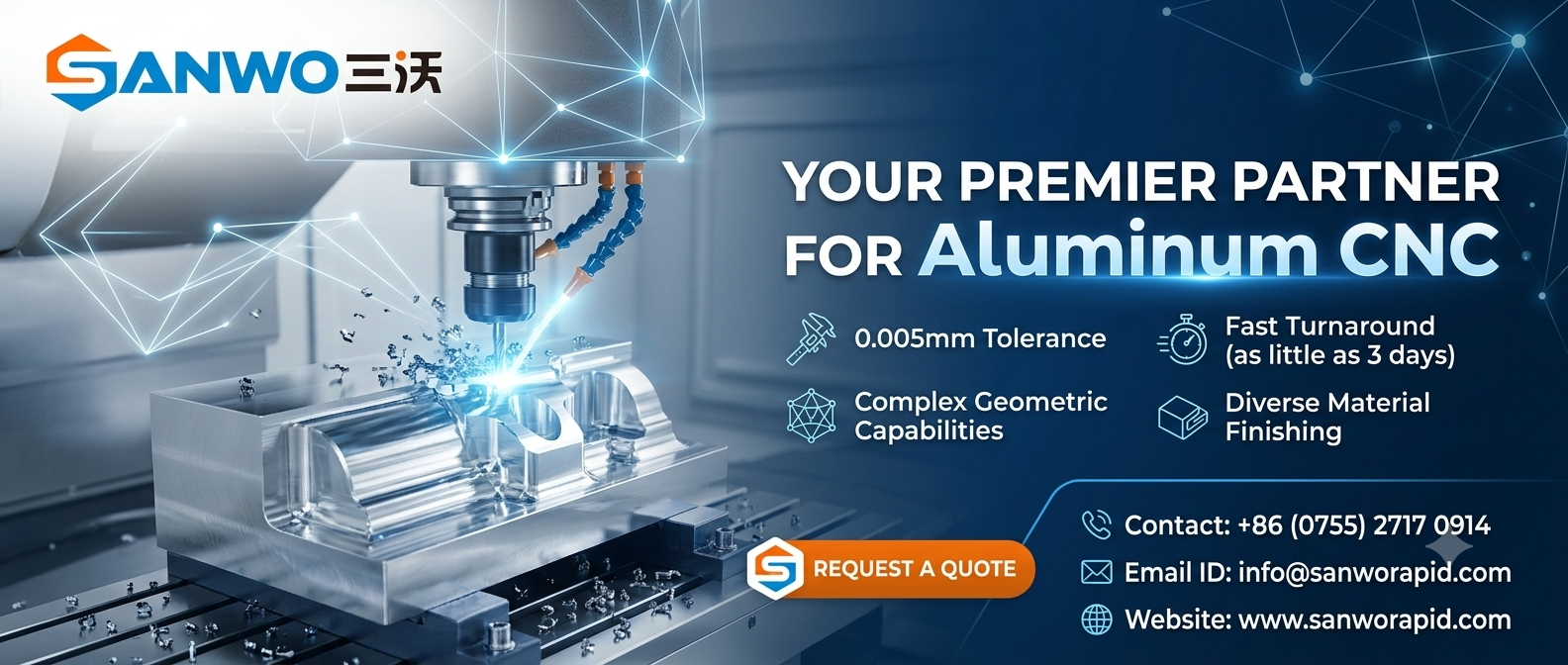
Aluminum CNC machining is one of the most widely used manufacturing processes for producing high-precision components, custom parts, and functional prototypes. It uses computer-controlled cutting tools to remove material from an aluminum workpiece and transform it into a finished component based on a digital design. This process delivers excellent dimensional accuracy, consistent quality, and smooth surface finishes.
Aluminum is a preferred material in modern manufacturing because it is lightweight, corrosion-resistant, durable, and relatively easy to machine. From automotive components and aerospace structures to electronic housings and industrial equipment, aluminum CNC machining supports a wide range of applications.
As product development becomes faster and more demanding, manufacturers increasingly rely on precision CNC machining to create complex parts, test product designs, and support low-volume and large-scale production.
What Is Aluminum CNC Machining?
Aluminum CNC machining is a subtractive manufacturing process in which computer numerical control (CNC) machines use cutting tools to remove unwanted material from an aluminum block, plate, or bar.
The process begins with a 3D CAD model or engineering drawing. The design is converted into machine instructions using computer-aided manufacturing (CAM) software. CNC equipment then follows these instructions to cut, drill, mill, or turn the aluminum material into the required shape.
Common aluminum CNC machining operations include:
- CNC Milling: Uses rotating cutting tools to produce slots, pockets, holes, and complex geometries.
- CNC Turning: Rotates the aluminum workpiece while a cutting tool creates cylindrical components.
- CNC Drilling: Produces accurate holes for fasteners, fittings, and assembly requirements.
- CNC Boring: Enlarges existing holes to achieve precise dimensions.
- CNC Tapping: Creates internal threads for screws and other fastening applications.
These operations can be combined to manufacture components with complex features and tight dimensional tolerances.
Why Is Aluminum Used for CNC Machining?
Aluminum offers several material advantages that make it suitable for precision manufacturing. Its mechanical properties, machinability, and relatively low weight make it a practical choice across many industries.
1. Lightweight Properties
Aluminum has a lower density than many commonly used metals, including steel. This makes it ideal for products where reducing weight is important without sacrificing the required structural performance.
2. Excellent Machinability
Aluminum is generally easier to cut than many harder metals. Its machinability allows manufacturers to achieve complex shapes, detailed features, and efficient production cycles.
3. Corrosion Resistance
Aluminum naturally develops a thin oxide layer that protects its surface from corrosion. Additional surface treatments can improve its appearance, wear resistance, and environmental durability.
4. Good Thermal and Electrical Conductivity
Aluminum efficiently transfers heat and conducts electricity, making it useful for heat sinks, electrical enclosures, connectors, and electronic components.
5. Cost-Effective Manufacturing
Its machinability can reduce machining time and tool wear compared with some harder materials. This helps manufacturers control production costs while maintaining component quality.
Common Aluminum Grades Used in CNC Machining
Selecting the correct aluminum alloy is essential for achieving the desired strength, durability, machinability, and surface finish.
| Aluminum Grade | Key Properties | Common Applications |
|---|---|---|
| 6061 Aluminum | Good strength, corrosion resistance, and machinability | Brackets, frames, housings |
| 7075 Aluminum | High strength and excellent strength-to-weight ratio | Aerospace and performance components |
| 5052 Aluminum | Excellent corrosion resistance and formability | Enclosures and sheet components |
| 2024 Aluminum | High strength and good fatigue performance | Aerospace structures |
| 6063 Aluminum | Good surface finish and corrosion resistance | Architectural and structural parts |
How to Choose the Right Aluminum Grade
Consider the following factors when selecting an aluminum alloy:
- Strength requirements: Choose 7075 or 2024 when higher mechanical strength is required.
- Corrosion resistance: Consider 5052 or 6061 for components exposed to moisture.
- Machinability: Evaluate 6061 for general-purpose precision machining.
- Weight limitations: Compare alloy density and required structural performance.
- Budget: Consider material availability, machining complexity, and finishing requirements.
The best alloy depends on the component’s operating environment, engineering specifications, and intended application.
How Does the Aluminum CNC Machining Process Work?
Aluminum CNC machining follows a structured manufacturing workflow to ensure accuracy and repeatability.
Step 1: CAD Design and Engineering
The process starts with a digital design created using CAD software. Engineers define the component’s dimensions, geometry, hole positions, wall thickness, and tolerance requirements.
A detailed 3D model helps manufacturers understand the design before production begins.
Step 2: CAM Programming
The CAD model is imported into CAM software, where machining operations and toolpaths are generated. These instructions determine how the CNC machine will cut the aluminum material.
The programming stage also considers cutting speeds, feed rates, tool selection, and machining sequences.
Step 3: Material Selection and Preparation
The appropriate aluminum alloy is selected according to the design specifications. The raw material is then cut into a suitable size and securely positioned in the CNC machine.
Step 4: CNC Machining Operations
The machine performs milling, turning, drilling, or other required operations. Multiple machining setups may be used to complete complex geometries.
Step 5: Deburring and Surface Finishing
After machining, sharp edges, burrs, and unwanted material are removed. Additional finishing processes may be applied to improve appearance, corrosion resistance, or surface performance.
Step 6: Quality Inspection
The finished component is inspected against the engineering drawing. Measurements may include overall dimensions, hole diameters, flatness, surface finish, and geometric tolerances.
Inspection equipment can include coordinate measuring machines (CMMs), micrometers, calipers, and other precision instruments.
Common Applications of Aluminum CNC Machined Parts
Aluminum CNC machining supports numerous industries because of its combination of strength, low weight, and manufacturing flexibility.
Aerospace Industry
Aerospace manufacturers use precision aluminum components in structural brackets, housings, mounting systems, and other aircraft parts. Weight reduction and dimensional accuracy are particularly important in this sector.
Automotive Industry
CNC-machined aluminum components are used in engine housings, transmission parts, suspension components, custom brackets, and lightweight structural assemblies.
Electronics Industry
Aluminum is widely used for electronic enclosures, heat sinks, mounting plates, and protective housings because of its thermal conductivity and machinability.
Medical Equipment
Aluminum machining can produce equipment housings, instrument components, mounting fixtures, and other precision parts, subject to the relevant medical application requirements.
Industrial Machinery
Manufacturers use CNC-machined aluminum for machine frames, fixtures, brackets, connectors, and custom mechanical components.
Aluminum CNC Machining vs. Other Manufacturing Methods
Choosing the right manufacturing process depends on design complexity, production quantity, material requirements, and budget.
| Manufacturing Method | Main Advantages | Best Applications |
|---|---|---|
| Aluminum CNC Machining | High precision, complex geometries, excellent repeatability | Prototypes and production parts |
| Aluminum Die Casting | Efficient for high-volume production | Large quantities of similar components |
| Aluminum Extrusion | Suitable for consistent cross-sectional profiles | Frames, rails, and structural profiles |
| Aluminum Sheet Metal Fabrication | Efficient for thin metal components | Enclosures, panels, and brackets |
| 3D Printing | Supports complex designs and rapid iterations | Specialized prototypes and low-volume parts |
CNC machining is particularly useful when components require accurate dimensions, specific mechanical properties, and features that are difficult to achieve through other processes.
Important Factors Affecting Aluminum CNC Machining Costs
The cost of aluminum CNC machining varies depending on several technical and commercial factors.
1. Material Grade
Different aluminum alloys have different material prices and machining characteristics. High-strength alloys may involve different tooling and machining considerations.
2. Part Design Complexity
Components with intricate geometries, deep pockets, thin walls, and multiple features generally require more machining time and careful programming.
3. Machining Time
Longer machine cycles increase production costs. Tool selection, cutting parameters, and the number of machining operations influence total processing time.
4. Production Quantity
Prototype orders often have higher per-unit costs because programming and setup expenses are distributed across fewer parts. Larger quantities can improve production efficiency.
5. Surface Finishing
Additional processes such as anodizing, polishing, sandblasting, and painting contribute to the final component cost.
6. Tolerance Requirements
Tighter tolerances may require specialized machining strategies, additional inspection, and more controlled production conditions.
Surface Finishing Options for Aluminum CNC Parts
Surface finishing improves the appearance and performance of aluminum components.
Common finishing options include:
- Anodizing: Creates a protective oxide layer and can provide different colors.
- Sandblasting: Produces a uniform matte surface texture.
- Polishing: Improves surface smoothness and visual appearance.
- Powder Coating: Applies a durable protective coating.
- Brushing: Creates a consistent directional surface texture.
- Chemical Conversion Coating: Improves corrosion protection and can support paint adhesion.
The appropriate finish depends on the component’s environment, appearance requirements, and functional purpose.
Tips for Designing Aluminum CNC Machined Parts
Good design practices can reduce manufacturing costs and improve component quality.
- Avoid unnecessarily tight tolerances: Apply tight tolerances only to critical functional features.
- Use suitable wall thicknesses: Extremely thin walls can create vibration and machining difficulties.
- Consider internal corner radii: Standard tool sizes can simplify machining and reduce costs.
- Optimize hole dimensions: Use practical drill sizes and thread specifications.
- Minimize complex setups: Design parts to reduce the number of machining orientations where possible.
- Specify surface finishes clearly: Identify the required finish for each critical surface.
- Provide accurate CAD files: Include detailed engineering drawings and material specifications.
Designing with manufacturing limitations in mind helps improve efficiency while maintaining the required performance.
How to Choose a Reliable Aluminum CNC Machining Supplier
Selecting an experienced manufacturing partner is important for achieving consistent quality and dependable delivery.
Before choosing a supplier, evaluate these factors:
- Machining capabilities: Check available CNC milling, turning, and multi-axis machining equipment.
- Material expertise: Confirm experience with the required aluminum alloys.
- Quality control: Ask about inspection procedures and measurement equipment.
- Engineering support: Look for assistance with design for manufacturability (DFM).
- Surface finishing: Check whether the supplier can coordinate the required finishing processes.
- Production flexibility: Evaluate the ability to handle prototypes, small batches, and production orders.
- Communication: Choose a supplier that provides clear technical updates and project coordination.
A capable manufacturing partner should understand your design requirements and help identify opportunities to improve quality, cost, and production efficiency.
For businesses looking for custom machining and rapid manufacturing support, SanwoRapid provides manufacturing solutions to support product development and precision component requirements.
Future Trends in Aluminum CNC Machining
The aluminum CNC machining industry continues to evolve as manufacturing technologies improve.
Several developments are shaping its future:
- Automation: Automated loading and machining systems help improve productivity.
- Advanced CNC Technology: Multi-axis machining supports increasingly complex geometries.
- Digital Manufacturing: CAD/CAM integration improves production planning and process control.
- Smart Quality Inspection: Digital measurement systems support more consistent quality monitoring.
- Sustainable Manufacturing: Improved material utilization and recycling help reduce manufacturing waste.
These developments are making precision machining more efficient, adaptable, and suitable for increasingly demanding engineering applications.
Frequently Asked Questions (FAQs)
1. What is aluminum CNC machining?
Aluminum CNC machining is a subtractive manufacturing process that uses computer-controlled cutting tools to create precise components from aluminum material.
2. Which aluminum grade is best for CNC machining?
Aluminum 6061 is a popular general-purpose option because it offers good machinability, strength, and corrosion resistance. Other grades may be more suitable for specialized applications.
3. Is aluminum suitable for precision CNC machining?
Yes. Aluminum is highly suitable for precision CNC machining because of its machinability and ability to produce accurate dimensions and complex features.
4. What industries use aluminum CNC machined parts?
Aerospace, automotive, electronics, medical equipment, industrial machinery, and consumer product manufacturers commonly use aluminum CNC machined components.
5. What is the difference between aluminum 6061 and 7075?
6061 offers a useful balance of strength, machinability, and corrosion resistance. 7075 provides higher strength but generally costs more and may be less suitable for certain corrosive environments.
6. Can aluminum CNC machining be used for prototypes?
Yes. CNC machining is an effective option for functional prototypes because it can produce parts from production-relevant materials with accurate dimensions.
7. What surface finishes are available for aluminum CNC parts?
Common options include anodizing, polishing, sandblasting, brushing, powder coating, and chemical conversion coating.
8. What factors affect aluminum CNC machining costs?
Material grade, part complexity, machining time, production volume, tolerance requirements, and surface finishing all influence the final cost.
9. Is aluminum CNC machining better than 3D printing?
Neither process is universally better. CNC machining is suitable for strong, precise components made from solid aluminum, while 3D printing supports certain complex geometries and specialized prototype requirements.
10. How long does aluminum CNC machining take?
Production time depends on design complexity, material availability, machining operations, quantity, finishing, and inspection requirements. Simple parts may be completed faster than complex components requiring multiple setups.
11. Can aluminum CNC machining produce complex shapes?
Yes. Multi-axis CNC machines can manufacture complex geometries, curved surfaces, pockets, slots, and detailed features when suitable tooling and machining strategies are used.
12. How can I reduce the cost of aluminum CNC machining?
You can reduce costs by simplifying part geometry, avoiding unnecessary tight tolerances, selecting readily available aluminum grades, optimizing wall thickness, and choosing suitable production quantities.