
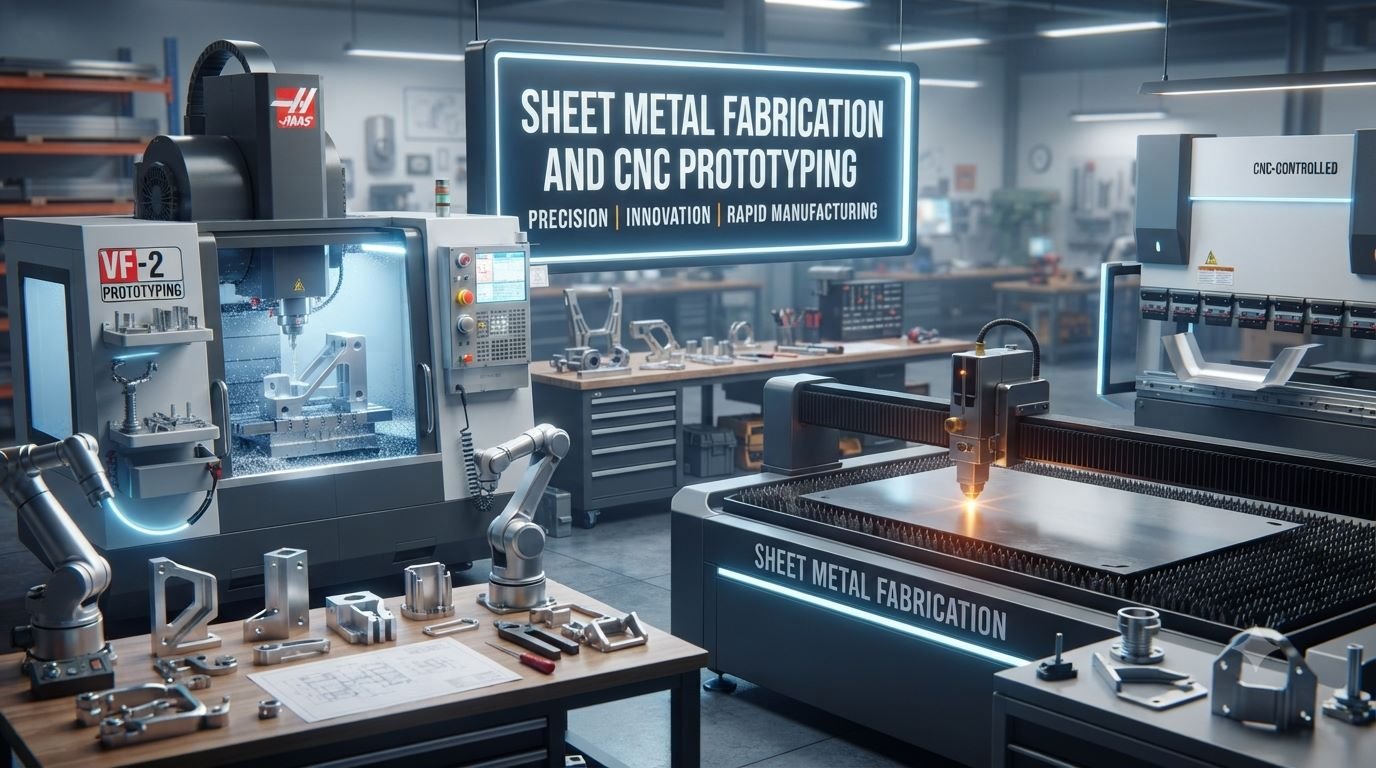
Modern product development depends on manufacturing methods that can transform engineering concepts into accurate, functional components quickly. Two widely used approaches are sheet metal fabrication and CNC prototyping. Although both serve different manufacturing requirements, they can work together to support rapid product development, functional testing, low-volume production, and customized industrial components.
What Is Sheet Metal Fabrication?
Sheet metal fabrication is a manufacturing process used to convert flat metal sheets into finished components through operations such as cutting, bending, forming, punching, and joining. Common materials include stainless steel, aluminum, mild steel, galvanized steel, and copper.
The process generally begins with a digital CAD drawing. The design is converted into manufacturing instructions before the sheet is cut and shaped according to the required dimensions.
Typical applications include:
- Electrical enclosures
- Machine covers
- Automotive components
- Brackets and mounting plates
- HVAC components
- Industrial cabinets
- Control panels
- Consumer-product housings
Major Sheet Metal Processes
Different fabrication techniques are selected according to material, thickness, geometry, production quantity, and required tolerances.
- Laser cutting: Uses a concentrated laser beam to produce precise profiles and openings.
- CNC punching: Creates holes and repetitive features efficiently.
- Press brake bending: Forms accurate angles and bends.
- Welding: Joins multiple fabricated sections into assemblies.
- Deburring: Removes sharp edges and improves component safety.
- Surface finishing: Includes powder coating, anodizing, polishing, and other treatments.
Why Design Matters
A fabrication design must account for bend allowance, material thickness, bend radius, hole placement, tolerances, and tool access. Designing with manufacturing constraints in mind can reduce rework and production costs.
Understanding CNC Prototyping
CNC prototyping involves using computer-controlled machining equipment to produce prototype components directly from digital designs. CNC machines can remove material from blocks, plates, or other workpieces using cutting tools.
Unlike additive manufacturing, CNC machining is subtractive: material is progressively removed until the desired geometry is achieved.
CNC prototyping is particularly useful when engineers need prototypes that closely represent the material properties, dimensions, and mechanical behavior of eventual production parts.
Common CNC processes include:
- CNC milling
- CNC turning
- CNC drilling
- CNC routing
- Multi-axis machining
How CNC Prototyping Supports Product Development
A prototype provides an opportunity to evaluate a design before committing to large-scale production. Engineers can inspect dimensions, assembly relationships, functionality, and appearance.
A typical CNC prototyping workflow includes:
- Create or refine the CAD model.
- Select an appropriate material.
- Generate CAM toolpaths.
- Machine the prototype.
- Inspect critical dimensions.
- Test the component.
- Modify the design if necessary.
- Manufacture the revised version.
This iterative process can identify design problems earlier and help teams make informed engineering decisions.
Sheet Metal Fabrication vs CNC Prototyping
| Feature | Sheet Metal Fabrication | CNC Prototyping |
| Starting material | Metal sheet | Solid block, plate, or stock |
| Main process | Cutting and forming | Material removal |
| Best suited for | Enclosures, panels, brackets | Detailed mechanical prototypes |
| Geometry | Flat, bent, formed | Complex 3D shapes |
| Material options | Primarily sheet metals | Metals and engineering plastics |
| Typical operations | Cutting, bending, welding | Milling, turning, drilling |
| Production suitability | Prototype to volume production | Prototypes and low-volume parts |
Neither process is universally better. The appropriate method depends on the component’s geometry, material, quantity, tolerance, and functional requirements.
Combining Both Manufacturing Methods
In many product-development projects, sheet metal fabrication and CNC prototyping can complement one another.
For example, an industrial machine may require a fabricated sheet-metal enclosure together with precision-machined brackets, shafts, mounting blocks, or connectors. Fabricating the enclosure and CNC machining the precision components can provide a practical combination of structural efficiency and dimensional accuracy.
This hybrid approach can be useful for:
- Robotics
- Industrial automation
- Electronic equipment
- Medical equipment
- Automotive development
- Aerospace components
- Laboratory instruments
Factors That Influence Manufacturing Costs
Manufacturing cost is affected by much more than material price. Design decisions can have a substantial impact on the final quotation.
Important factors include:
- Material type and thickness
- Part dimensions
- Number of operations
- Machining time
- Number of bends
- Tooling requirements
- Surface finishing
- Dimensional tolerances
- Order quantity
- Inspection requirements
- Packaging and shipping
For CNC prototypes, reducing unnecessary machining features and selecting suitable tolerances can often make the design more economical. For fabricated parts, minimizing complicated bends and unnecessary welding can simplify production.
Improving Prototype Design for Manufacturing
Design for manufacturability, commonly called DFM, should be considered before production begins.
Useful practices include:
- Specify realistic tolerances.
- Avoid unnecessarily complex geometries.
- Select readily available materials.
- Consider minimum bend radii.
- Maintain adequate spacing between holes and bends.
- Reduce unnecessary machining operations.
- Clearly identify critical dimensions.
- Communicate surface-finish requirements.
- Provide complete CAD files and technical drawings.
Early communication between designers and manufacturers can prevent costly revisions later in the development cycle.
Quality Control and Inspection
Reliable prototypes require more than visual inspection. Depending on the application, manufacturers may use measuring equipment such as calipers, micrometers, height gauges, coordinate measuring machines, and optical inspection systems.
Quality checks can verify:
- Overall dimensions
- Hole diameter and location
- Flatness
- Bend angles
- Thread dimensions
- Surface condition
- Assembly fit
- Material specifications
For demanding applications, inspection documentation can also provide traceability and help verify that critical requirements have been met.
Applications Across Modern Industries
The combination of fabrication and CNC manufacturing supports numerous industries. Automotive companies use fabricated panels and machined components during vehicle development. Electronics manufacturers require enclosures, brackets, and precision fixtures. Robotics companies frequently combine sheet-metal structures with CNC-machined joints and mounting components.
Other applications include:
- Industrial machinery
- Renewable-energy equipment
- Telecommunications
- Consumer electronics
- Automation systems
- Prototyping laboratories
- Engineering research
Frequently Asked Questions
What is sheet metal fabrication?
It is the process of cutting, bending, forming, and joining metal sheets to create functional components and assemblies.
What is CNC prototyping?
CNC prototyping uses computer-controlled machining equipment to create physical prototypes from digital CAD designs.
Is CNC prototyping suitable for functional testing?
Yes. CNC prototypes can be manufactured from engineering materials suitable for evaluating mechanical fit and functionality.
Which materials can be used for sheet metal fabrication?
Common choices include aluminum, stainless steel, mild steel, galvanized steel, and copper.
Which materials can CNC machines process?
Depending on the equipment, CNC machines can process aluminum, steel, stainless steel, brass, copper, titanium, and various engineering plastics.
Is sheet metal fabrication suitable for prototypes?
Yes. It can efficiently produce functional enclosures, brackets, panels, frames, and other components in prototype quantities.
How does CNC prototyping reduce development risk?
It allows engineers to physically evaluate a design before larger production commitments are made.
Can fabricated and CNC-machined parts be used together?
Yes. Many assemblies combine formed sheet-metal structures with precision-machined components.
What affects CNC prototype pricing?
Material, complexity, machining time, tolerances, finishing, quantity, and inspection requirements all influence cost.
Why are CAD drawings important?
Accurate CAD models and technical drawings communicate geometry, dimensions, tolerances, and manufacturing requirements clearly.