
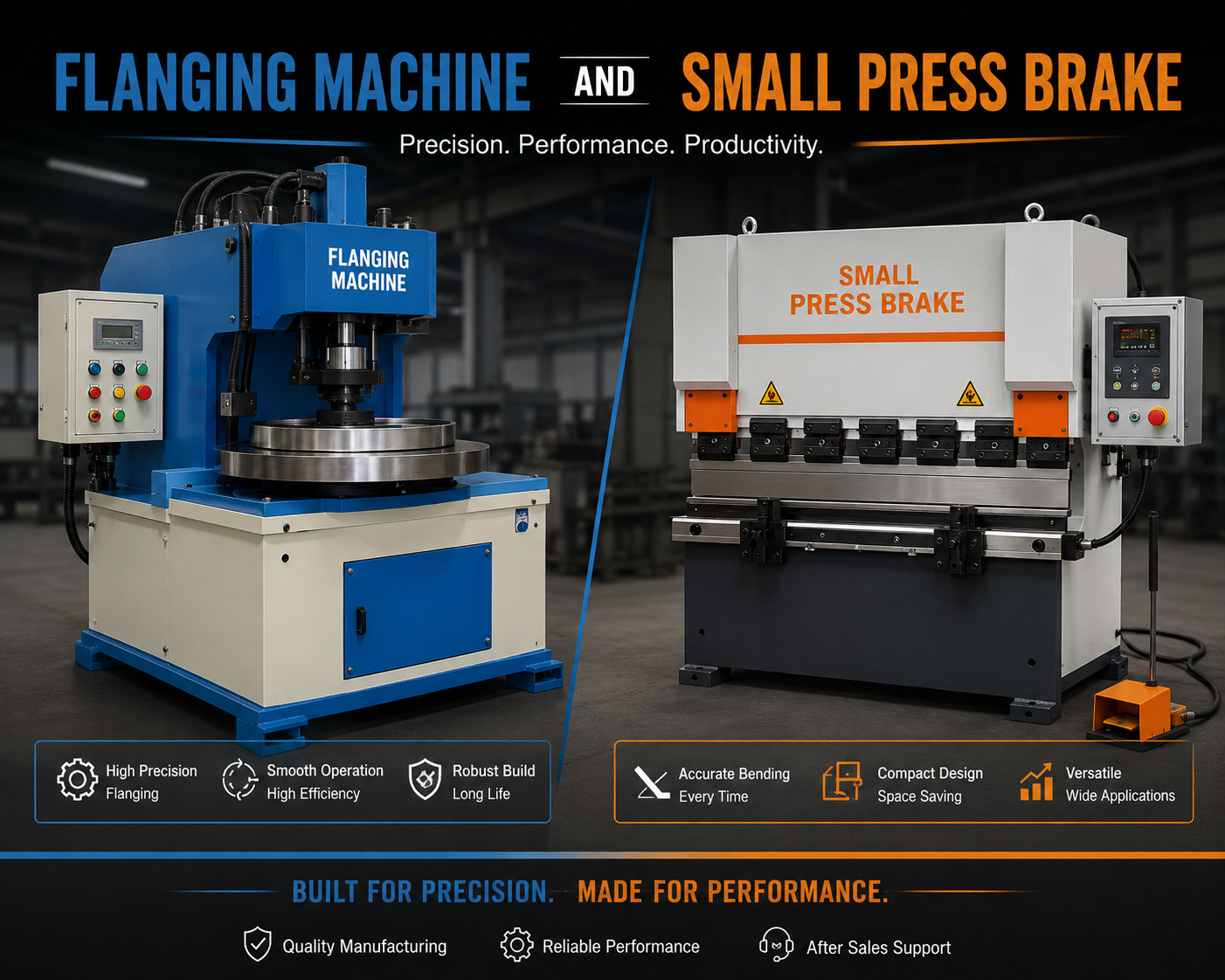
A flanging machine is mainly used to create controlled edges around sheet metal or fabricated components, while a small press brake produces straight bends, folds, channels, and angular profiles. When selected correctly, these machines can improve product consistency, reduce manual labor, and make small-to-medium fabrication operations more productive.
Why Metal Forming Accuracy Matters
Sheet metal parts often need to fit together with very small dimensional variations. An incorrect bend angle, inconsistent flange, or distorted edge can create problems during welding, assembly, sealing, and installation.
Accurate forming provides several advantages:
- Better component fit
- Reduced material waste
- Less rework
- Improved welding preparation
- Consistent finished dimensions
- Faster assembly
- Better product appearance
This is why selecting appropriate forming machinery is essential for both quality and productivity.
How a Flanging Machine Adds Value to Production
A flanging machine forms the edge of a sheet, disc, cylinder, or fabricated section into a defined flange. The flange can provide additional stiffness, create an attachment surface, or prepare two components for joining.
Unlike simple bending, flanging may involve gradual deformation around a curved or circular profile. The machine must therefore control material flow carefully to prevent excessive stretching or wrinkling.
Common Flanging Methods
Manufacturers may use different methods depending on component shape and production requirements.
Roll forming gradually shapes the edge using rotating tools.
Die forming presses the material into a predetermined flange geometry.
Rotary forming is frequently used for circular parts and cylindrical products.
Why Progressive Forming Is Useful
Forming a large flange in a single movement may place excessive stress on the material. Progressive forming distributes deformation over multiple stages, helping improve edge quality and dimensional control.
Where Flanging Machines Are Commonly Used
Flanged components appear in many industrial products.
Typical applications include:
- Ventilation ducts
- Metal drums
- Storage vessels
- Industrial tanks
- Pipe fittings
- Exhaust components
- Air handling systems
- Metal containers
- Circular covers
- Fabricated housings
The flanging machine becomes particularly valuable when identical components must be produced repeatedly.
Understanding the Small Press Brake
A small press brake performs controlled bending by positioning sheet metal between an upper punch and a lower die. Force from the machine pushes the sheet into the die, producing the desired angle.
Compact press brakes are suitable for companies that require professional bending capability but do not need the size or capacity of a large production press.
Why Compact Press Brakes Are Popular
A smaller machine can be easier to install and operate while still supporting many everyday fabrication jobs.
Its advantages can include:
- Reduced floor-space requirement
- Lower power demand on some models
- Faster setup for small components
- Convenient tooling changes
- Accurate short-length bending
- Suitable production flexibility
Production Versatility
A small press brake can manufacture different parts simply by changing tooling and adjusting machine settings. This makes it useful for customized jobs and low-volume production.
Products Made with a Small Press Brake
Compact press brakes are frequently used for producing:
- Mounting brackets
- Control panel parts
- Electrical enclosures
- Metal covers
- Machine guards
- Furniture components
- Automotive brackets
- Stainless steel panels
- Shelving components
- Prototype assemblies
One machine can therefore support multiple product categories within the same workshop.
Flanging Machine vs Small Press Brake
| Production Requirement | Flanging Machine | Small Press Brake |
| Edge forming | Excellent | Possible for straight edges |
| Angular bending | Limited | Excellent |
| Circular component work | Highly suitable | Less suitable |
| Bracket production | Limited | Highly suitable |
| Tank edge preparation | Highly suitable | Application dependent |
| Tooling flexibility | Process-specific | High |
| Prototype bending | Moderate | Excellent |
| Repetitive flange work | Excellent | Moderate |
The machines should not always be viewed as competitors. In many fabrication plants, both are used at different production stages.
Important Features of a Reliable Flanging Machine
Before selecting a flanging machine, manufacturers should study the actual components they intend to produce.
Material Capacity
Machine capacity should match both material thickness and material strength. Stainless steel may require considerably different forming force than thinner aluminum.
Component Geometry
For circular parts, operators should check supported diameter ranges and flange dimensions.
Forming Control
Adjustable forming pressure and controlled roller movement can help maintain consistency across multiple workpieces.
Structural Rigidity
A rigid frame is important because machine deflection can affect flange dimensions and surface quality.
Important Features of a Small Press Brake
Choosing a small press brake requires careful evaluation of several specifications.
Working Width
The machine’s bending length should accommodate current parts as well as reasonably expected future projects.
Press Capacity
Press force must be sufficient for material type, thickness, bend length, and tooling configuration.
Backgauge System
The backgauge determines how deeply a workpiece is positioned before bending. Accurate positioning improves flange dimensions and repeatability.
Control System
Basic manual controls may suit occasional work, while digital or CNC controls can simplify jobs with several bend sequences.
Understanding Springback in Metal Bending
When metal is bent, it naturally attempts to return slightly toward its original shape after pressure is released. This effect is called springback.
Springback depends on:
- Material strength
- Sheet thickness
- Bend radius
- Grain direction
- Forming method
- Tool geometry
Operators may need to slightly over-bend a component so that it reaches the correct final angle after springback occurs.
Tips for Better Machine Productivity
Good production results require more than simply operating the equipment.
Manufacturers can improve performance by:
- Standardizing machine settings
- Recording successful job parameters
- Inspecting tooling regularly
- Removing damaged tools
- Measuring first-production samples
- Training operators
- Maintaining lubrication
- Checking machine alignment
- Keeping work areas clean
Regular inspection also helps identify wear before it causes quality problems.
Safety Considerations During Metal Forming
Both machines generate substantial forming forces. Operators should follow machine-specific safety instructions and never bypass protective systems.
Important precautions include maintaining guards, keeping hands away from forming zones, using appropriate work supports, and ensuring that only trained personnel operate equipment.
Frequently Asked Questions
1. Why is a flanging machine used?
A flanging machine creates shaped edges that improve strength, joining, sealing, or assembly.
2. What is the main function of a small press brake?
A small press brake creates accurate straight bends in sheet metal using punch-and-die tooling.
3. Can aluminum be processed on these machines?
Yes, provided machine settings and tooling are suitable for the aluminum grade and thickness.
4. Are flanging machines only used for circular components?
No. Machine design determines whether straight, curved, or circular components can be formed.
5. Is a small press brake suitable for stainless steel?
Yes, but its tonnage must be sufficient for the required stainless steel thickness and bend length.
6. What is a press brake backgauge?
A backgauge positions the sheet accurately before bending and controls the finished flange dimension.
7. Why does sheet metal spring back?
Elastic recovery occurs after bending force is removed, causing the angle to open slightly.
8. Can a small press brake make boxes?
Yes. With suitable tooling and sufficient clearance, it can form box and enclosure components.
9. What causes flange distortion?
Incorrect tooling, excessive forming speed, unsuitable radius, uneven pressure, or material variation may cause distortion.
10. Which machine requires more tooling?
Requirements depend on the job, but press brakes typically use different punch-and-die combinations for varied bending tasks.
11. Can these machines support custom manufacturing?
Yes. Both can support customized products when suitable tooling and settings are available.
12. How should machine capacity be selected?
Capacity should be based on maximum material thickness, strength, dimensions, tooling requirements, and expected production load.