
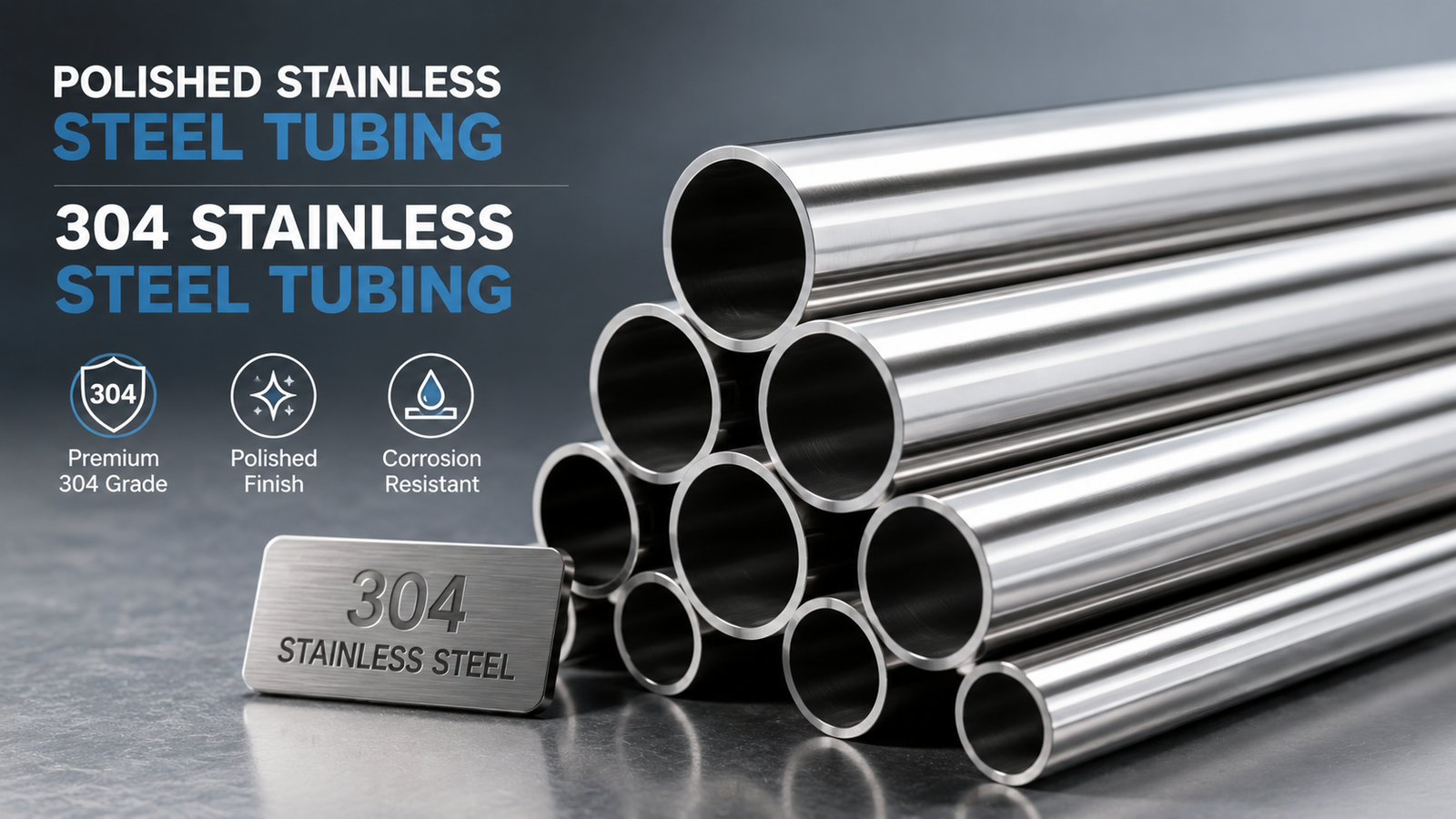
Stainless steel tubing has become an essential material for industries where strength, cleanliness, durability, and visual quality are equally important. Among the most commonly specified options, Polished Stainless Steel Tubing and 304 Stainless Steel Tubing stand out because they can serve applications ranging from decorative architectural structures to demanding industrial equipment.
However, these terms describe two different characteristics. Polished tubing refers primarily to surface finish, while 304 identifies a particular stainless steel alloy grade. Understanding this distinction helps buyers avoid specification errors and select tubing that matches environmental, mechanical, fabrication, and appearance requirements.
Why Stainless Steel Tubing Is Widely Used
Tubular stainless steel products offer an effective balance between structural performance and material efficiency. Hollow tube sections can deliver substantial strength without the unnecessary weight associated with solid metal bars.
Industries also value stainless steel because it provides:
- Good resistance to rust and oxidation
- Long operational life
- Professional surface appearance
- Excellent fabrication flexibility
- Relatively low maintenance
- Easy cleaning
- Multiple sizes and shapes
- Compatibility with welding and forming processes
Both 304 Stainless Steel Tubing and polished tube products can therefore be incorporated into machinery, building systems, process equipment, commercial interiors, and engineered assemblies.
What Makes Polished Stainless Steel Tubing Different?
Polished Stainless Steel Tubing undergoes an additional finishing process after manufacturing. Abrasive belts, wheels, compounds, or other mechanical finishing techniques are used to refine the tube surface.
The result may be a soft satin finish, directional brushed appearance, bright polished surface, or highly reflective mirror finish.
Advantages of a Polished Surface
A carefully finished surface can provide benefits beyond appearance.
Polished stainless tubing is frequently selected because it can:
- Improve visual consistency
- Make finished products look more premium
- Simplify routine surface cleaning
- Reduce noticeable surface imperfections
- Suit customer-facing installations
- Complement modern architectural designs
For this reason, polished tubes are frequently seen in retail environments, hotels, transportation facilities, kitchens, commercial buildings, and high-end fabrication projects.
Surface Finish Should Match the Application
Not every project requires mirror polishing. A lightly brushed or satin surface may actually be more suitable where fingerprints, minor scratches, or reflections need to remain less noticeable.
Surface specification should therefore be based on function rather than appearance alone.
What Is 304 Stainless Steel Tubing?
304 Stainless Steel Tubing is produced using one of the world’s most widely adopted austenitic stainless steel grades. Its chromium and nickel content helps provide corrosion resistance, formability, toughness, and fabrication performance.
Grade 304 has become popular because it performs reliably in a broad range of ordinary industrial and commercial environments without requiring highly specialized manufacturing processes.
Common applications include:
- Food-processing systems
- Beverage equipment
- Machinery frames
- Architectural structures
- Kitchen equipment
- Water-handling systems
- Automotive fabrication
- Furniture manufacturing
- Heat-transfer equipment
- General engineering components
Key Performance Benefits of 304 Stainless Steel Tubing
One reason 304 Stainless Steel Tubing remains widely specified is that it provides balanced performance rather than focusing on only one property.
Corrosion Resistance
Grade 304 performs well against many common atmospheric conditions, moisture, food products, and mild chemicals. This makes it suitable for numerous indoor and outdoor applications.
Fabrication Flexibility
The material can be cut, welded, bent, drilled, machined, and formed into finished components. This flexibility gives designers greater freedom when creating complex systems.
Clean Surface Characteristics
Stainless steel surfaces are relatively straightforward to clean, which is especially important for food, beverage, kitchen, laboratory, and processing equipment.
Long-Term Value
Although stainless steel may have a higher initial material cost than some alternatives, its durability and reduced need for coatings can contribute to favorable lifecycle economics.
Polished Tubing and 304 Tubing Are Not Opposites
A common misunderstanding is that buyers must select either polished tubing or 304 tubing.
In reality, 304 Stainless Steel Tubing can also be polished.
For example, a manufacturer may produce a round 304 stainless tube and then apply a satin, brushed, or mirror finish according to the customer’s specification.
| Consideration | Polished Stainless Steel Tubing | 304 Stainless Steel Tubing |
| Refers to | Surface treatment | Material grade |
| Main focus | Appearance and smoothness | Material performance |
| Finish options | Satin, brushed, bright, mirror | Mill or polished |
| Corrosion resistance | Depends on base alloy | Generally good |
| Typical applications | Visible and hygienic areas | Industrial and structural |
| Can be welded | Depends on underlying grade | Yes |
| Can be polished | Already finished | Yes |
Therefore, the final specification could be described as polished 304 stainless steel tubing.
Popular Shapes and Manufacturing Options
Stainless tubing is manufactured in numerous forms to suit different engineering requirements.
Round Stainless Steel Tubing
Round tubing is frequently used for handrails, process equipment, furniture, automotive parts, and fluid-handling applications.
Square Stainless Steel Tubing
Square tube provides clean lines and convenient flat surfaces for structural fabrication, frames, partitions, and architectural installations.
Rectangular Stainless Steel Tubing
Rectangular profiles are often used when directional strength, space efficiency, or specific architectural proportions are required.
Welded and Seamless Construction
Welded tubing is manufactured from formed stainless steel strip with a welded longitudinal seam. It is economical and suitable for numerous general applications.
Seamless tubing contains no longitudinal weld and may be selected for particular high-pressure, instrumentation, process, or specialized engineering requirements.
Industries Using Polished and 304 Stainless Tubing
The versatility of Polished Stainless Steel Tubing makes it valuable across a diverse range of sectors.
Architecture and Construction
Polished tubing is used for balustrades, railings, façades, entrance systems, canopies, decorative frames, and interior fixtures.
Food and Beverage Manufacturing
304 Stainless Steel Tubing is commonly found in equipment frameworks, processing machinery, commercial kitchen installations, and selected product-handling systems.
Automotive and Transportation
Tubing can be fabricated into supports, protective structures, decorative components, and specialized vehicle assemblies.
Pharmaceutical and Laboratory Equipment
Smooth stainless surfaces are useful where equipment requires regular cleaning and controlled manufacturing conditions.
Factors to Check Before Buying Stainless Steel Tubing
Choosing tubing solely according to price may create problems later. Buyers should assess the complete specification.
Important considerations include:
- Stainless steel grade
- Outside diameter
- Wall thickness
- Tube profile
- Dimensional tolerances
- Surface finish
- Welded or seamless construction
- Operating temperature
- Environmental exposure
- Fabrication requirements
Material certification and applicable standards may also be necessary for regulated or technically demanding projects.
Maintaining Stainless Steel Tubing
Proper maintenance helps preserve both appearance and performance.
Use appropriate stainless steel cleaners and avoid harsh tools that can unnecessarily damage polished surfaces. Dirt, salts, chemical residues, and other contaminants should be removed periodically.
For decorative Polished Stainless Steel Tubing, cleaning should follow the direction of the existing brushed grain where applicable.
Correct handling during fabrication is equally important. Contact with carbon-steel particles can contaminate stainless surfaces and potentially contribute to surface staining.
FAQ About Polished Stainless Steel and 304 Tubing
What does polished stainless steel tubing mean?
It means the tube surface has been mechanically finished to improve smoothness and appearance.
Is polished tubing always grade 304?
No. Polished tubing can be produced from different stainless steel grades, including 304 and 316.
Why is 304 stainless steel widely used?
It provides a practical combination of corrosion resistance, strength, fabrication ability, availability, and cost.
Can 304 stainless tubing have a mirror finish?
Yes. Grade 304 tubing can be mechanically polished to achieve highly reflective surfaces.
Is 304 stainless steel suitable outdoors?
It performs well in many normal outdoor environments, although highly saline or chloride-rich environments may require another grade.
Can 304 tubing be welded?
Yes. 304 Stainless Steel Tubing generally offers good weldability using suitable procedures.
Which tube shape is most common?
Round tubing is extremely common, although square and rectangular tubing are widely used for structural applications.
Is polished stainless tubing suitable for railings?
Yes. Its strength, corrosion resistance, and attractive finish make it popular for railing systems.
How should wall thickness be chosen?
Wall thickness should be selected according to load, pressure, structural performance, fabrication method, and applicable standards.
Does polished tubing require painting?
Normally, stainless steel is used without conventional paint because its corrosion resistance comes from the material itself.