
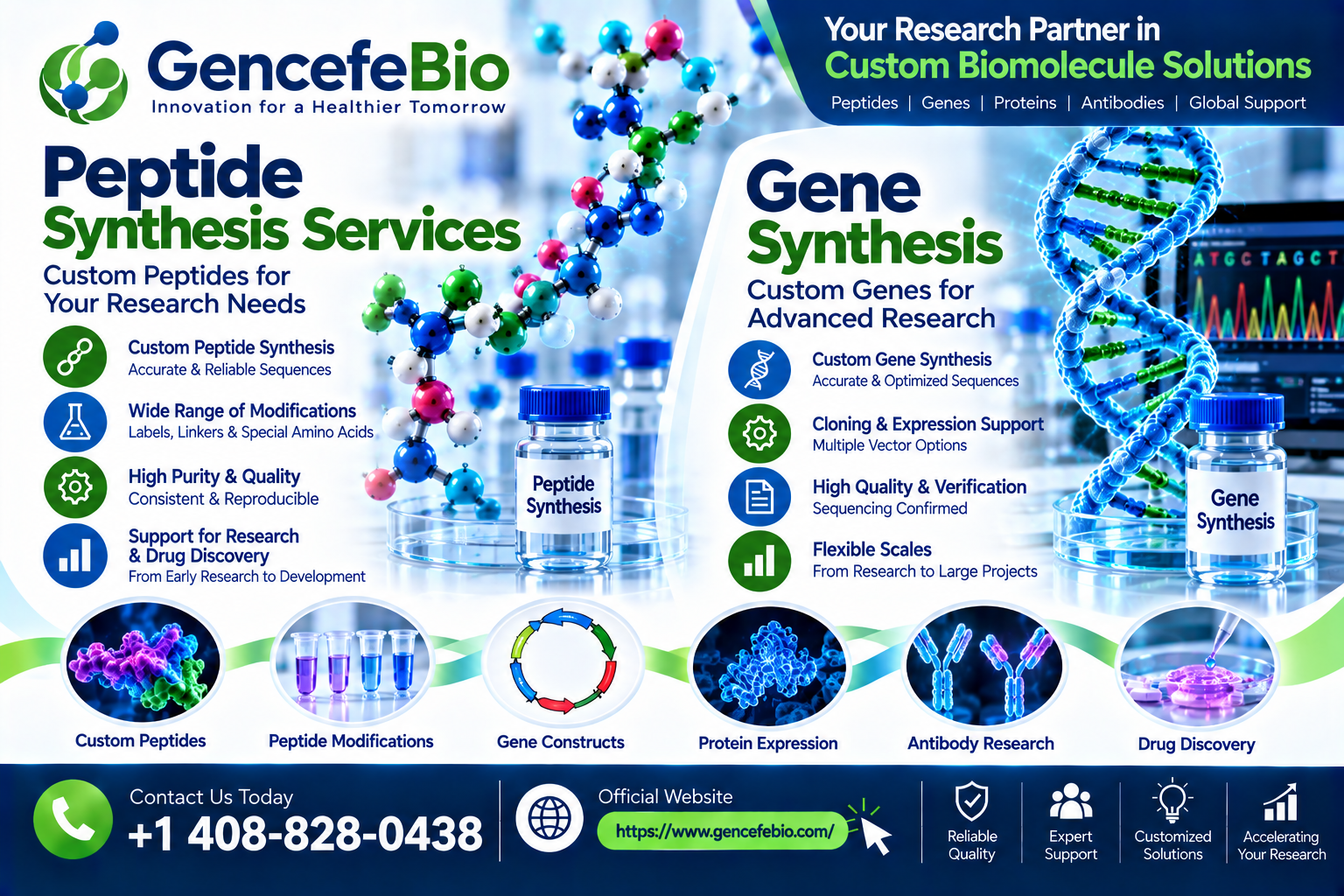
Biotechnology, pharmaceutical development, diagnostics, and academic research are increasingly moving toward customized biological reagents that match highly specific experimental goals. This trend is driving greater demand for peptide synthesis services and gene synthesis, two technologies that help researchers move from digital sequence design to physical materials for laboratory testing.
Peptides allow scientists to investigate selected amino-acid sequences, protein regions, binding sites, and epitopes, while synthesized genes provide defined DNA constructs for cloning, expression, functional studies, and synthetic biology. Although the two technologies serve different purposes, they can complement one another within the same research program.
What Are Peptide Synthesis Services?
peptide synthesis services provide researchers with custom peptides manufactured according to a specified amino-acid sequence.
Peptides are shorter chains of amino acids than most proteins and can be designed to represent a particular region of a biological target.
Common research applications include:
- Antibody development
- Epitope mapping
- Protein interaction studies
- Enzyme assays
- Biomarker research
- Drug discovery
- Analytical standards
- Immunology
- Assay development
Each project may require different specifications for sequence length, purity, quantity, and modifications.
Why Custom Peptides Matter
Standard catalog peptides cannot cover every research target.
Using peptide synthesis services, researchers can request material based on the exact protein region or amino-acid sequence needed for an experiment.
This can be particularly valuable when studying:
Antibody Recognition
A peptide can represent a selected epitope used in antibody-related research.
Protein Binding
Specific regions can be isolated to investigate molecular interactions.
Enzyme Activity
Custom peptides may act as substrates in biochemical experiments.
Sequence Variants
Researchers can compare normal and altered sequences to study how particular amino-acid changes influence function.
Key Considerations in Peptide Design
Successful peptide manufacturing begins with good design.
Sequence Length
Longer sequences can be more challenging to synthesize and purify.
Amino-Acid Composition
Certain combinations of residues may affect solubility, aggregation, and synthesis efficiency.
Purity
The required purity level should match the intended research application.
Modifications
Depending on capability, peptides may include labels, linkers, affinity groups, or modified amino acids.
Researchers should discuss difficult sequences with the provider before production begins.
Quality Control for Peptide Synthesis
Quality control can be essential for obtaining reliable experimental results.
Depending on the project, documentation may include:
- Identity confirmation
- Purity assessment
- Molecular mass
- Quantity
- Appearance
- Modification verification
Researchers should determine analytical requirements before ordering because different experiments may require different levels of characterization.
What Is Gene Synthesis?
gene synthesis is the laboratory creation of DNA according to a researcher-defined nucleotide sequence.
Instead of isolating a gene from a natural biological source, scientists can design a sequence digitally and have the corresponding DNA produced for research.
Applications may include:
- Molecular cloning
- Recombinant protein expression
- Synthetic biology
- Functional genetics
- Assay development
- Reporter constructs
- Research controls
- Pathway studies
The final construct can be customized according to the intended experimental workflow.
Why Gene Synthesis Is Valuable
Traditional molecular cloning can involve several steps to isolate, modify, and assemble DNA.
gene synthesis may allow researchers to begin directly with a defined sequence.
Potential advantages include:
Precise Sequence Design
Researchers can specify exactly which DNA sequence they require.
Sequence Optimization
Certain experimental projects may benefit from redesigning a coding sequence for a particular expression system.
Easy Variant Creation
Researchers can compare different sequence versions without relying entirely on naturally occurring templates.
Standardized Reagents
Sequence-defined DNA can make it easier to reproduce a construct in future experiments.
Gene Synthesis for Protein Expression
One major application of synthesized genes is recombinant protein research.
A typical workflow may involve:
Target Selection → Gene Design → DNA Synthesis → Cloning → Expression → Protein Analysis
Researchers may design DNA encoding a particular protein, domain, or variant and then introduce that construct into an appropriate expression system.
The quality of the original gene design can influence the efficiency of downstream research.
How Peptide Synthesis Services and Gene Synthesis Work Together
These technologies can complement each other within larger biotechnology programs.
For example:
Protein Target Selection → Gene Synthesis → Recombinant Protein Production → Peptide Design → Antibody or Binding Research
Alternatively, a project may begin with peptide studies and later progress toward full-length recombinant protein research using a synthesized gene.
This gives researchers the flexibility to study a biological target at multiple levels.
Applications in Antibody Development
Both peptide synthesis services and gene synthesis can support antibody research.
Custom peptides may serve as research antigens representing selected regions of a protein.
Synthesized genes can support the production of full recombinant proteins or other antigen formats.
Choosing between peptide and protein antigens depends on factors such as:
- Target structure
- Desired epitope
- Experimental application
- Antibody specificity requirements
In some programs, researchers may evaluate both approaches.
Applications in Drug Discovery
Drug-development programs rely heavily on well-defined research reagents.
Custom peptides may support:
- Binding studies
- Enzyme assays
- Epitope research
- Target validation
Gene synthesis may support:
- Recombinant target production
- Cellular models
- Functional studies
- Screening platforms
Together, these technologies can help research teams build more customized discovery workflows.
Applications in Synthetic Biology
Synthetic biology combines computational design with biological engineering.
Researchers may use gene synthesis to create DNA components that support studies of:
- Gene regulation
- Metabolic pathways
- Biological circuits
- Protein engineering
- Engineered research systems
Custom peptides may then be used to investigate specific protein interactions or functional domains associated with those systems.
Sequence Verification Matters
Accuracy is critical in both peptide and DNA-based research.
A single sequence difference can potentially alter:
- Protein function
- Antibody binding
- Enzyme activity
- Expression
- Experimental results
Researchers should therefore carefully review submitted sequences and request quality documentation appropriate to the project.
Choosing Peptide Synthesis Services
When comparing providers, research teams should consider more than price.
Important factors include:
- Supported sequence lengths
- Purity options
- Available modifications
- Quality-control documentation
- Technical support
- Synthesis scale
- Packaging
- Turnaround expectations
Complex peptide designs may require additional technical consultation.
Choosing a Gene Synthesis Provider
Researchers considering gene synthesis may want to evaluate:
- Supported sequence complexity
- Available construct formats
- Sequence verification
- Cloning options
- Technical communication
- Quality-control standards
- Scalability
- Delivery format
Difficult DNA sequences can sometimes require redesign or additional technical review.
Reproducibility in Biological Research
Customized reagents are especially useful when they can be reproduced consistently.
Researchers should maintain records covering:
- Peptide or DNA sequence
- Batch information
- Purity
- Concentration
- Modifications
- Storage conditions
- Experimental use
Detailed documentation makes it easier to reproduce results and compare data between experiments.
Frequently Asked Questions
What are peptide synthesis services?
Peptide synthesis services produce custom amino-acid sequences according to researcher-defined specifications for biotechnology and life-science research.
What are synthetic peptides used for?
They are commonly used in antibody research, binding studies, enzyme assays, drug discovery, biomarkers, and analytical experiments.
Can custom peptides include modifications?
Yes, depending on technical capability, peptides may include selected chemical labels or functional modifications.
What is gene synthesis?
Gene synthesis is the production of a defined DNA sequence based on a digital nucleotide design.
What can synthesized genes be used for?
They may support cloning, recombinant protein expression, synthetic biology, functional studies, and assay development.
Is gene synthesis the same as DNA sequencing?
No. Sequencing determines the order of nucleotides in an existing DNA sample, while synthesis creates new DNA according to a specified sequence.
Can peptide and gene synthesis be used in the same project?
Yes. Many biotechnology programs use synthesized genes for protein production and custom peptides for targeted binding or antibody studies.
Why does peptide purity matter?
Purity can influence experimental performance, particularly in sensitive analytical or biological applications.
Why is gene sequence verification important?
An incorrect nucleotide can potentially alter the resulting protein or experimental outcome.
What should researchers consider when choosing a supplier?
Technical capability, sequence quality, characterization, documentation, customization, scientific support, and reproducibility are important factors.
Media Contact
Research & Business Enquiries
Contact: +1 408-828-0438
Official Website: https://www.gencefebio.com/