
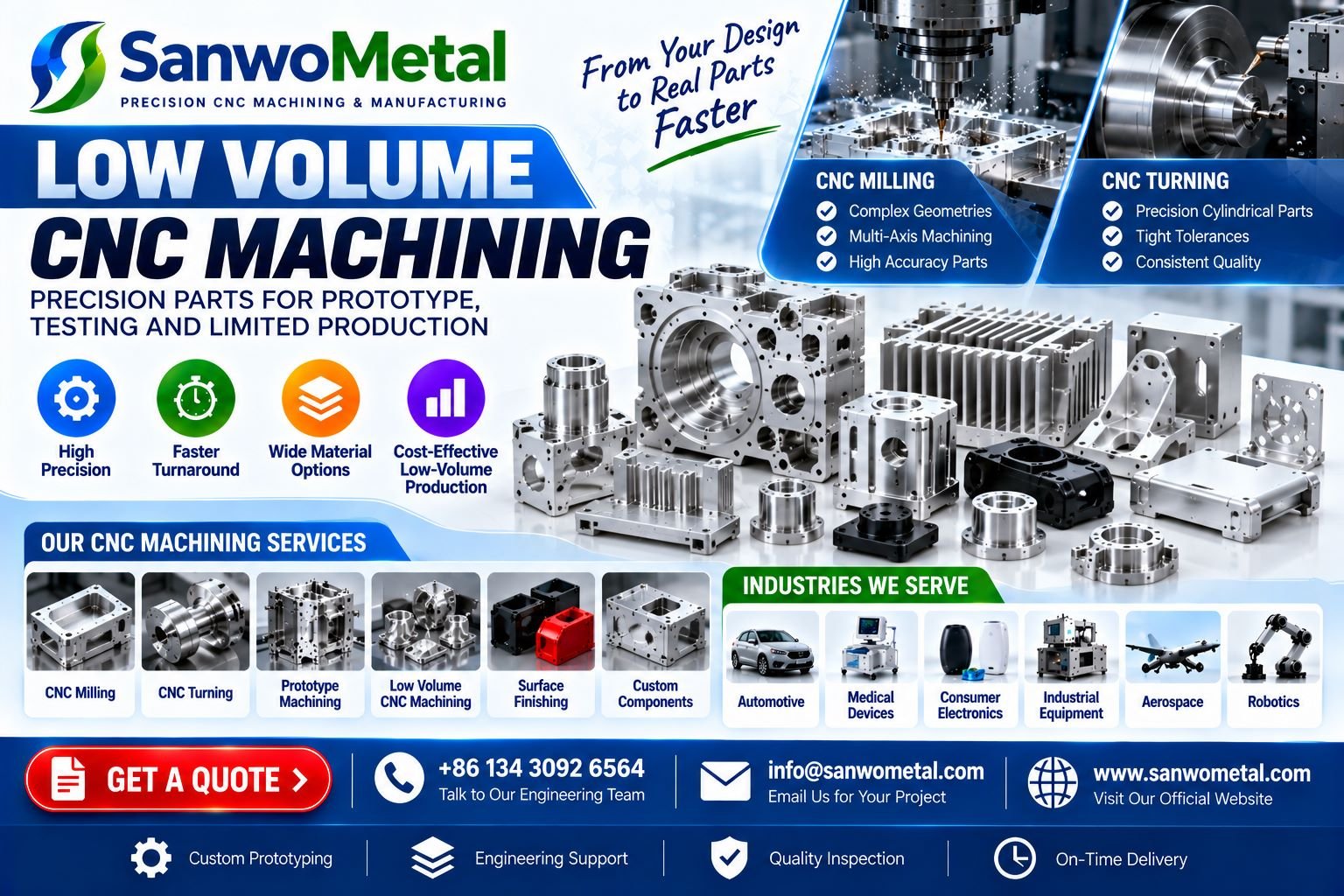
Product development is becoming increasingly focused on manufacturing flexibility as businesses seek practical ways to introduce new products without immediately committing to large production quantities.
From industrial machinery and electronic enclosures to robotics and specialised mechanical equipment, manufacturers often need precision components for testing, limited production, and product improvements.
Low volume cnc machining provides an approach for producing smaller quantities of customised components using computer-controlled manufacturing equipment.
Meanwhile, cnc machining prototyping allows engineers to transform digital designs into physical components for evaluating dimensions, assembly compatibility, and functional performance.
Together, these manufacturing approaches can help businesses manage product development risks while creating a practical transition between initial concepts and commercial manufacturing.
Why Flexible Manufacturing Matters
Traditional large-scale manufacturing can require significant investment in production equipment, tooling, and inventory.
For products with uncertain demand or specialised requirements, committing to high production quantities may create unnecessary financial exposure.
Small-batch manufacturing offers an alternative.
Businesses can produce limited quantities of components for product evaluation, pilot applications, or specialised customer requirements.
However, the most suitable production strategy depends on component complexity, quantity, material requirements, and manufacturing costs.
What Is Low Volume CNC Machining?
Low volume cnc machining is a manufacturing approach involving the production of relatively small batches of precision components through computer numerical control equipment.
CNC machines follow programmed instructions to remove material from metal or plastic workpieces.
Common operations include milling, turning, drilling, and selected finishing processes.
Production quantities vary according to project requirements.
Unlike manufacturing methods that rely on dedicated mass-production tooling, CNC machining can often accommodate design changes through revised programming and suitable setup adjustments.
This flexibility makes it relevant to customised industrial components and limited-production applications.
Understanding CNC Machining Prototyping
Cnc machining prototyping involves creating physical sample parts from engineering drawings or computer-aided design models.
These components help engineers assess whether a proposed design satisfies functional and dimensional requirements.
A machined prototype may be produced using the same material intended for the finished product.
This can be useful when evaluating strength, fit, mounting arrangements, or mechanical behaviour.
However, prototype performance also depends on surface finishing, manufacturing tolerances, and the intended testing conditions.
Prototype approval should therefore follow clearly defined engineering requirements.
The Importance of Pilot Production
A functional prototype demonstrates whether a design can meet selected requirements.
However, producing one successful component does not necessarily establish that the design is ready for repeated manufacturing.
Pilot production helps bridge this gap.
A manufacturer may produce a limited batch to evaluate machining consistency, assembly procedures, inspection requirements, and component compatibility.
These results can identify problems that were not apparent during initial prototyping.
This approach can support more informed decisions about future manufacturing quantities.
Comparing Prototyping and Low Volume Manufacturing
| Manufacturing Factor | CNC Prototyping | Low Volume CNC Machining |
| Primary Purpose | Evaluate product designs | Produce limited quantities |
| Production Quantity | Usually individual or small sample sets | Small production batches |
| Design Changes | Often frequent | More controlled |
| Inspection Focus | Functional and dimensional evaluation | Repeatability and conformity |
| Main Application | Product development | Pilot production and specialised orders |
| Cost Consideration | Engineering and setup requirements | Setup and per-part manufacturing costs |
Both approaches can support different stages of product development.
Why Material Selection Influences Results
CNC machining supports various engineering metals and plastics.
Commonly considered materials include aluminium alloys, stainless steels, brass, and selected engineering polymers.
Each material has different characteristics involving strength, corrosion resistance, thermal behaviour, and machinability.
For example, aluminium may be appropriate for lightweight mechanical components, while stainless steel can be selected for certain corrosion-resistant applications.
However, suitability depends on the specific material grade and operating environment.
Engineers should define material specifications before approving production.
Managing Tolerances and Component Accuracy
Dimensional tolerance defines the permitted variation in a manufactured component.
Tight tolerances may be necessary for precision assemblies, but applying unnecessarily restrictive tolerances can increase manufacturing difficulty and cost.
Engineers should identify critical dimensions according to product function.
Geometric dimensioning and tolerancing can also help communicate requirements involving position, orientation, and form.
Manufacturers should review technical drawings before machining begins.
Clear specifications reduce misunderstandings and help establish appropriate inspection procedures.
Why CNC Machining Supports Product Customisation
Specialised industrial products frequently require components designed for particular operating conditions.
Standard components may not provide the necessary dimensions, mounting arrangements, or functional features.
CNC machining allows businesses to manufacture parts according to approved custom designs.
Applications may include:
- Robotics: Custom brackets, housings, and mechanical interfaces.
- Industrial Automation: Mounting plates and machine components.
- Electronics: Precision enclosures and heat-management components.
- Medical Equipment: Specialised mechanical parts subject to applicable requirements.
- Research Equipment: Custom fixtures and experimental components.
Each application requires appropriate engineering review.
How Small-Batch Manufacturing Can Reduce Inventory Risks
Producing large quantities of components before confirming demand can create inventory challenges.
Unsold parts may require storage or become unsuitable after design changes.
Limited production allows businesses to align manufacturing quantities more closely with expected requirements.
However, smaller batches may have higher individual component costs because setup expenses are distributed across fewer parts.
Businesses should compare total project costs rather than focusing exclusively on unit prices.
The most appropriate strategy balances manufacturing efficiency, product demand, and financial exposure.
Quality Control in Precision CNC Manufacturing
Quality verification is important during both prototype development and production.
Depending on the component, inspection may involve dimensional measurement, surface examination, and functional testing.
Coordinate measuring machines and other precision instruments can support verification of suitable features.
Manufacturers should establish inspection criteria based on approved engineering drawings.
For repeat production, consistent documentation can help identify deviations between manufactured batches.
Quality control supports reliable results when combined with appropriate machining processes and material specifications.
Choosing a CNC Manufacturing Partner
Businesses evaluating precision machining suppliers should consider:
- Equipment Capabilities: Suitable milling, turning, and machining operations.
- Material Experience: Familiarity with relevant engineering metals and plastics.
- Technical Support: Ability to review drawings and identify manufacturing concerns.
- Prototype Capabilities: Support for initial sample development.
- Quality Inspection: Appropriate dimensional verification procedures.
- Production Flexibility: Ability to accommodate reasonable batch quantities and approved design changes.
Clear communication helps establish realistic expectations regarding manufacturing scope and component acceptance.
Frequently Asked Questions (FAQs)
1. What is low volume CNC machining?
It is the production of relatively small quantities of precision components using computer-controlled machining equipment.
2. What is CNC machining prototyping?
It is the process of manufacturing physical prototype components from digital engineering designs to evaluate fit, function, and manufacturability.
3. Which materials are suitable for CNC machining?
Common options include aluminium, stainless steel, brass, and selected engineering plastics, depending on the intended application.
4. Can CNC machining support customised industrial parts?
Yes. CNC machining can manufacture customised components according to approved dimensions, materials, and technical specifications.
5. How can businesses choose a reliable CNC machining manufacturer?
They should evaluate technical capabilities, material expertise, prototype support, dimensional inspection methods, and manufacturing communication.
Media Contact
Department: CNC Machining and Precision Manufacturing Enquiries
Email : info@sanwometal.com
Contact : +86 (0755) 2717 0914
Official Website : https://www.sanwometal.com/