
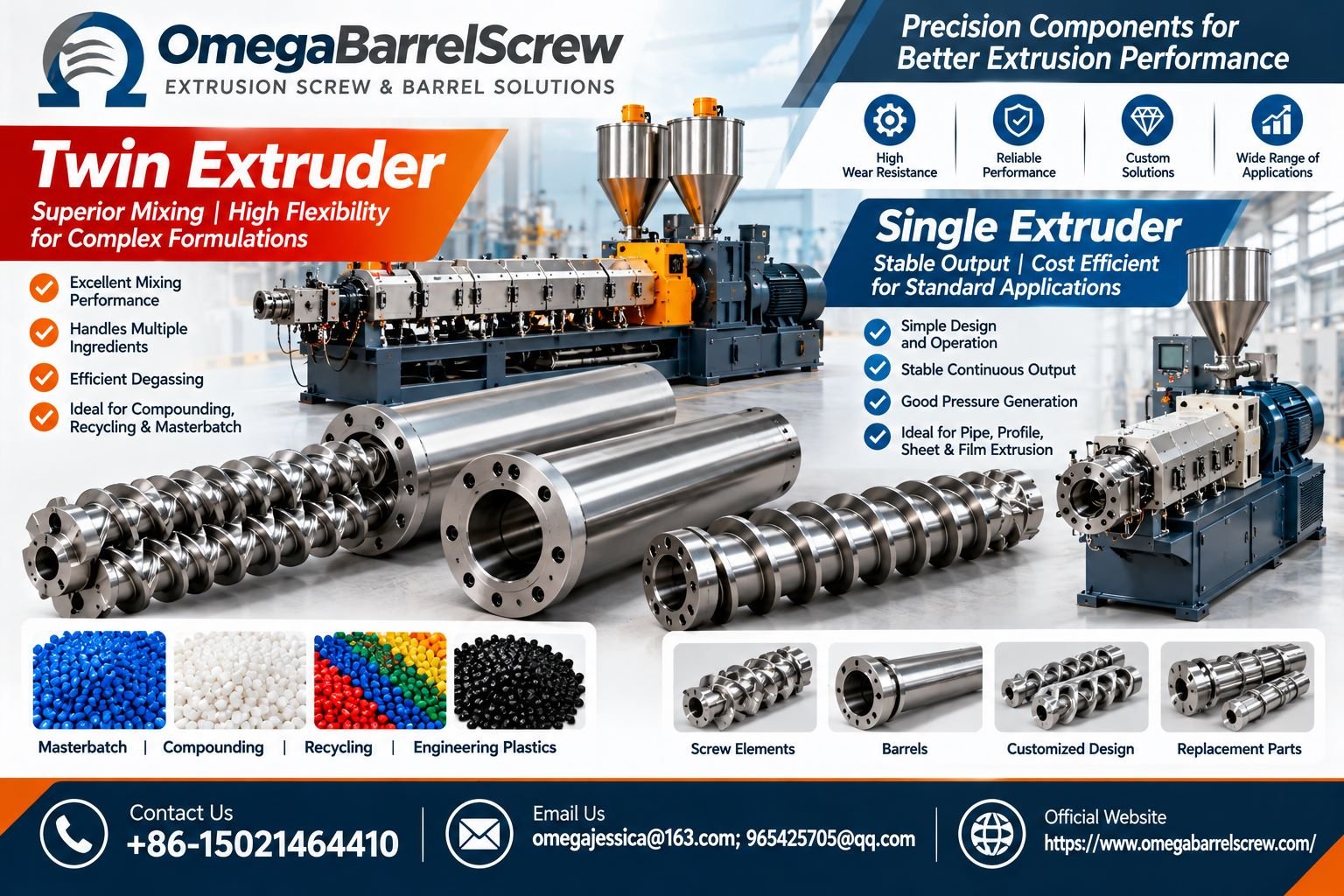
As manufacturers look for higher productivity, better material consistency, improved mixing, and more flexible processing, extrusion technology continues to play a central role across plastics, compounding, recycling, masterbatch, profile, pipe, sheet, and specialty polymer applications. Two widely used machine configurations are the twin extruder and the single extruder, each offering distinct advantages depending on the material, process objective, output requirement, and formulation complexity.
While both systems transport and process material through a heated barrel using a rotating screw arrangement, their operating characteristics can differ significantly. Selecting the correct system requires careful evaluation of mixing intensity, shear, pressure development, residence time, feeding behavior, degassing, and downstream requirements.
What Is a Twin Extruder?
A twin extruder uses two screws rotating inside the barrel instead of one.
Depending on the design, the screws may be configured as:
- co-rotating
- counter-rotating
- intermeshing
- non-intermeshing
This design allows the machine to provide strong mixing, controlled conveying, and efficient material distribution.
Twin-screw systems are commonly used in applications that require intensive blending or compounding.
Typical applications include:
- masterbatch
- engineering plastics
- filler compounding
- polymer blends
- recycling
- additives
- reactive extrusion
- devolatilization
Why Twin Extruders Are Popular in Compounding
One of the main strengths of a twin extruder is its mixing capability.
The two screws can create controlled distributive and dispersive mixing, helping combine polymers with:
- pigments
- fillers
- fibers
- additives
- modifiers
- stabilizers
This is particularly useful when a formulation contains multiple components that must be distributed evenly.
Better Feeding of Difficult Materials
Some raw materials are difficult to feed consistently.
Low-bulk-density powders, fillers, fibers, and certain recycled materials may not flow smoothly in conventional systems.
A twin extruder can provide more positive material conveying, which may improve feeding stability in demanding applications.
Side feeders can also be integrated when fillers, fibers, or other ingredients need to be added at specific stages of the process.
Degassing and Volatile Removal
Twin-screw machines are often selected for applications requiring moisture or volatile removal.
Venting zones or vacuum systems may help remove:
- moisture
- trapped gases
- residual monomers
- volatile contaminants
This can be especially useful in recycling, reactive extrusion, and polymer compounding.
Effective degassing can improve finished pellet quality and reduce surface defects.
Flexible Screw Configuration
A major advantage of many twin-screw systems is modular screw design.
Processing elements may be arranged according to the required function.
Configurations can include:
- conveying elements
- kneading blocks
- mixing elements
- reverse elements
- special shear sections
This flexibility allows processors to optimize residence time, mixing, shear, and pressure.
Different formulations can therefore be processed using customized screw configurations.
What Is a Single Extruder?
A single extruder uses one rotating screw inside a heated barrel.
It is one of the most common machines in plastics processing and is valued for its relatively simple construction, dependable operation, and efficient continuous output.
Single-screw machines are widely used for:
- pipe extrusion
- profile extrusion
- sheet extrusion
- film processing
- cable coating
- pelletizing
- general polymer processing
For applications where the raw material is already well blended, a single screw can often provide highly efficient processing.
Advantages of a Single Extruder
The single extruder remains popular because it offers several practical benefits.
Simple Mechanical Design
With fewer moving components, the system may be easier to operate and maintain.
Stable Continuous Output
Single-screw machines can provide reliable production for consistent polymer feedstocks.
Good Pressure Generation
They are well suited to processes where stable melt pressure is required before a die.
Cost Efficiency
For suitable applications, a single-screw system may offer lower initial investment and simpler maintenance.
How Single Screw Processing Works
Inside the barrel, the screw typically performs several functions.
Feeding
Solid material enters through the hopper.
Compression
The material is compacted and begins to soften.
Melting
Heat from the barrel and shear generated by screw rotation melt the polymer.
Metering
The melt becomes more uniform before being delivered toward the die.
The exact screw geometry depends on the polymer and application.
Twin Extruder vs Single Extruder
The choice between a twin extruder and single extruder depends on the process requirement.
A twin-screw machine is often preferred when:
- strong mixing is required
- multiple ingredients are used
- fillers or fibers must be incorporated
- devolatilization is important
- reactive processing is required
A single-screw machine may be preferred when:
- the feed material is already homogeneous
- continuous melt pumping is the primary goal
- the process requires strong pressure development
- operational simplicity is important
Neither design is universally better.
The correct choice depends on the formulation and output target.
Barrel and Screw Quality Matter
The performance of both machine types depends heavily on the condition and quality of the screw and barrel.
Important factors include:
- material selection
- hardness
- wear resistance
- surface treatment
- dimensional accuracy
- screw geometry
Processing abrasive fillers, glass fibers, minerals, or recycled compounds can accelerate wear.
Worn components may reduce output and affect melt consistency.
Wear Resistance for Compounding Applications
A twin extruder processing filled compounds can experience significant abrasion.
High-wear zones may require:
- hardened screw elements
- wear-resistant liners
- bimetallic barrels
- specialized surface treatments
The same principle applies to a single extruder used for abrasive compounds or recycled materials.
Correct metallurgy can significantly influence component service life.
Temperature Control Is Essential
Extrusion quality depends on controlled temperature throughout the barrel.
Poor thermal control can lead to:
- incomplete melting
- material degradation
- unstable viscosity
- inconsistent output
Heating and cooling zones should be matched to the polymer being processed.
Some materials require narrow processing windows, making accurate temperature management particularly important.
Screw Speed and Shear
Screw speed influences:
- output
- shear
- residence time
- mixing
- melt temperature
Higher speed may increase throughput, but excessive shear can damage sensitive materials.
For a twin extruder, screw speed and element configuration must work together.
For a single extruder, screw geometry and rotational speed must match the material and desired output.
Energy Efficiency and Productivity
Modern extrusion systems increasingly focus on reducing energy consumption while maintaining production capacity.
Efficiency can be influenced by:
- motor design
- gearbox performance
- barrel insulation
- screw geometry
- heating systems
- process optimization
Stable operation often results in better energy efficiency than running a machine near unstable process limits.
Maintenance and Preventive Inspection
Regular maintenance is important for both extrusion systems.
Operators should inspect:
- screw wear
- barrel wear
- gearbox condition
- seals
- heaters
- temperature sensors
- cooling circuits
- alignment
Preventive inspection can identify wear before it causes serious process instability or equipment damage.
Choosing the Right Extrusion Supplier
Processors should evaluate both machine design and technical support.
Important supplier capabilities include:
- screw and barrel engineering
- application knowledge
- material selection
- wear-resistant options
- dimensional accuracy
- machining quality
- repair and replacement support
- technical documentation
- customization
- international delivery capability
A supplier that understands polymer behavior can provide more useful recommendations than one focused only on dimensions.
Frequently Asked Questions
What is a twin extruder?
A twin extruder is an extrusion machine that uses two screws to convey, mix, melt, and process polymer materials.
Where are twin extruders commonly used?
They are widely used in compounding, masterbatch production, recycling, polymer blending, filler incorporation, and reactive extrusion.
What is a single extruder?
A single extruder uses one rotating screw inside a barrel to melt and continuously process polymer materials.
Where is a single extruder used?
Common applications include pipe, profile, sheet, film, cable coating, and general polymer processing.
Which machine provides better mixing?
Twin-screw machines generally provide stronger and more controllable mixing for complex formulations.
Is a single extruder easier to maintain?
Its simpler mechanical design can make maintenance more straightforward in many applications.
Can both process recycled plastic?
Yes, depending on material quality, contamination, moisture, and process requirements.
Why do screws and barrels wear?
Abrasive fillers, fibers, contaminants, high shear, and long operating hours can contribute to wear.
Can screw geometry be customized?
Yes. Screw profile and configuration can be designed according to polymer and application requirements.
How should a processor choose between twin and single screw?
The decision should consider mixing requirement, formulation complexity, pressure demand, output, degassing needs, material type, and operating cost.
Media Contact
Extrusion Components & Business Enquiries
Contact: +86-15021464410
Email: omegajessica@163.com;965425705@qq.com
Official Website: https://www.omegabarrelscrew.com/
