
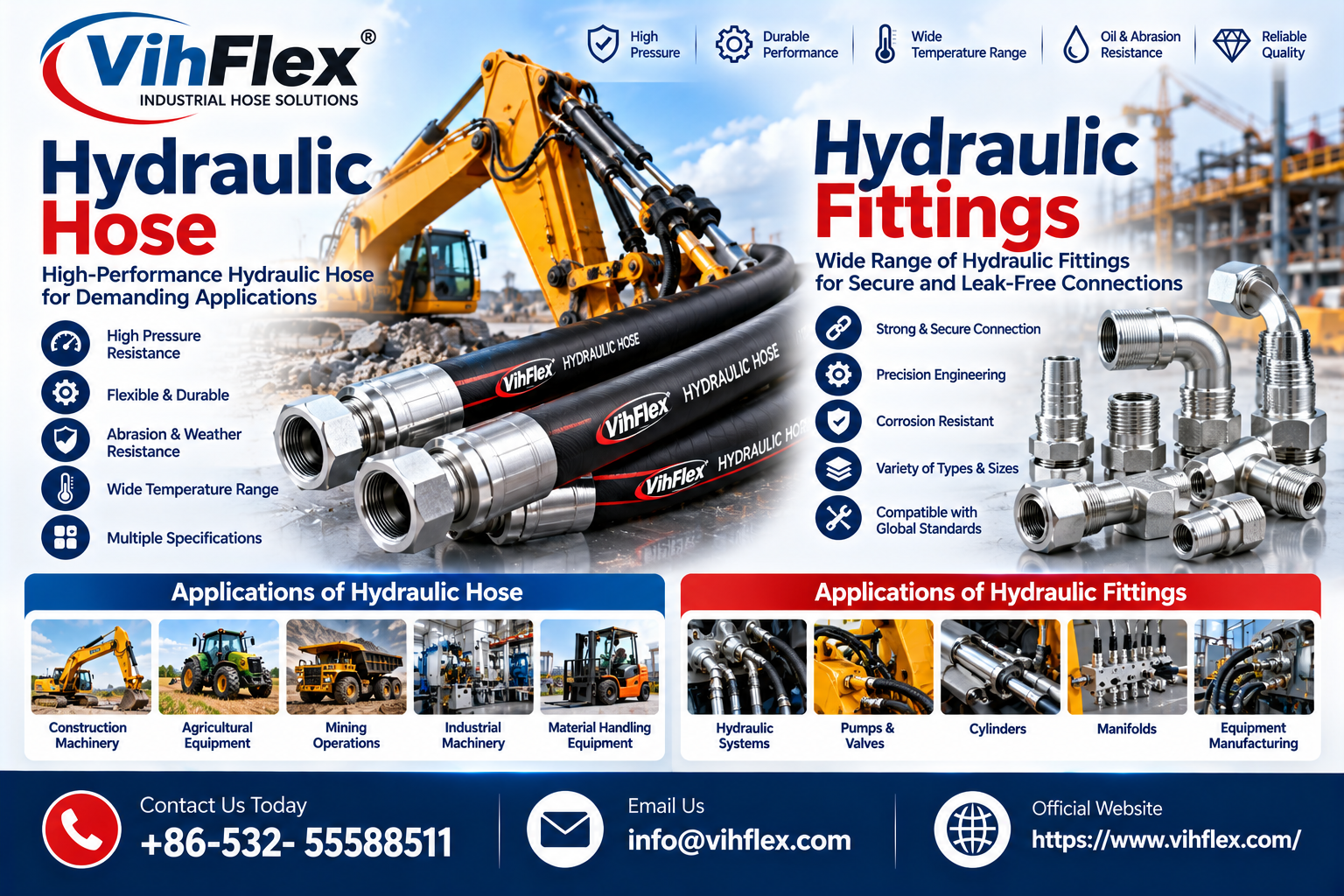
As construction equipment, agricultural machinery, mining operations, manufacturing lines, transportation systems, and heavy industrial equipment become more demanding, the reliability of every fluid-power component matters. This is increasing attention on high-performance Hydraulic Hose products and accurately matched Hydraulic Fittings that can withstand pressure, vibration, temperature changes, repeated movement, and demanding operating environments.
Hydraulic systems depend on controlled transfer of pressurized fluid. A hose or fitting that is incorrectly selected, installed, or maintained can reduce system efficiency, cause leaks, increase downtime, and create safety risks.
What Is a Hydraulic Hose?
A Hydraulic Hose is a flexible reinforced tube designed to transport hydraulic fluid between system components.
It is commonly used in equipment such as:
- Excavators and loaders
- Tractors and harvesters
- Cranes and lifting equipment
- Mining machinery
- Industrial presses
- Material-handling equipment
- Construction machinery
- Manufacturing systems
Unlike a general-purpose hose, hydraulic hose must withstand substantial internal pressure while remaining flexible enough to accommodate movement.
How Hydraulic Hose Is Constructed
A typical hydraulic hose contains three main layers.
Inner Tube
The inner tube carries hydraulic fluid and must be compatible with the oil or fluid used in the system.
Reinforcement
Reinforcement provides pressure resistance and may consist of textile braiding, steel-wire braiding, or spiral steel wire depending on the application.
Outer Cover
The cover protects the reinforcement from abrasion, weather, oil, and external damage.
The exact construction should be selected according to pressure, temperature, bend requirements, and operating environment.
Why Pressure Rating Matters
Pressure is one of the most important considerations when selecting a Hydraulic Hose.
Manufacturers generally specify:
- Working pressure
- Burst pressure
- Test pressure
Working pressure is the rating intended for normal system operation.
Burst pressure is a safety-related test value and should never be treated as the normal operating limit.
Pressure spikes should also be considered because sudden increases can place additional stress on a hose assembly.
Temperature Can Affect Hose Life
Hydraulic systems may operate in extremely cold or hot environments.
Excessive temperature can affect:
- Inner-tube materials
- Outer cover
- Reinforcement
- Hydraulic fluid
- Seal performance
Both fluid temperature and surrounding environmental temperature should be considered.
A hose operating near engines, furnaces, exhaust systems, or other heat sources may require additional protection.
Abrasion Resistance for Heavy Equipment
Construction and mining machinery can expose hoses to rough surfaces, vibration, dirt, and constant movement.
A Hydraulic Hose with a durable outer cover can help protect the reinforcement from abrasion.
However, even high-abrasion-resistant hoses should be routed carefully.
Where contact cannot be avoided, protective sleeves, clamps, or guards may be appropriate.
What Are Hydraulic Fittings?
Hydraulic Fittings are connectors used to join hoses with pumps, valves, cylinders, manifolds, motors, and other system components.
They help create secure fluid connections capable of operating under hydraulic pressure.
Common fitting types may include:
- Straight connectors
- Elbows
- Tees
- Adapters
- Flanges
- Couplings
- Crimp fittings
The correct fitting depends on the hose type, system thread, pressure rating, and equipment connection.
Why Hydraulic Fittings Must Match the Hose
Not all fittings are compatible with every hose.
A hydraulic assembly must use a hose-and-fitting combination designed to work together.
Important compatibility factors include:
- Hose construction
- Hose diameter
- Fitting stem design
- Crimp dimensions
- Pressure rating
- Connection standard
Using an incorrectly matched fitting can lead to leaks, fitting separation, or premature failure.
Professional assembly procedures are therefore essential.
Crimping Quality Is Critical
Many Hydraulic Fittings are permanently attached to hoses using a hydraulic crimping machine.
Correct crimping requires:
- Proper dies
- Accurate crimp diameter
- Compatible hose and fitting
- Correct insertion depth
- Suitable equipment
Under-crimping may allow the fitting to loosen.
Over-crimping can damage the hose structure.
Crimp specifications should follow the component manufacturer’s technical guidance.
Common Hydraulic Connection Standards
Hydraulic systems can use different thread and sealing systems depending on equipment origin and application.
Examples may include metric, BSP, JIC, ORFS, NPT, and flange-type connections.
Using the wrong connection can cause:
- Leaks
- Damaged threads
- Poor sealing
- Installation delays
Buyers should confirm thread type, size, and sealing method before ordering Hydraulic Fittings.
Hydraulic Hose Routing Affects Performance
Even the correct hose can fail early if routing is poor.
Installers should avoid:
- Excessive twisting
- Sharp bends
- Tight stretching
- Contact with moving parts
- Direct exposure to heat
- Abrasion points
A hose should have enough length to accommodate movement without being excessively loose.
The minimum bend radius specified for the hose should also be respected.
Fluid Compatibility Should Be Verified
Hydraulic systems may use mineral oil, synthetic fluids, biodegradable fluids, or other specialized media.
The hose inner tube and fitting seals must be compatible with the fluid.
Chemical incompatibility can cause:
- Swelling
- Hardening
- Softening
- Cracking
- Leakage
Manufacturers should review compatibility data before changing hydraulic fluids.
Inspection Helps Prevent Unexpected Failure
Routine inspection is one of the most effective ways to improve hydraulic system reliability.
A Hydraulic Hose should be checked for:
- Cracks
- Abrasion
- Blisters
- Exposed wire
- Kinking
- Leakage
- Damaged covers
Hydraulic Fittings should be checked for:
- Corrosion
- Leakage
- Looseness
- Cracks
- Distortion
- Damaged threads
Any assembly showing serious deterioration should be replaced according to suitable maintenance procedures.
Cleanliness Matters in Hydraulic Systems
Hydraulic systems can be sensitive to contamination.
Particles introduced during hose assembly can affect:
- Pumps
- Valves
- Cylinders
- Servo systems
Good assembly practices may include cleaning hoses after cutting and protecting open ends before installation.
Keeping dirt and debris out of the system helps protect expensive hydraulic components.
Choosing the Right Hydraulic Hose and Fittings Supplier
Industrial customers should evaluate suppliers on technical capability, not price alone.
Important considerations include:
- Pressure range
- Hose construction
- Fitting compatibility
- Size availability
- Thread standards
- Quality control
- Assembly capability
- Technical documentation
- Export experience
- Supply reliability
A supplier that understands complete hose assemblies can help reduce compatibility problems.
Frequently Asked Questions
What is a Hydraulic Hose?
A Hydraulic Hose is a flexible reinforced hose used to transport pressurized hydraulic fluid between components in a fluid-power system.
Where are hydraulic hoses commonly used?
They are widely used in construction, agriculture, mining, manufacturing, transportation, lifting equipment, and industrial machinery.
What are Hydraulic Fittings?
Hydraulic Fittings are connectors used to join hydraulic hoses to pumps, valves, cylinders, motors, and other system components.
Can any fitting be used with any hydraulic hose?
No. Hose and fitting compatibility must be confirmed according to manufacturer specifications.
Why is working pressure important?
The working-pressure rating indicates the pressure the hose is designed to handle during normal operation.
What causes hydraulic hose failure?
Common causes include abrasion, excessive pressure, high temperature, twisting, incorrect routing, chemical incompatibility, and poor assembly.
How can hydraulic hose life be improved?
Correct routing, proper pressure selection, abrasion protection, regular inspection, and appropriate fluid compatibility can help improve service life.
Why do hydraulic fittings leak?
Leaks may result from incorrect installation, damaged seals, loose connections, incompatible threads, excessive vibration, or component wear.
What information is needed when ordering a hydraulic hose assembly?
Useful details include hose size, working pressure, length, hydraulic fluid, temperature range, fitting type, thread standard, and equipment application.
Should damaged hydraulic hoses be repaired?
High-pressure hydraulic hoses showing structural damage should generally be replaced using the appropriate hose and fitting specification rather than relying on temporary repairs.
Media Contact
Industrial Hose & Hydraulic Solutions Enquiries
Contact: +86-532-55588511
Email: info@vihflex.com
Official Website: https://www.vihflex.com/
