
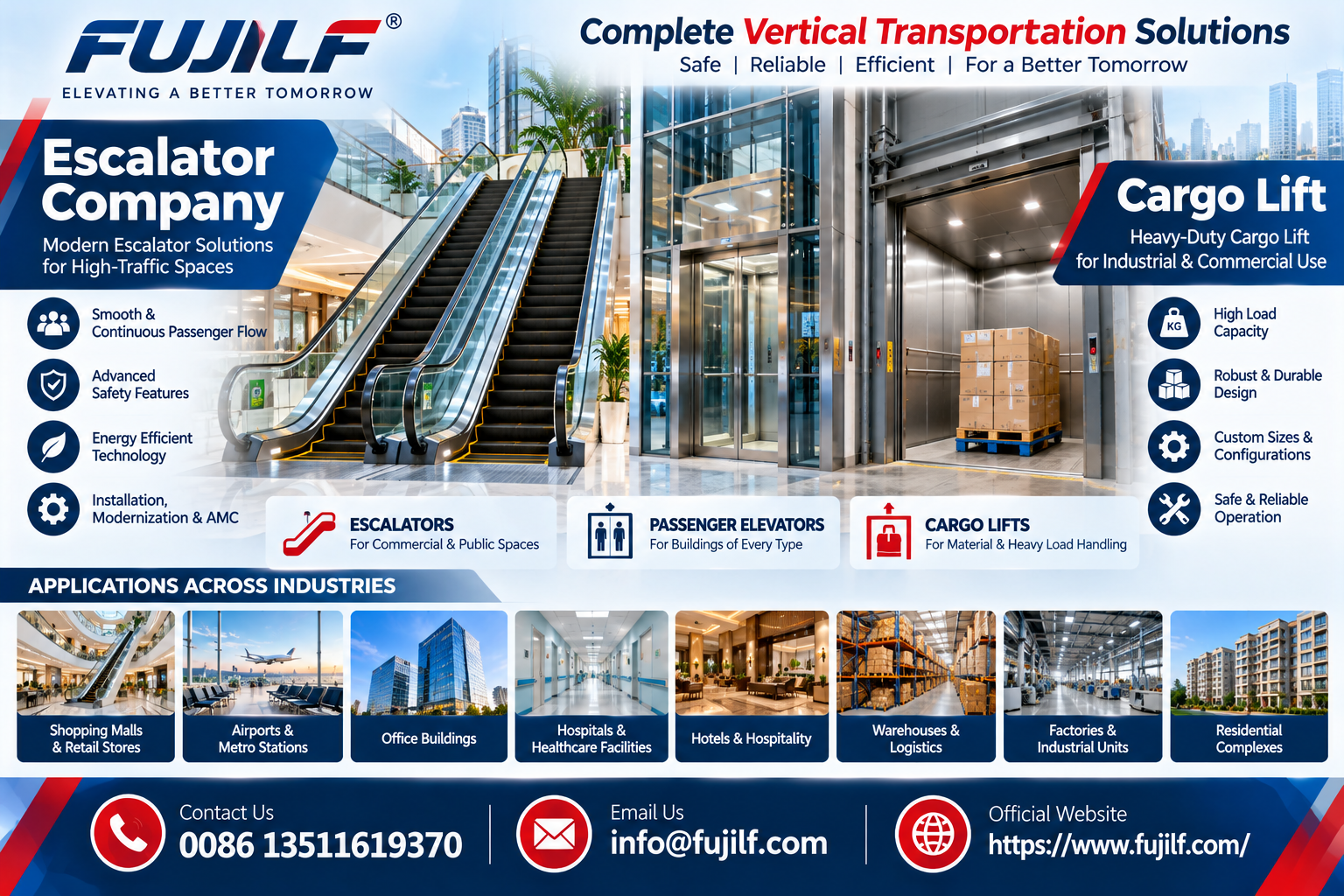
As commercial complexes, airports, hospitals, warehouses, shopping centres, factories, hotels, and high-rise developments continue to expand, demand for efficient vertical transportation is growing. A professional escalator company plays an important role in helping building owners move people safely and continuously, while a well-designed cargo lift supports the reliable movement of goods, equipment, materials, and heavy loads between floors.
Although escalators and cargo lifts serve different purposes, both systems are essential to modern building planning. Their performance depends on correct design, capacity selection, installation quality, safety features, maintenance, and suitability for the operating environment.
What Does an Escalator Company Provide?
An escalator company typically supports the design, supply, installation, modernization, and maintenance of escalator systems for public and commercial buildings.
Escalators are commonly installed in:
- shopping malls
- airports
- railway and metro stations
- hotels
- hospitals
- office complexes
- exhibition centres
- public buildings
Unlike conventional lifts, escalators continuously transport passengers and can handle high pedestrian traffic without requiring passengers to wait for a cabin.
Why Escalators Are Important in High-Traffic Buildings
In busy commercial environments, movement between floors must be smooth and predictable.
Escalators can help:
Maintain Continuous Passenger Flow
People can move between levels without waiting for lift doors to open or cabins to arrive.
Reduce Pressure on Passenger Lifts
In multi-level retail or public buildings, escalators can handle routine floor-to-floor movement while lifts remain available for other users.
Improve Wayfinding
Visible escalators can naturally guide visitors toward upper or lower levels.
Support High Traffic Volumes
Correctly sized equipment can serve large numbers of passengers during peak periods.
Key Factors in Escalator Selection
A reliable escalator company should evaluate several technical factors before recommending equipment.
These include:
- rise height
- inclination
- step width
- expected passenger volume
- operating hours
- indoor or outdoor installation
- available structural space
- energy requirements
- safety standards
A shopping mall may have very different requirements from a metro station or airport terminal.
Safety Features in Modern Escalators
Modern escalator systems may incorporate multiple safety features designed to reduce operational risks.
Depending on system design, these can include:
- emergency stop controls
- step monitoring
- handrail speed monitoring
- skirt protection
- comb plate monitoring
- overload protection
- braking systems
Routine inspection and maintenance are essential because escalators operate continuously and contain many moving components.
Energy Efficiency Is Becoming More Important
Building owners increasingly want vertical transportation systems that reduce unnecessary energy consumption.
Modern escalators may use features such as:
- variable-speed operation
- standby modes
- efficient motors
- intelligent control systems
- LED lighting
For buildings with long operating hours, energy-efficient technology can provide meaningful operational benefits over the system’s lifecycle.
What Is a Cargo Lift?
A cargo lift is designed primarily for transporting goods, materials, equipment, pallets, or other loads between different levels of a building.
It is commonly used in:
- factories
- warehouses
- logistics centres
- supermarkets
- hotels
- hospitals
- commercial kitchens
- industrial facilities
Cargo lifts may be configured for different load capacities and platform sizes depending on the materials being transported.
Why Cargo Lifts Matter in Industrial Operations
Manual movement of heavy goods between floors can be inefficient and may increase handling risks.
A properly specified cargo lift can improve material flow by providing a dedicated vertical transportation route.
Key benefits may include:
Faster Material Movement
Goods can move between floors more efficiently.
Improved Workflow
Separate goods transportation can reduce congestion in passenger areas.
Heavy Load Capability
Systems can be designed for substantial loads based on operational needs.
Better Space Utilization
Vertical movement allows businesses to use multiple floors more efficiently.
Cargo Lift Capacity Must Match the Application
One of the most important considerations is load capacity.
The correct capacity depends on:
- maximum expected weight
- pallet dimensions
- trolley or equipment size
- loading method
- frequency of use
- floor-to-floor travel distance
Choosing a lift that is undersized can create operational limitations, while unnecessarily oversized equipment may increase project cost.
Businesses should define their real working load rather than estimating casually.
Platform and Door Configuration
Cargo lift design should also consider the way goods enter and leave the lift.
Possible arrangements include:
Single-Side Entry
Suitable when goods enter and exit from the same side.
Through-Type Entry
Allows materials to enter from one side and exit from another.
Custom Platform Dimensions
Useful for pallets, trolleys, industrial equipment, or oversized goods.
Door dimensions should match the largest object expected to enter the lift.
Cargo Lift Safety Considerations
A professional cargo system should include appropriate safety controls for the intended application.
Depending on the design, these may include:
- door interlocks
- overload protection
- emergency controls
- braking systems
- landing protection
- limit switches
- controlled access
Users should follow the manufacturer’s operational instructions and avoid exceeding rated capacity.
Escalator Company vs Cargo Lift Supplier
An escalator company primarily focuses on passenger movement systems, while a cargo lift supplier addresses goods transportation.
However, both require similar professional capabilities:
- site assessment
- engineering design
- manufacturing
- installation
- commissioning
- testing
- preventive maintenance
For large projects, working with a supplier that understands multiple vertical transportation technologies can simplify coordination.
Installation Quality Affects Long-Term Performance
Even high-quality equipment can perform poorly if installation is inaccurate.
Important installation considerations include:
- alignment
- structural support
- electrical connections
- safety adjustments
- door and landing accuracy
- commissioning tests
Proper installation helps improve reliability and can reduce future maintenance problems.
Preventive Maintenance Reduces Downtime
Vertical transportation systems operate repeatedly throughout the day.
Maintenance programs should include scheduled inspection of mechanical, electrical, and safety components.
For escalators, technicians may inspect:
- steps
- chains
- handrails
- comb plates
- brakes
- motors
- sensors
For a cargo lift, inspection may cover:
- doors
- guides
- drive systems
- platform condition
- safety switches
- control equipment
Preventive servicing can help identify wear before it results in unexpected breakdowns.
Modernization Extends Equipment Life
Older escalators and cargo lifts do not always require complete replacement.
Modernization may involve upgrading:
- controllers
- motors
- safety devices
- electrical systems
- drive components
- cabin or platform finishes
A qualified escalator company should evaluate whether modernization or replacement offers better long-term value.
Choosing the Right Vertical Transportation Supplier
Building owners and developers should evaluate suppliers on technical expertise as well as price.
Important factors include:
- engineering capability
- product quality
- safety systems
- customization options
- installation experience
- maintenance support
- spare-part availability
- response time
- project management
- after-sales service
Reliable after-sales support is particularly important because vertical transportation systems require ongoing maintenance throughout their service life.
Frequently Asked Questions
What does an escalator company do?
An escalator company designs, supplies, installs, modernizes, and maintains escalator systems for commercial and public buildings.
Where are escalators commonly installed?
Shopping malls, airports, railway stations, hotels, hospitals, offices, and other high-traffic buildings commonly use escalators.
What is a cargo lift?
A cargo lift is a vertical transportation system designed primarily for moving goods, materials, equipment, or heavy loads between floors.
Where are cargo lifts used?
They are commonly used in warehouses, factories, hotels, supermarkets, hospitals, and logistics facilities.
How is cargo lift capacity selected?
Capacity should be based on the heaviest expected load, platform dimensions, frequency of use, and operating conditions.
Can cargo lifts be customized?
Yes. Platform size, load capacity, door arrangement, travel height, and control configuration can often be customized.
Are escalators energy efficient?
Modern escalators can include energy-saving motors, standby modes, and intelligent controls to reduce unnecessary power use.
Why is maintenance important?
Regular maintenance helps improve safety, reliability, equipment life, and operational continuity.
Can an old escalator be modernized?
Yes. Depending on equipment condition, components such as controls, drives, motors, and safety devices may be upgraded.
What information is needed before requesting a quotation?
Useful details include building type, travel height, passenger or load capacity, available space, expected traffic, installation environment, and required configuration.
Media Contact
Elevator, Escalator & Cargo Lift Enquiries
Contact: 0086 13511619370
Email: info@fujilf.com
Official Website: https://www.fujilf.com/
