
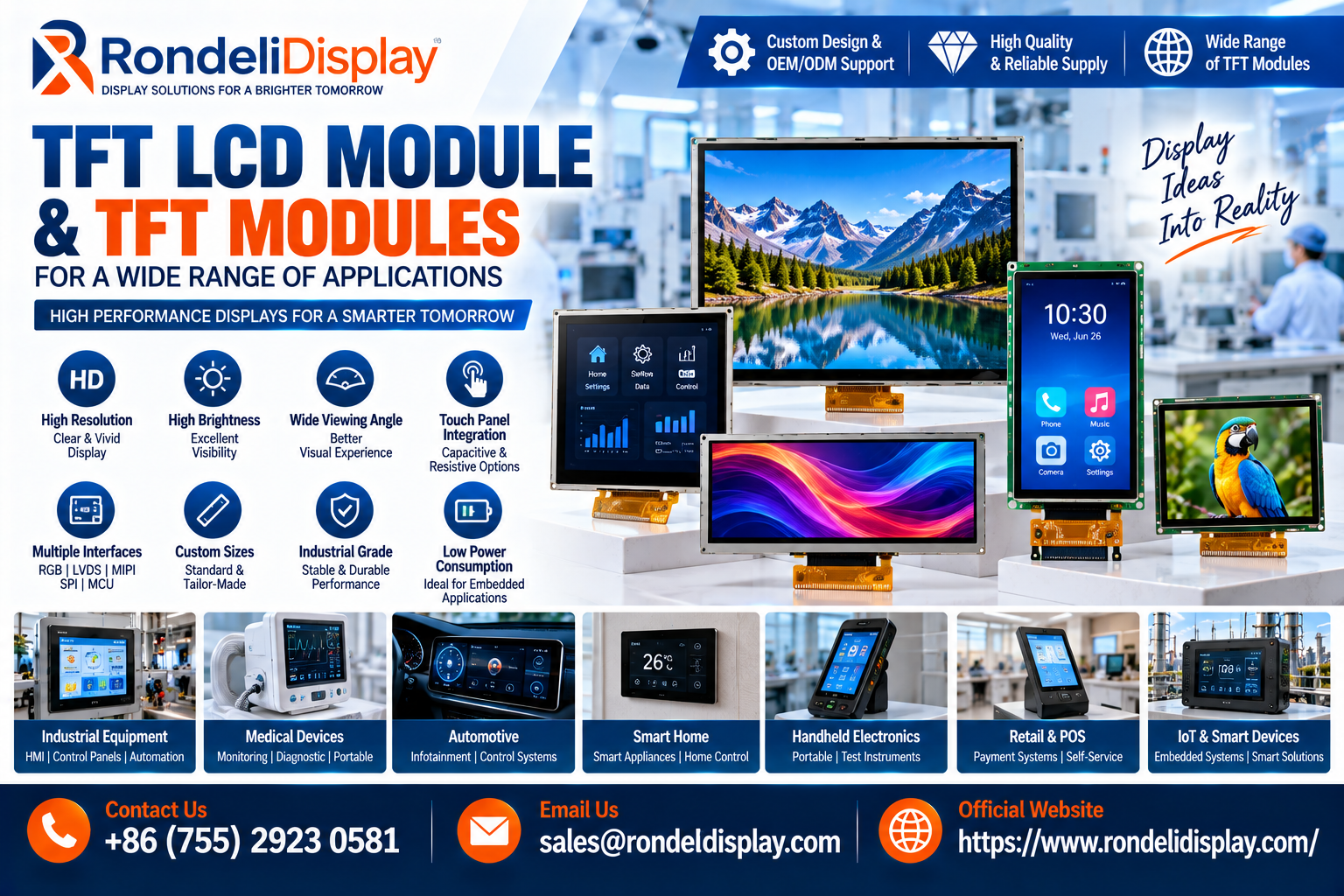
As industrial equipment, medical devices, automotive systems, smart appliances, handheld electronics, control panels, and IoT products become more visual and interactive, demand for a high-quality TFT LCD Module continues to grow. At the same time, manufacturers and product developers are evaluating a broader range of TFT Modules to achieve the right balance of resolution, brightness, viewing angle, interface compatibility, power consumption, and mechanical fit.
Thin-film transistor display technology remains widely used because it can support clear graphics, color-rich interfaces, touch integration, and flexible screen sizes across both commercial and industrial applications.
What Is a TFT LCD Module?
A TFT LCD Module is a liquid-crystal display that uses thin-film transistor technology to control individual pixels more precisely.
Compared with simpler passive-matrix display technologies, TFT construction allows faster response, better image control, and more detailed visual output.
A complete TFT LCD assembly may include:
- LCD panel
- Backlight
- Driver IC
- Flexible printed circuit
- Interface connector
- Optional touch panel
- Mechanical frame
- Protective cover
The exact configuration depends on the target application.
Why TFT LCD Technology Is Widely Used
TFT displays are popular because they can support a broad range of product designs.
Good Image Quality
A modern TFT LCD Module can display detailed graphics, icons, menus, video, and user-interface elements.
Wide Size Range
TFT screens are available in compact and larger formats, making them suitable for handheld devices, control panels, and embedded systems.
Multiple Resolutions
Different pixel resolutions can be selected according to the visual requirements of the product.
Touch Compatibility
Capacitive or resistive touch panels can often be integrated with the display.
Industrial Flexibility
Selected modules can be designed for wider operating temperatures, higher brightness, and long-term availability.
What Are TFT Modules?
TFT Modules generally refer to complete TFT display assemblies rather than the bare LCD glass alone.
A module may include:
- Display panel
- Driver electronics
- Backlighting
- Connection interface
- Touch functionality
- Mounting structure
This integrated approach can simplify product development because the display manufacturer provides a more complete assembly.
For OEM projects, modules can often be customized around the enclosure, motherboard, and interface requirements.
Common Applications of TFT Modules
TFT displays are used across many sectors.
Industrial Control Equipment
Factories and automation systems use displays for machine settings, alerts, process data, and operator interfaces.
Medical Devices
Displays may present patient information, readings, menus, and equipment controls.
Automotive Systems
TFT screens are used in dashboards, control interfaces, rear-seat systems, charging equipment, and specialized vehicle electronics.
Smart Home Products
Thermostats, appliances, security panels, and home-control devices frequently use compact color displays.
Handheld Electronics
Portable instruments and consumer devices can use small TFT screens to provide visual feedback and interactive menus.
Display Size Should Match the User Experience
Screen size is one of the first decisions in product design.
A smaller TFT LCD Module may be suitable for:
- Handheld devices
- Compact meters
- Wearable or portable equipment
Larger displays may work better for:
- Industrial control panels
- Medical equipment
- Kiosks
- Smart appliances
The viewing distance, amount of information displayed, and enclosure size should all be considered.
A larger screen is not always better if it increases power consumption or makes the product unnecessarily bulky.
Resolution Affects Clarity
Resolution determines the number of pixels available on the screen.
Higher resolution can improve:
- Text sharpness
- Icon detail
- Image clarity
- Interface design
However, higher resolution can also require greater processing capability, memory, and bandwidth.
For this reason, designers should select a resolution that matches the content rather than automatically choosing the highest available option.
Brightness Matters in Different Environments
Display brightness can have a major impact on usability.
An indoor device may require moderate brightness, while an outdoor or vehicle display may need significantly higher luminance.
A TFT LCD Module intended for bright conditions should be evaluated for:
- Backlight brightness
- Contrast
- Anti-glare treatment
- Optical bonding options
- Power consumption
High brightness can improve visibility but may also increase energy use and heat.
Viewing Angle Is an Important Specification
Some displays are viewed primarily from the front, while others need to remain readable from multiple angles.
Modern TFT Modules may use different panel technologies to improve viewing performance.
Wide viewing angles are particularly useful for:
- Shared control panels
- Automotive screens
- Medical displays
- Public-facing equipment
The expected installation position should therefore be defined before final display selection.
Interface Compatibility Simplifies Integration
The display interface must match the host system.
Common interface options may include:
- RGB
- LVDS
- MIPI
- SPI
- MCU-style parallel interfaces
The correct interface depends on display size, resolution, processor capability, and system architecture.
Before ordering a module, engineers should verify:
- Pin configuration
- Voltage requirements
- Timing
- Data format
- Connector type
Early compatibility checks can prevent significant redesign work later.
Touchscreen Integration
Touch functionality can transform a display into a complete user interface.
Two commonly used options are:
Capacitive Touch
Often selected for smartphones, smart appliances, modern industrial interfaces, and other applications requiring smooth gesture-based interaction.
Resistive Touch
May be preferred where operation with gloves or a stylus is important.
A touch panel can be integrated with TFT Modules according to the mechanical and electrical requirements of the finished product.
Optical Bonding Can Improve Display Performance
Optical bonding joins the cover lens or touch panel more closely to the LCD using a transparent bonding material.
Potential advantages can include:
- Reduced internal reflection
- Improved readability
- Better structural integrity
- Reduced condensation risk in selected environments
This process may be especially useful for industrial, outdoor, automotive, or medical products.
Backlight Design Influences Performance
Most TFT LCDs require a backlight.
LED backlighting is commonly used because it can provide:
- Good brightness
- Energy efficiency
- Long operating life
- Compact design
Backlight configuration influences display brightness and power consumption.
For battery-powered devices, engineers may prioritize efficient backlight control.
Industrial products may instead focus more heavily on brightness and operating longevity.
Mechanical Design and Customization
A standard display may not always fit the product enclosure.
Customized TFT Modules can potentially include changes to:
- FPC length
- Connector position
- Touch panel size
- Cover glass
- Mounting holes
- Frame structure
- Backlight
- Interface configuration
Customization can help reduce mechanical compromises in the final product.
However, buyers should clearly define dimensions and tolerances before tooling or sample development begins.
Reliability Testing for TFT LCD Modules
Display modules may operate for long periods and under different environmental conditions.
Testing can include:
- Temperature cycling
- High-temperature operation
- Low-temperature operation
- Humidity exposure
- Vibration
- Drop testing for portable products
- Backlight life evaluation
- Touch-panel testing
- Interface verification
- Visual inspection
The required test plan should match the intended application.
Industrial vs Consumer TFT Modules
Consumer and industrial applications can have very different priorities.
Consumer electronics may focus on:
- Slim design
- High resolution
- Visual appearance
- Cost
Industrial TFT Modules may place more emphasis on:
- Long product availability
- Wide temperature ranges
- Stable supply
- Higher brightness
- Durability
- Technical support
Understanding the target market helps prevent choosing a display that looks attractive but performs poorly in actual use.
Quality Control in TFT Display Production
Quality inspection may include:
- Dead-pixel checks
- Brightness measurement
- Color consistency
- Backlight inspection
- Connector testing
- Touch functionality
- Surface inspection
- Dimensional verification
Consistency becomes particularly important when displays are used across thousands of identical products.
A reliable module should perform predictably from one production batch to another.
Choosing the Right TFT LCD Module
Buyers should define their requirements before comparing suppliers.
Important factors include:
- Screen size
- Resolution
- Brightness
- Viewing angle
- Interface
- Touch requirement
- Operating temperature
- Backlight life
- Mechanical dimensions
- Expected order quantity
A clear technical specification makes communication easier and reduces the risk of selecting an unsuitable display.
Frequently Asked Questions
What is a TFT LCD Module?
A TFT LCD Module is an active-matrix liquid-crystal display assembly that uses thin-film transistor technology to control individual pixels.
What are TFT Modules used for?
TFT Modules are commonly used in industrial controls, medical devices, automotive systems, appliances, handheld electronics, and IoT products.
Can TFT LCD modules include touchscreens?
Yes. Capacitive or resistive touch panels can be integrated depending on the application.
What interfaces are available?
Common options may include RGB, LVDS, MIPI, SPI, and MCU-style interfaces.
Can TFT modules be customized?
Yes. FPC, connectors, cover glass, touch panels, backlighting, and mechanical dimensions may be customized.
What does display brightness mean?
Brightness refers to the amount of light emitted by the display and is important for readability under different lighting conditions.
Are high-brightness TFT displays suitable for outdoor use?
Selected high-brightness modules can be suitable for outdoor products when combined with appropriate optical and environmental design.
Why is viewing angle important?
Wide viewing angles help keep the screen readable when users are not positioned directly in front of it.
What information is needed for a quotation?
Useful details include screen size, resolution, interface, brightness, touch requirements, operating temperature, quantity, and mechanical drawing.
How should a TFT display be tested before mass production?
Sample testing should confirm interface compatibility, visual quality, touch performance, mechanical fit, and operating stability.
Media Contact
TFT LCD & Display Module Enquiries
Email: sales@rondelidisplay.com
Official Website: https://www.rondelidisplay.com/
