
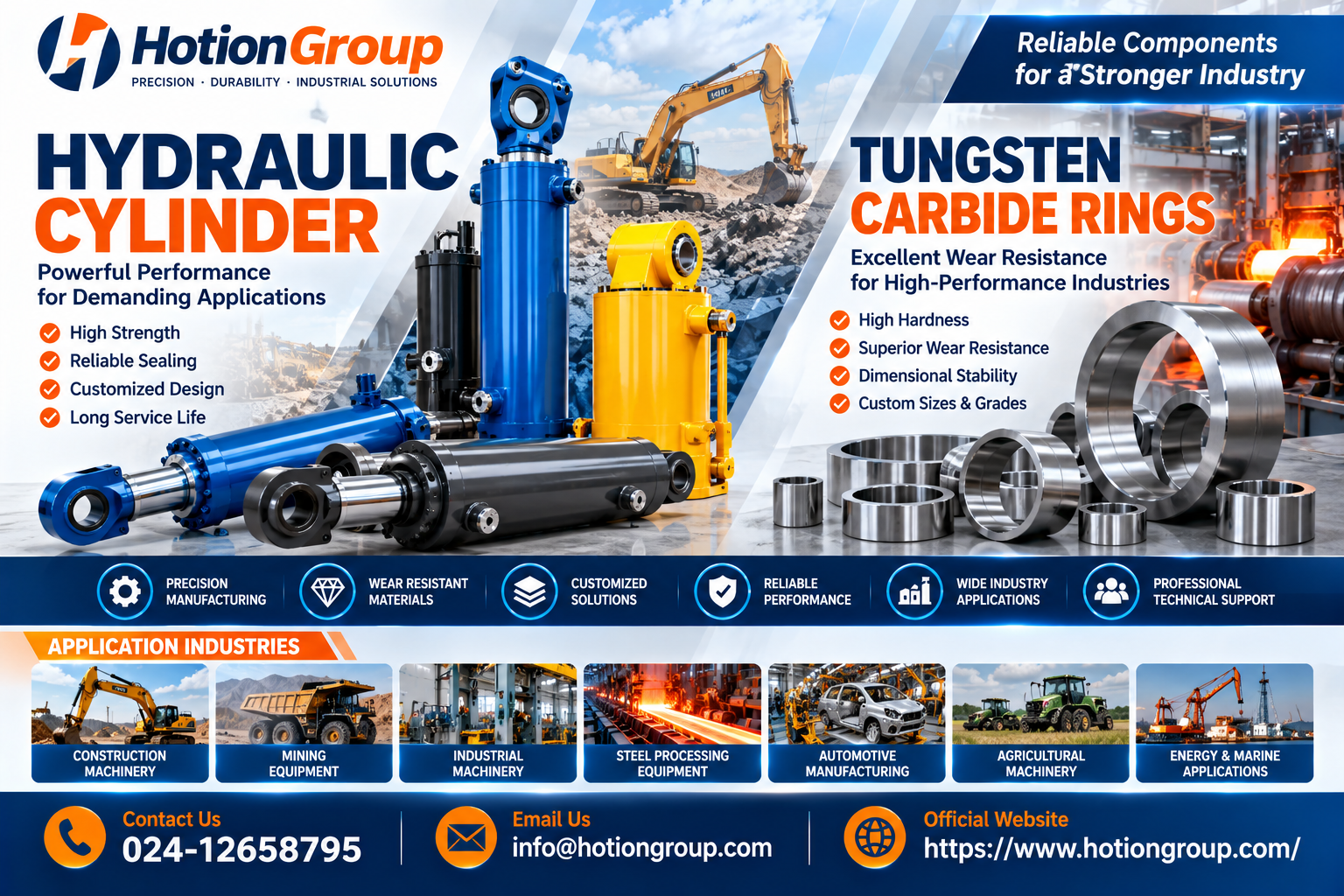
As manufacturers across construction, mining, automotive, machinery, steel processing, material handling, energy, and heavy engineering continue to demand more durable components, attention is increasing around the performance of the Hydraulic Cylinder and Tungsten Carbide Rings. Although these components serve very different purposes, both are essential in systems where reliability, wear resistance, load capacity, and long service life are critical.
A hydraulic cylinder converts fluid power into controlled linear force, while tungsten carbide rings are valued for their hardness, wear resistance, and ability to perform under demanding mechanical conditions. Together, they represent two important categories of industrial components used in high-load and high-wear environments.
What Is a Hydraulic Cylinder?
A Hydraulic Cylinder is a mechanical actuator that converts hydraulic pressure into linear movement and force.
It is widely used in equipment that requires pushing, pulling, lifting, pressing, clamping, or positioning.
Typical applications include:
- Construction machinery
- Mining equipment
- Material handling systems
- Agricultural machinery
- Industrial presses
- Steel processing equipment
- Marine systems
- Manufacturing automation
The basic cylinder consists of a barrel, piston, piston rod, seals, end caps, and hydraulic ports.
When pressurized fluid enters the cylinder, it acts on the piston and creates controlled linear motion.
Why Hydraulic Cylinders Are Important
Hydraulic systems are popular because they can generate high force from relatively compact equipment.
A well-designed Hydraulic Cylinder can provide:
High Force Output
Hydraulic pressure allows powerful linear movement in demanding industrial applications.
Controlled Motion
Flow and pressure controls can provide accurate movement and positioning.
Compact Design
Hydraulic cylinders can generate substantial force without requiring large mechanical drive systems.
Flexible Installation
Different mounting styles can be designed according to equipment requirements.
Main Types of Hydraulic Cylinders
Different applications require different cylinder configurations.
Single-Acting Cylinder
Hydraulic pressure moves the piston in one direction, while gravity or another force provides the return movement.
Double-Acting Cylinder
Hydraulic pressure controls movement in both extension and retraction directions.
Telescopic Cylinder
Multiple stages allow a long stroke from a compact retracted length.
These are commonly used in tipping and lifting applications.
Tie-Rod Cylinder
Tie rods hold the cylinder assembly together and are often used in industrial machinery.
Welded Cylinder
A welded body offers a compact construction suitable for mobile and heavy-duty equipment.
Materials Used in Hydraulic Cylinders
Material selection depends on working pressure, load, environment, and service conditions.
Common materials may include:
- Carbon steel
- Alloy steel
- Stainless steel
- Chrome-plated rod material
- Specialized seal materials
The piston rod surface is particularly important because it must resist wear, corrosion, and seal damage.
Importance of Seals and Surface Finish
Hydraulic cylinder reliability depends heavily on sealing performance.
Seals help prevent internal and external leakage.
Important factors include:
- Surface roughness
- Rod hardness
- Barrel finish
- Seal compatibility
- Operating temperature
- Fluid type
Poor sealing can result in pressure loss, contamination, reduced efficiency, and equipment downtime.
What Are Tungsten Carbide Rings?
Tungsten Carbide Rings are wear-resistant components manufactured from tungsten carbide-based materials.
Tungsten carbide is known for combining exceptional hardness with strong wear resistance.
Industrial carbide rings may be used in applications such as:
- Rolling mills
- Wire and rod processing
- Tube production
- Sealing systems
- Guide applications
- High-wear machinery
- Forming and sizing equipment
Unlike decorative jewelry rings, industrial carbide rings are engineered for mechanical performance.
Why Tungsten Carbide Is Valuable
The main advantage of tungsten carbide is its ability to resist wear under demanding conditions.
Key characteristics include:
High Hardness
Carbide can maintain dimensional integrity under abrasive operating conditions.
Wear Resistance
It is suitable for components exposed to repeated friction or material contact.
Compressive Strength
Tungsten carbide performs well under high compressive loads.
Dimensional Stability
The material can help maintain consistent geometry over long production cycles.
Tungsten Carbide Rings in Metal Processing
Metal processing equipment often operates continuously at high speeds.
Tungsten Carbide Rings may be used in rolling and forming applications where conventional steel components would wear more quickly.
Potential benefits include:
- Longer working life
- Reduced dimensional variation
- Better surface consistency
- Lower replacement frequency
- Improved production stability
The correct carbide composition depends on the load, speed, impact conditions, and material being processed.
Carbide Grade Selection Matters
Not all tungsten carbide grades are identical.
The material is typically produced using tungsten carbide particles combined with a metallic binder.
Different grades may provide different balances of:
- Hardness
- Toughness
- Wear resistance
- Impact resistance
A harder grade may provide stronger wear resistance, while a tougher grade may be preferable in applications involving shock or impact.
Correct grade selection is therefore critical.
Hydraulic Cylinder and Carbide Components in Heavy Machinery
A Hydraulic Cylinder and Tungsten Carbide Rings may both be used within the same industrial production environment.
For example, a steel or tube processing facility may rely on hydraulic systems for:
- Positioning
- Clamping
- Lifting
- Pressing
- Roll adjustment
At the same time, carbide rings may be used in:
- Rolling
- Guiding
- Sizing
- Forming
- Wear-critical contact points
This combination of hydraulic force and wear-resistant tooling helps support continuous production.
Precision Manufacturing Is Essential
Both component categories require accurate manufacturing.
For hydraulic cylinders, important dimensional areas include:
- Bore diameter
- Rod diameter
- Piston fit
- Seal grooves
- Mounting geometry
For carbide rings, manufacturers may control:
- Outside diameter
- Inside diameter
- Width
- Surface finish
- Concentricity
Precision directly influences component performance and service life.
Maintenance of Hydraulic Cylinders
Regular inspection can help prevent unexpected failure.
Maintenance may include:
- Checking for oil leakage
- Inspecting rod surfaces
- Monitoring seal condition
- Checking mounting points
- Maintaining hydraulic fluid cleanliness
- Inspecting hoses and fittings
Contaminated hydraulic fluid can accelerate internal wear.
Keeping the hydraulic system clean is therefore essential.
Maintenance of Tungsten Carbide Rings
Carbide rings generally provide excellent wear resistance, but they should still be inspected.
Operators may look for:
- Cracks
- Chips
- Uneven wear
- Surface damage
- Dimensional changes
Correct mounting and alignment are also important because carbide is extremely hard but may be vulnerable to damage under severe impact or improper installation.
Applications Across Industries
Construction
Hydraulic cylinders are used in excavators, loaders, lifting equipment, and heavy machinery.
Mining
Hydraulic equipment performs lifting, positioning, and force applications under demanding conditions.
Steel Processing
Carbide rings can support rolling, forming, guiding, and sizing operations.
Automotive Manufacturing
Hydraulic systems may be used in pressing, assembly, and production equipment.
Tube and Wire Production
Tungsten Carbide Rings can be used where continuous material contact creates high wear.
Choosing the Right Hydraulic Cylinder
Before selecting a Hydraulic Cylinder, buyers should define:
- Required force
- Working pressure
- Stroke length
- Mounting configuration
- Operating speed
- Environment
- Temperature
- Hydraulic fluid
- Duty cycle
- Installation space
A properly selected cylinder can improve both safety and equipment performance.
Choosing the Right Tungsten Carbide Rings
For carbide rings, buyers should evaluate:
- Application
- Material being processed
- Required hardness
- Impact conditions
- Operating speed
- Dimensions
- Surface finish
- Carbide grade
The lowest-cost ring may not provide the best lifecycle value if it wears quickly or causes production instability.
Frequently Asked Questions
What is a Hydraulic Cylinder?
A Hydraulic Cylinder is a mechanical actuator that uses pressurized hydraulic fluid to generate controlled linear force and movement.
Where are hydraulic cylinders used?
They are commonly used in construction machinery, mining equipment, industrial presses, agriculture, material handling, and manufacturing systems.
What are Tungsten Carbide Rings?
Tungsten Carbide Rings are industrial wear-resistant components made from carbide materials for high-friction and high-load applications.
Why is tungsten carbide used in industrial rings?
It provides high hardness, wear resistance, compressive strength, and dimensional stability.
Can hydraulic cylinders be customized?
Yes. Bore size, stroke, mounting, rod diameter, seals, and operating pressure can be customized.
Are tungsten carbide rings available in different grades?
Yes. Different grades provide different combinations of hardness, toughness, and wear resistance.
What causes hydraulic cylinder failure?
Common causes can include seal wear, contamination, rod damage, misalignment, excessive pressure, and poor maintenance.
Can carbide rings crack?
Yes. Although carbide is extremely hard, improper impact, alignment, or installation can cause cracking or chipping.
Why is precision important?
Accurate dimensions help ensure proper fitting, alignment, sealing, and consistent industrial performance.
What information should buyers provide when requesting a quotation?
Useful details include dimensions, application, material requirements, operating conditions, expected load, quantity, and technical drawings where available.
Media Contact
Hydraulic & Tungsten Carbide Product Enquiries
Contact: 024-12658795
Email: info@hotiongroup.com
Official Website: https://www.hotiongroup.com/
