
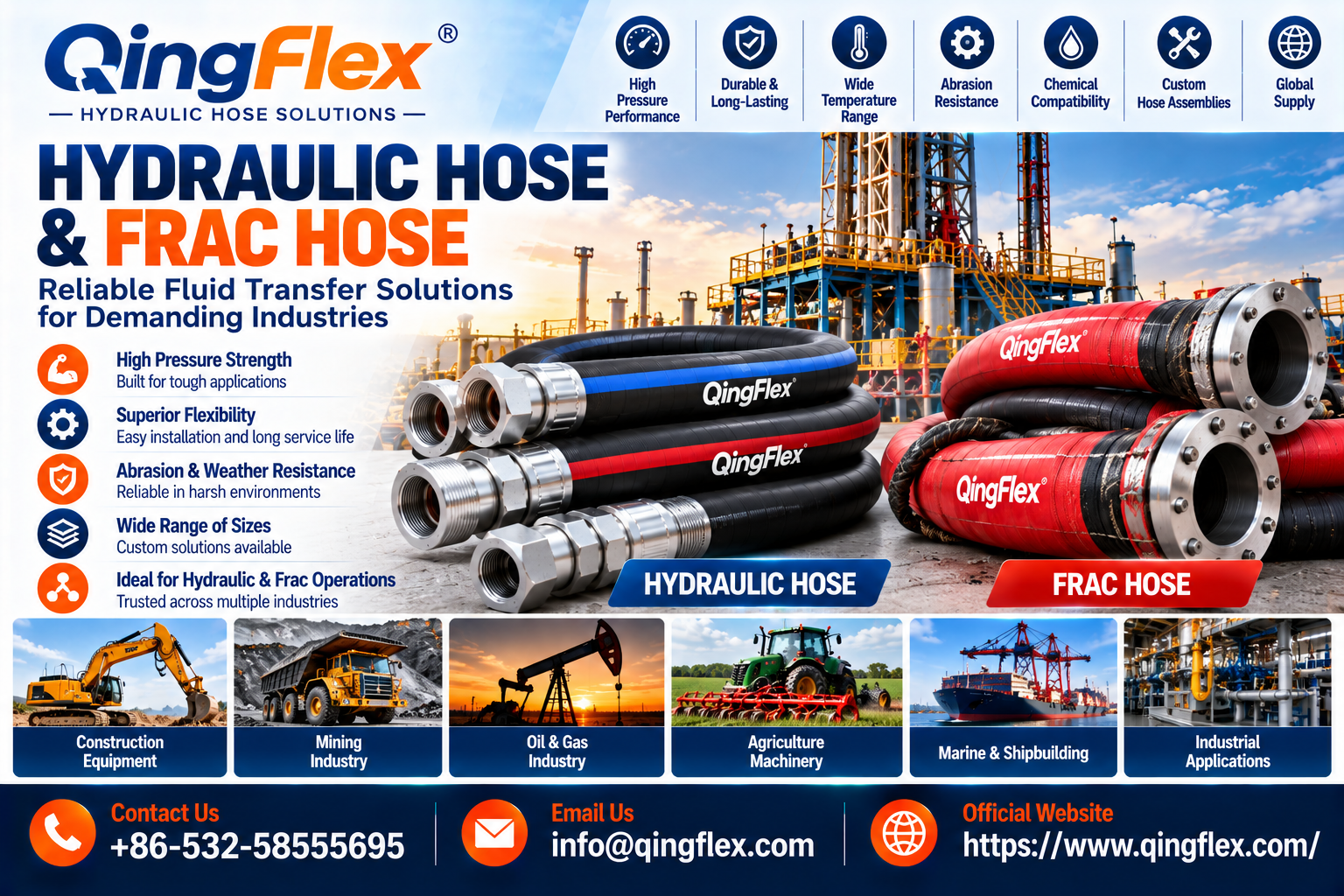
Fluid-transfer systems are becoming increasingly important as heavy industries seek reliable ways to operate equipment under demanding pressure, movement, temperature, and environmental conditions. The Hydraulic Hose remains a fundamental component in mobile machinery and industrial hydraulic systems, while the frac hose serves specialized fluid-transfer requirements associated with hydraulic fracturing and related oilfield operations.
Although both products are flexible hose solutions, their applications, construction requirements, operating environments, and selection criteria can differ substantially. This is encouraging industrial buyers to focus more closely on application data rather than purchasing hoses based only on size or appearance.
Hydraulic Hose Remains Essential to Fluid Power Systems
A Hydraulic Hose transfers hydraulic fluid between components while providing the flexibility required by moving or remotely positioned equipment.
Hydraulic systems are widely found in construction equipment, mining machinery, manufacturing systems, agricultural machines, material-handling equipment, and other heavy-duty applications.
Unlike rigid piping, flexible hose can accommodate certain movement and installation configurations. However, this flexibility also means proper selection and routing are essential.
System designers should consider working pressure, temperature, fluid compatibility, hose dimensions, reinforcement, bend requirements, fittings, equipment movement, and surrounding conditions.
Frac Hose Serves a Specialized Operating Environment
A frac hose is associated with demanding fluid-transfer operations where equipment configuration and operating conditions can create specialized requirements.
Hydraulic fracturing sites can involve complex equipment layouts, intensive operations, vibration, movement, and challenging outdoor environments. Hose selection therefore needs to follow the requirements of the specific application rather than assumptions based on general industrial use.
The transferred media, pressure conditions, temperature, connections, routing, and environmental exposure should all be evaluated.
Hose Construction Should Match the Application
A typical industrial hose can contain several functional layers.
The inner tube is selected to handle the intended medium. Reinforcement contributes to pressure capability and structural performance. The outer cover provides protection appropriate to the hose design and intended operating environment.
The exact construction of a Hydraulic Hose varies according to application and product specifications.
Likewise, a frac hose may require a construction designed around its intended oilfield service. Buyers should review manufacturer documentation instead of assuming that hoses with similar external dimensions have equivalent capabilities.
Pressure Is Important, but It Is Not the Only Factor
Pressure rating is a central consideration when selecting industrial hose, but it should not be evaluated independently.
Temperature can affect material behavior. Fluid compatibility can influence the suitability of the inner tube. Movement can create mechanical stress. External abrasion can damage the cover, while incorrect routing may place unnecessary strain near fittings.
For a Hydraulic Hose, the complete system operating conditions should therefore be understood before selection.
A frac hose requires the same disciplined approach, particularly where operating conditions are demanding or project requirements are highly specific.
Routing Can Influence Hose Service Performance
Even an appropriately specified hose can experience problems if installation creates unnecessary mechanical stress.
A hose should not be twisted to force alignment. Excessively tight bends can place stress on the assembly, while continuous rubbing against surrounding equipment can create abrasion.
Movement also needs to be considered.
A Hydraulic Hose connected to moving machinery should have an installation arrangement appropriate for the equipment’s operating motion.
Similarly, frac hose routing should reflect the site configuration and manufacturer’s installation guidance.
Proper routing is therefore an engineering and maintenance consideration, not merely an installation detail.
Fittings Complete the Hose Assembly
The integrity of a fluid-transfer system depends on more than the flexible hose.
End fittings, couplings, adapters, and other connections form part of the complete assembly. Their compatibility with the hose and application should be confirmed.
Mixing components without appropriate verification can introduce unnecessary risk.
When specifying a Hydraulic Hose, buyers should consider the complete assembly rather than purchasing hose and fittings as unrelated components.
For specialized frac hose applications, connection requirements can be particularly important because the assembly must match the intended equipment and service conditions.
Abrasion Management Deserves Attention
Heavy equipment often operates in environments where hoses can contact metal surfaces, structural components, other hoses, dirt, and debris.
Repeated contact may gradually damage the outer cover.
Routing should therefore minimize unnecessary rubbing where practical. Appropriate protective solutions may also be considered when recommended for the application.
However, protection should not be used to disguise poor routing.
Regular inspection of a Hydraulic Hose or frac hose can help maintenance personnel identify visible abrasion before it progresses further.
Inspection Is Part of Responsible Hose Management
Industrial hoses are service components and should be included in preventive maintenance programs.
Inspections can look for visible leakage, cover damage, abrasion, cracking, deformation, damaged connections, unusual movement, or other signs requiring further assessment.
Replacement intervals should not be guessed.
Maintenance decisions should consider manufacturer recommendations, equipment instructions, operating severity, applicable standards, site procedures, and inspection findings.
For demanding oilfield operations, documenting frac hose condition can also support maintenance planning and equipment readiness.
Technical Documentation Supports Better Procurement
Purchasing teams increasingly work alongside engineering and maintenance departments when sourcing industrial hose.
Before ordering a Hydraulic Hose, relevant information may include hose size, operating pressure, temperature, fluid type, required connections, movement, bend requirements, external environment, and equipment specifications.
A frac hose may require additional application-specific details depending on the project.
Clear documentation helps suppliers understand the requirement and enables buyers to compare products on technical suitability rather than price alone.
Frequently Asked Questions
What is a Hydraulic Hose?
A Hydraulic Hose is a flexible component designed to transfer hydraulic fluid between suitable components in a hydraulic system.
What is a frac hose?
A frac hose is a specialized flexible hose used for suitable fluid-transfer applications associated with hydraulic fracturing and related oilfield operations.
Where are hydraulic hoses used?
They are commonly found in construction, mining, agriculture, manufacturing, material handling, drilling, transportation equipment, and other fluid-power applications.
Is frac hose the same as standard hydraulic hose?
Not necessarily. The products may have different constructions, applications, pressure requirements, connections, and operating specifications.
How is the correct hose selected?
Selection should consider pressure, temperature, transferred media, size, fittings, movement, routing, environmental conditions, and applicable equipment requirements.
Why is hydraulic hose reinforcement important?
Reinforcement contributes to the hose’s ability to handle specified operating demands. The appropriate construction depends on the intended application.
Why should hose twisting be avoided?
Twisting can introduce mechanical stress and interfere with the hose’s intended movement and installation geometry.
Can any fitting be installed on a hydraulic hose?
No. Hose, fitting, and assembly compatibility should be confirmed according to the relevant manufacturer’s specifications and procedures.
How often should industrial hoses be inspected?
Inspection frequency should reflect manufacturer guidance, equipment requirements, operating severity, applicable procedures, and site-specific maintenance programs.
What should buyers provide when requesting a frac hose?
Buyers should provide relevant application information, including intended service, dimensions, pressure, temperature, media, connection requirements, routing, and operating environment.
Media Contact
Hydraulic & Industrial Hose Enquiries
Contact: +86-532-58555695
Email: info@qingflex.com
Website: https://www.qingflex.com/